Review
. 2013;54(2):122-43.
doi: 10.1093/ilar/ilt049.

Systems biology of the vervet monkey

Review

Systems biology of the vervet monkey

Anna J Jasinska et al. ILAR J. 2013.

Abstract

Nonhuman primates (NHP) provide crucial biomedical model systems intermediate between rodents and humans. The vervet monkey (also called the African green monkey) is a widely used NHP model that has unique value for genetic and genomic investigations of traits relevant to human diseases. This article describes the phylogeny and population history of the vervet monkey and summarizes the use of both captive and wild vervet monkeys in biomedical research. It also discusses the effort of an international collaboration to develop the vervet monkey as the most comprehensively phenotypically and genomically characterized NHP, a process that will enable the scientific community to employ this model for systems biology investigations.

Keywords: African green monkey; genetics; genomics; phenomics; simian immunodeficiency virus [SIV]; systems biology; transcriptomics; vervet.


Figures
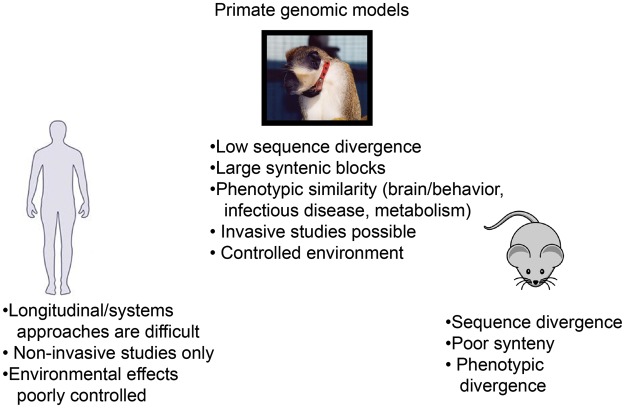
Figure 1
Figure 1
Nonhuman primates (NHPs) as intermediate models between human and rodents. NHPs are indispensable models for biomedical research because of their close phylogenetic relationship to humans, as reflected in their high conservation with humans in terms of genomic sequence and structure, physiology, behavior, susceptibility to diseases, and other phenotypes. At the same time, NHPs may be employed for longitudinal and invasive investigations that are impractical or unethical in humans.
Figure 2
Figure 2
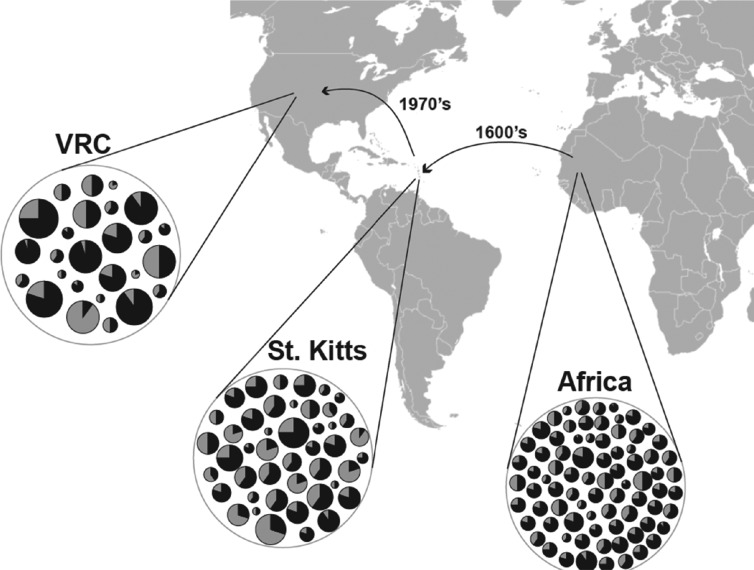
Effect of genetic bottlenecks on genetic architecture in the Caribbean vervet. The Caribbean vervets employed in biomedical research include those living on the islands of St. Kitts, Nevis, and Barbados, as well as those brought form St. Kitts and Nevis to the University of California–Los Angeles to found the Vervet Research Colony (VRC). The history of the VRC includes two genetic bottlenecks, the first beginning in the 1600s when vervets were brought from West Africa to St. Kitts and Nevis, and the second beginning in the 1970s when wild caught animals from both islands were used as founders to establish the VRC. The figure provides a schematic representation of the effect of genetic bottlenecks on the genetic architecture of the Caribbean vervet. The pie charts within each circle depict polymorphic loci in each setting. The number of polymorphisms is presumed to be reduced through the progressive bottlenecks, as shown by the decreasing number of pie charts. The proportion of genetic variance within the population represented by a single locus is presumed to increase as the number of polymorphic loci decrease, as illustrated by the size of each pie chart. Genetic drift may dramatically alter the allele frequencies of the polymorphic alleles remaining after the bottleneck, as shown by the gray/black distributions in the pie charts.
Figure 3
Figure 3
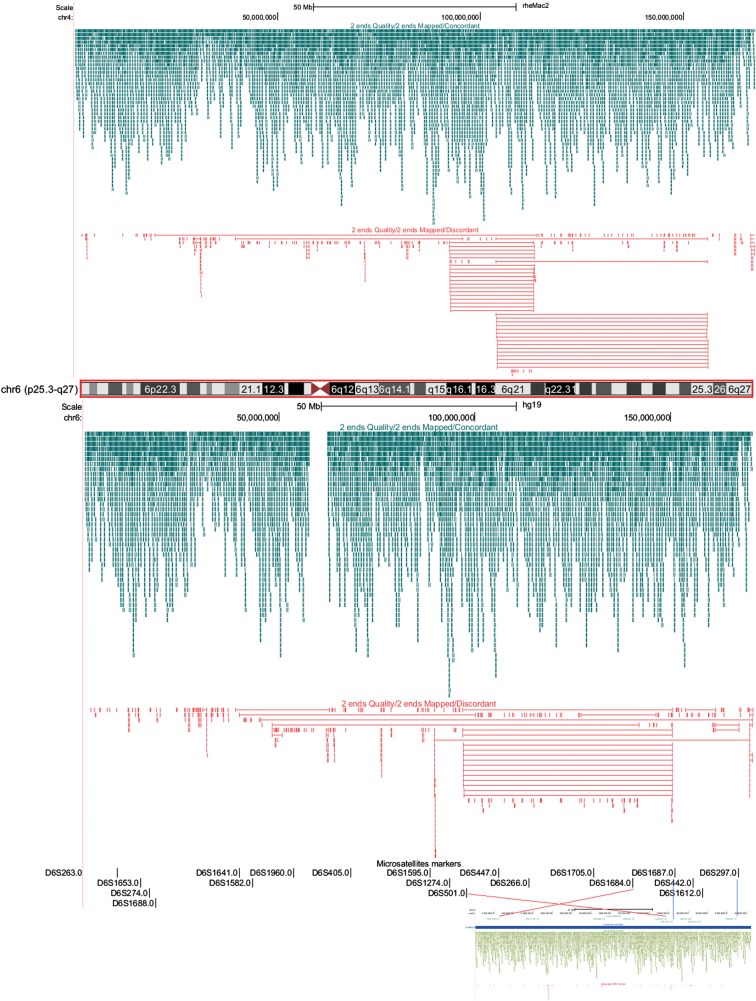
Vervet genome rearrangements provide a new perspective on primate genome evolution. The panels show UCSC Genome Browser views of vervet bacterial artificial chromosome (BAC) paired ends aligned to rhesus chr6 (rheMac.2, top) human chr6 (hg19, middle), and the vervet draft assembly (bottom). Green lines delineate vervet BAC paired ends concordant for interval distance and sequence orientations. Red lines delineate vervet BAC end pairs, discordant for either interval distance, sequence orientations, or both. Clusters of concordant BACs indicate cross-species syntenic regions, whereas clusters of discordant BACs indicate rearrangements. In the example, the vervet orthologous region is organized differently from both rhesus and human. Vervet BAC end pairs aligned to a 70-Mb vervet scaffold (bottom) demonstrate that the rearrangements have been accurately reconstructed in the vervet genome assembly.
Figure 4
Figure 4
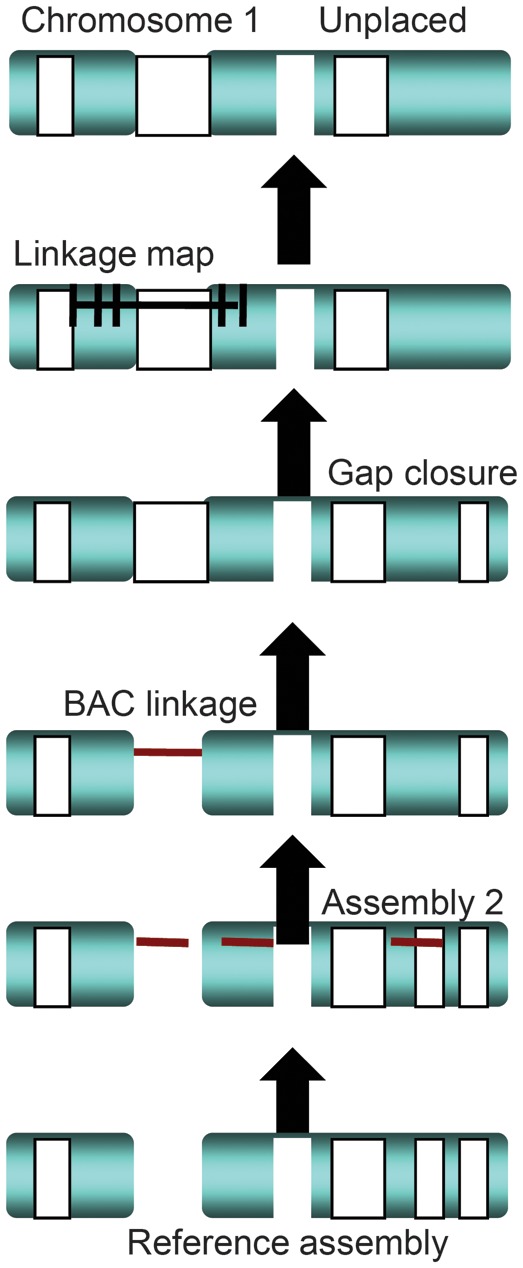
A phased assembly process for multiple data types. Lined white boxes represent gaps in scaffolds. Gray blocks represent nongapped consensus sequence. Blank gaps are areas where no linkage or sequence data are available.
Figure 5
Figure 5
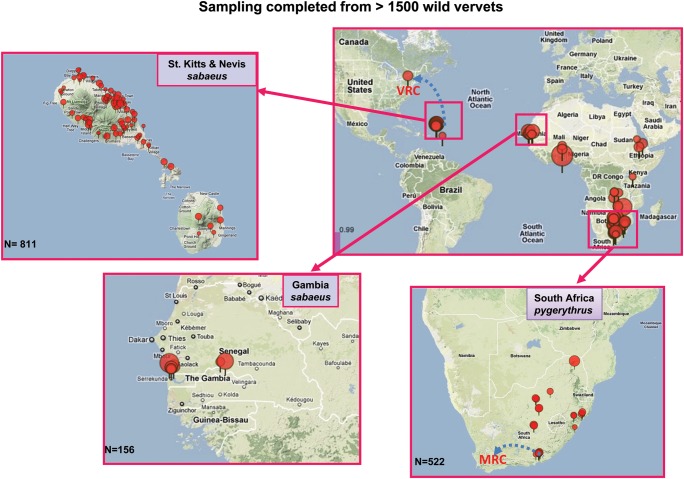
Systems Biology Sample Repository sampling locations of wild vervets worldwide. To facilitate large-scale genetic analysis of various complex traits related to human diseases, biological material banked in the Systems Biology Sample Repository at the University of California–Los Angeles and multiple types of phenotypic data have been collected from more than 1500 wild vervets from South African pygerythrus, West African sabaeus, St. Kitts sabaeus, and Nevis sabaeus. Animals have been captured, assigned unique identifiers using a microchip injected subcutaneously to enable long-term follow-up studies of each monkey, sampled, and released in a trapping location. Red pins indicate GPS-defined geographic location, and pin size is proportional to the number of sampled animals at each location. MRC, Medical Research Council; VRC, Vervet Research Colony.
Figure 6
Figure 6
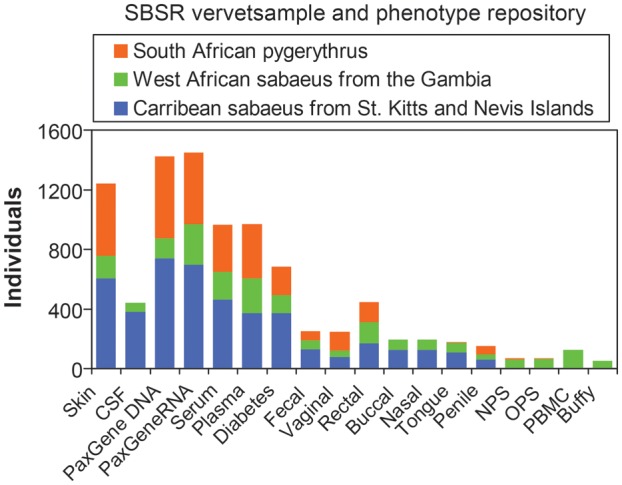
Vervet biomaterial and phenotypic resources managed by the Systems Biology Sample Repository. The histograms indicate the number of biological samples of different types that have been banked from the three most heavily sampled vervet populations, as shown in the key. The specific types of samples represented by the histograms are as follows: CSF, cisternal cerebrospinal fluid; diabetes, blood samples for diabetes-related measures; PaxGene DNA and RNA, blood samples collected for DNA and RNA extraction; serum and plasma, samples from which multiple aliquots have been established; skin, fibroblasts from punch skin biopsies. Samples for microbiome analyses were collected from feces, vagina, rectum, buccal swab, nose, tongue, penis, nasopharyngeal swab (NPS), and oropharyngeal swab (OPS). PBMC, peripheral blood mononuclear cells; Buffy, the buffy coat layer of blood cells.
Figure 7
Figure 7
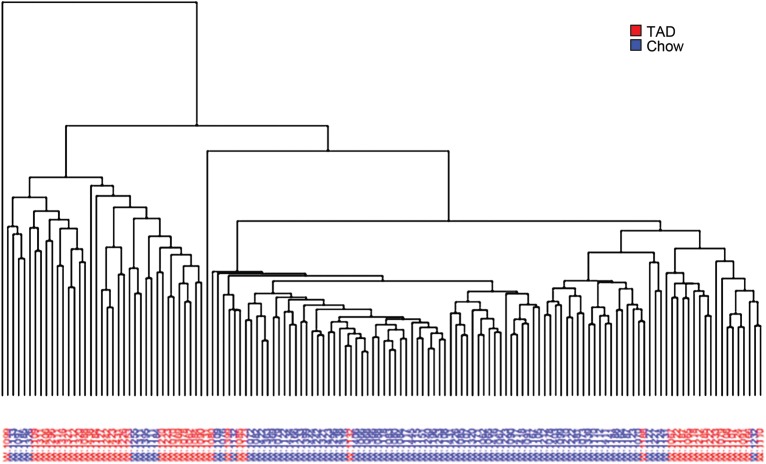
Dendrogram of the vervet fecal microbiome under two diets: monkey chow and a typical American Diet (TAD). Eighty-nine female vervets (aged 4.6–24.9 years) on a routine diet of monkey chow were switched to TAD (35% calories from fat) for 27 to 28 weeks, and samples were collected before and after the diet change. In all, 138 samples (rectal swabs) were obtained. DNA was extracted using the MOBIO PowerSoil kit, and the 16S rRNA genes were amplified (variable regions 3–5) and subjected to pyrosequencing using the 454 Life Sciences sequencing platform. Sequences were compared with the Ribosomal Database Project (RDP) database after quality filtering and the taxa, and their abundances found in each sample were tallied. The Bray–Curtis index was calculated for all pairings of samples, and this was used to construct the dendrogram shown by hierarchical clustering with complete linkage.

References

    1. Alkan C, Sajjadian S, Eichler EE. Limitations of next-generation genome sequence assembly. Nat Methods. 2011;8:61–65. - PMC - PubMed
    1. Allen GM. Mammals of the West Indies. Bulletin of the Museum of Comparative Zoology. 1911;54:175–263.
    1. Altmann J, Alberts SC. Growth rates in a wild primate population: Ecological influences and maternal effects. Behav Ecol Sociobiol. 2005;57:490–501.
    1. Bacopoulos NG, Redmond DE, Baulu J, Roth RH. Chronic haloperidol or fluphenazine: Effects on dopamine metabolism in brain, cerebrospinal fluid and plasma of Cercopithecus aethiops (vervet monkey) J Pharmacol Exp Ther 212. 1980:1–5. - PubMed
    1. Bailey JN, Breidenthal SE, Jorgensen MJ, McCracken JT, Fairbanks LA. The association of DRD4 and novelty seeking is found in a nonhuman primate model. Psychiatr Genet. 2007;17:23–27. - PubMed

Publication types

LinkOut - more resources