


P-MITE: a database for plant miniature inverted-repeat transposable elements
- PMID: 24174541
- PMCID: PMC3964958
- DOI: 10.1093/nar/gkt1000
P-MITE: a database for plant miniature inverted-repeat transposable elements
Abstract
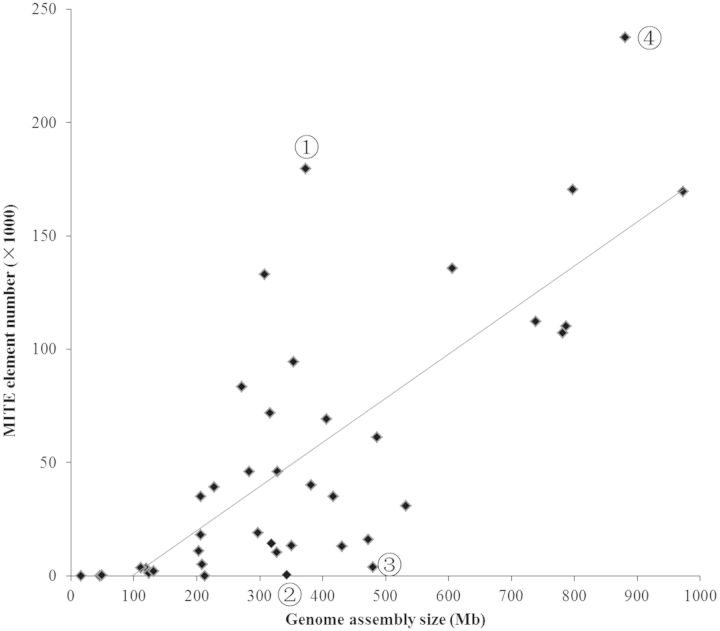
Miniature inverted-repeat transposable elements (MITEs) are prevalent in eukaryotic species including plants. MITE families vary dramatically and usually cannot be identified based on homology. In this study, we de novo identified MITEs from 41 plant species, using computer programs MITE Digger, MITE-Hunter and/or Repetitive Sequence with Precise Boundaries (RSPB). MITEs were found in all, but one (Cyanidioschyzon merolae), species. Combined with the MITEs identified previously from the rice genome, >2.3 million sequences from 3527 MITE families were obtained from 41 plant species. In general, higher plants contain more MITEs than lower plants, with a few exceptions such as papaya, with only 538 elements. The largest number of MITEs is found in apple, with 237 302 MITE sequences. The number of MITE sequences in a genome is significantly correlated with genome size. A series of databases (plant MITE databases, P-MITE), available online at http://pmite.hzau.edu.cn/django/mite/, was constructed to host all MITE sequences from the 41 plant genomes. The databases are available for sequence similarity searches (BLASTN), and MITE sequences can be downloaded by family or by genome. The databases can be used to study the origin and amplification of MITEs, MITE-derived small RNAs and roles of MITEs on gene and genome evolution.
Figures
References
-
- Feschotte C, Mouches C. Evidence that a family of miniature inverted-repeat transposable elements (MITEs) from the Arabidopsis thaliana genome has arisen from a pogo-like DNA transposon. Mol. Biol. Evol. 2000;17:730–737. - PubMed
Publication types
MeSH terms
Substances
LinkOut - more resources
Full Text Sources
Other Literature Sources
