


Effects of prenatal cocaine/polydrug exposure on substance use by age 15
- PMID: 24176200
- PMCID: PMC3941005
- DOI: 10.1016/j.drugalcdep.2013.09.031
Effects of prenatal cocaine/polydrug exposure on substance use by age 15
Abstract
Objective: Examined effects of prenatal cocaine exposure (PCE) on tobacco, alcohol, marijuana and cocaine use by age 15.
Methods: Adolescent (n=358; 183 PCE, 175 non-prenatally cocaine exposed; NCE) drug use was assessed using urine, hair, and/or blood spot samples and self-report (Youth Risk Behavior Surveillance System; YRBSS) at ages 12 and 15. Logistic regression assessed effects of PCE on drug use controlling for other drug exposures, environment and blood lead levels (BLL).
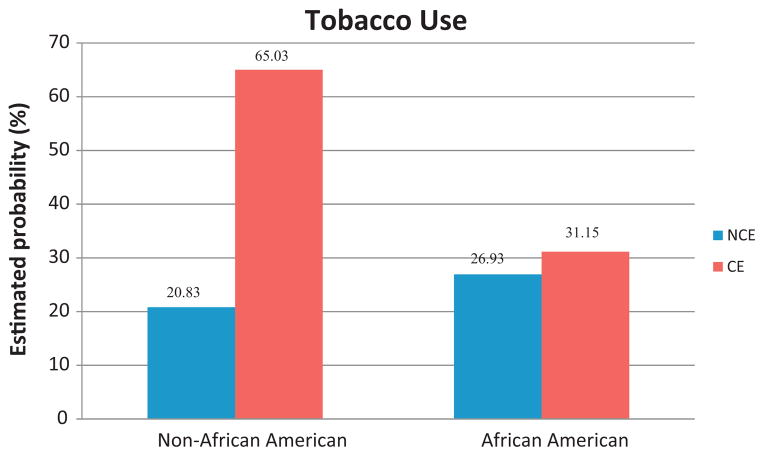
Results: Adjusted percentages of drug use (PCE vs. NCE) were: tobacco 35% vs. 26% (p<.04), marijuana 33% vs. 23% (p<.04), alcohol 40% vs. 35% (p<.01), and any drugs 59% vs. 50% (p<.005). PCE adolescents were twice as likely to use tobacco (OR=2.02, 95% CI=1.05-3.90, p<.04), 2.2 times more likely to use alcohol (OR=2.16, 95% CI=1.21-3.87, p<.01) and 1.8 times more likely to use marijuana (OR=1.81, 95% CI=1.02-3.22, p<.04) than NCE adolescents. A race-by-cocaine-exposure interaction (p<.01) indicated PCE non-African American adolescents had greater probability of tobacco use (65%) than NCE non-African American youth (21%). PCE was associated with any drug use (OR=2.16, CI=1.26-3.69, p<.005), while higher BLL predicted alcohol use (p<.001). Violence exposure was a predictor of tobacco (p<.002), marijuana (p<.0007) and any drug (p<.04).
Conclusions: PCE and exposure to violence increased the likelihood of tobacco, marijuana or any drug use by age 15, while PCE and higher early BLL predicted alcohol use. Prevention efforts should target high risk groups prior to substance use initiation.
Keywords: Adolescent substance use; Lead; Prenatal cocaine exposure; Violence.
Copyright © 2013. Published by Elsevier Ireland Ltd.
Conflict of interest statement
No conflict of interest declared.
Figures
References
-
- Anthony JC, Petronis KR. Early-onset drug use and risk of later drug problems. Drug Alcohol Depend. 1995;40:9–15. - PubMed
-
- Baer JS, Sampson PD, Barr HM, Connor PD, Streissguth AP. A 21-year longitudinal analysis of the effects of prenatal alcohol exposure on young adult drinking. Arch Gen Psychiatry. 2003;60:377–385. - PubMed
-
- Behnke M, Eyler FD, Garvan CW, Wobie K, Hou W. Cocaine exposure and developmental outcome from birth to 6 months. Neurotoxicol Teratol. 2002;24:283–295. - PubMed
-
- Behrendt S, Wittchen HU, Hofler M, Lieb R, Beesdo K. Transitions from first substance use to substance use disorders in adolescence: is early onset associated with a rapid escalation? Drug Alcohol Depend. 2009;99:68–78. - PubMed
Publication types
MeSH terms
Grants and funding
LinkOut - more resources
Full Text Sources
Other Literature Sources
Medical
