. 2013 May;11(3):231-49.
doi: 10.2174/1570159X11311030001.

Neurobiological consequences of sleep deprivation

Affiliations

Neurobiological consequences of sleep deprivation

Karim Alkadhi et al. Curr Neuropharmacol. 2013 May.

Abstract

Although the physiological function of sleep is not completely understood, it is well documented that it contributes significantly to the process of learning and memory. Ample evidence suggests that adequate sleep is essential for fostering connections among neuronal networks for memory consolidation in the hippocampus. Sleep deprivation studies are extremely valuable in understanding why we sleep and what are the consequences of sleep loss. Experimental sleep deprivation in animals allows us to gain insight into the mechanism of sleep at levels not possible to study in human subjects. Many useful approaches have been utilized to evaluate the effect of sleep loss on cognitive function, each with relative advantages and disadvantages. In this review we discuss sleep and the detrimental effects of sleep deprivation mostly in experimental animals. The negative effects of sleep deprivation on various aspects of brain function including learning and memory, synaptic plasticity and the state of cognition-related signaling molecules are discussed.

Keywords: LTD; LTP; Modified Multiple Platform; anxiety; electrophysiology; exercise.; neurogenesis; nicotine.


Figures
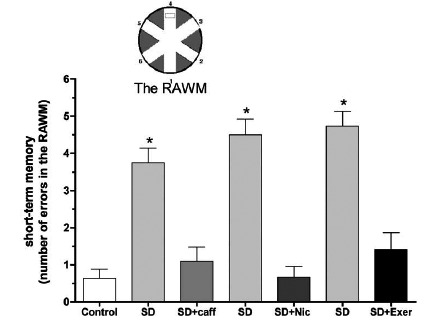
Fig. (1)
Fig. (1)
Short-term memory (30 min after training) performance in the radial arm water maze (RAWM) by rats sleep deprived for 24 hour (untreated SD) and/or treated with caffeine (caff), nicotine (Nic) or exercise (Exer). The SD of each group revealed marked impairment of short-term memory indicated by the significantly higher number of errors in RAWM. (*) denotes significant difference (p < 0.001; 10-12 rats/group) from control as well as all treatment groups. Inset: diagram of the RAWM (adapted from: Alhaider et al. [108], Zaagar et al. [99]).
Fig. (2)
Fig. (2)
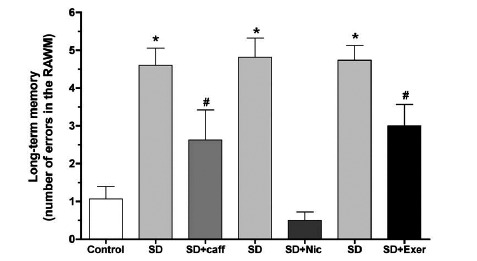
Long-term memory (24h after training and immediately following post-training SD) performance in the radial arm water maze (RAWM) by rats with 24 hour sleep deprivation (untreated SD) and/or treatment with caffeine (caff), nicotine (Nic) or exercise (Exer). The SD of each group revealed marked impairment of long-term memory indicated by the significantly higher number of errors in RAWM. (*) denotes significant difference (p < 0.001; 10-12 rats/group) from all other groups; (#) denotes significant difference from SD as well as control groups (p<0.05; n=10-12 rats). Note that, unlike nicotine treatment, neither caffeine treatment nor exercise is effective in totally reversing the effect of SD. (adapted from: Alhaider et al. [108]; Aleisa et al [109]).
Fig. (3)
Fig. (3)
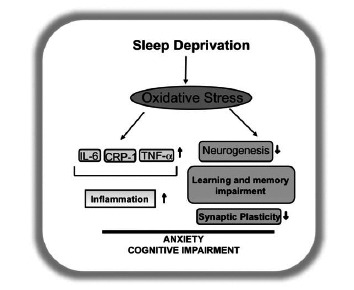
Working hypothesis for the involvement of oxidative stress in the effects of sleep deprivation.
Fig. (4)
Fig. (4)
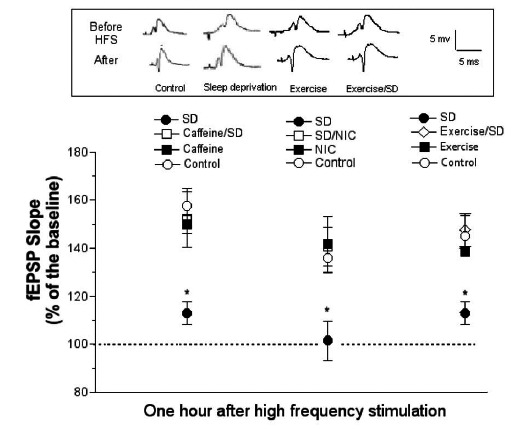
Sleep deprivation (SD) severely suppressed Hippocampal early LTP (E-LTP) represented by increases in fEPSP slope of population spike evoked by HFS of the Schaffer collaterals/commissural synapses in area CA1 of anesthetized rats (measured at 60 min after HFS: 8 pulses at 400 Hz/10s repeated 8 times). Chronic caffeine, nicotine or regular exercise treatment of sleep-deprived rats prevented the deleterious effect of SD. (*) indicates significant difference from all groups (p <0.05-0.001, n=5-7 rats). Inset is population spikes from a representative exercise set of experiments; calibrations, 5 mV/5 ms, apply to all traces. (adapted from: Alhaider et al. [108]; Aleisa et al. [109]; Zagaar et al. [99]).

References

    1. Orzel-Gryglewska J. Consequences of sleep deprivation. Int. J. Occup. Med. Environ Health . 2010;23:95–114. - PubMed
    1. Kalia M. Neurobiology of sleep. Metabolism . 2006;55:S2–S6. - PubMed
    1. Luppi PH. Neurochemical aspects of sleep regulation with specific focus on slow-wave sleep. World J. Biol.Psychiatry . 2010;11(Suppl 1 ):4–8. - PubMed
    1. Lucero MA. Lengthening of REM sleep duration consecutive to learning in the rat. Brain Res. 1970;20:319–22. - PubMed
    1. Smith C, Kitahama K, Valatx JL, Jouvet M. Increased paradoxical sleep in mice during acquisition of a shock avoidance task. Brain Res. 1974;77(2 ):221–30. - PubMed