


Electrophysiological responses to emotional prosody perception in cochlear implant users
- PMID: 24179776
- PMCID: PMC3777796
- DOI: 10.1016/j.nicl.2013.01.001
Electrophysiological responses to emotional prosody perception in cochlear implant users
Abstract
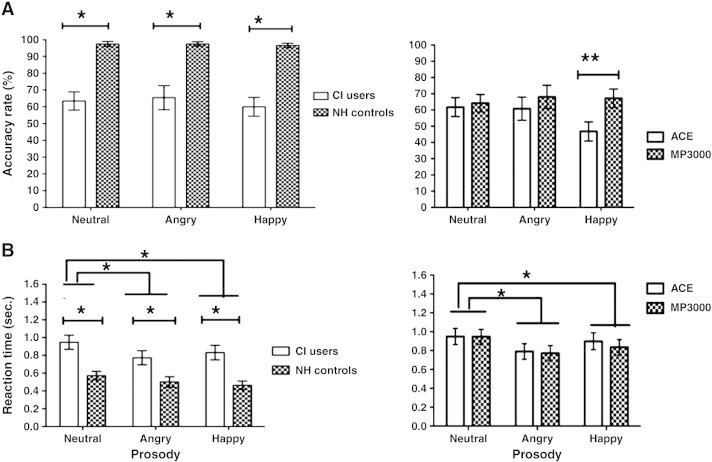
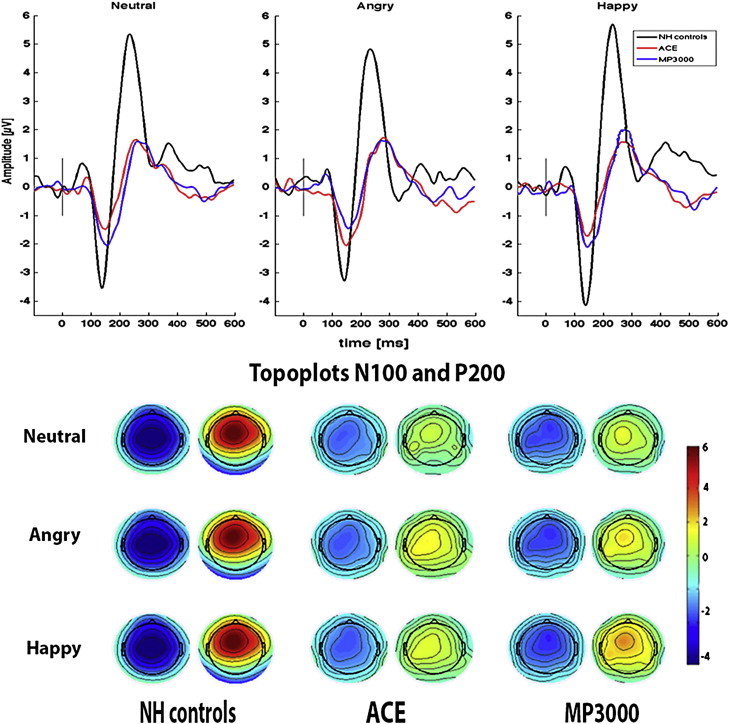
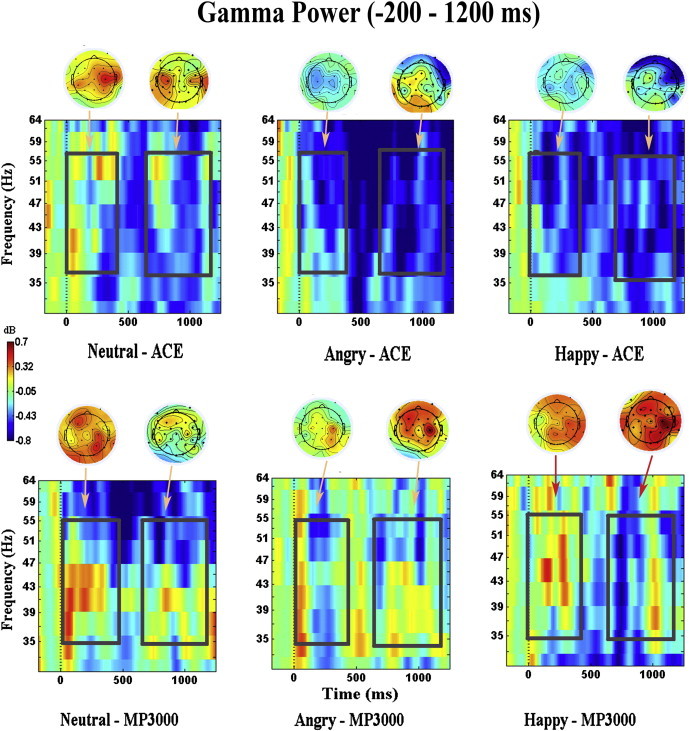
The present electroencephalographic (EEG) study investigated the ability of cochlear implant (CI) users to recognize emotional prosody. Two CI speech-processing strategies were compared: the ACE (Advance Combination Encoder) and the newly developed MP3000. Semantically neutral sentences spoken in three different emotional prosodies (neutral, angry, happy) were presented to 20 post-lingually deafened CI users and age-matched normal-hearing controls. Event related potentials (ERPs) were recorded to study the N100 and the P200 responses. In addition, event-related spectral power modulations were calculated to study the brain activity corresponding to the recognition of prosody in earlier (0-400) as well as later (600-1200) part of the stimuli where the prosodic features differed maximally. CI users with MP3000 strategy showed a higher proportion of correctly recognized prosodic information compared to the ACE strategy users. Our ERP results demonstrated that emotional prosody elicited significant N100 and P200 peaks. Furthermore, the P200 amplitude in response to happy prosodic information was significantly more positive for the MP3000 strategy compared to the ACE strategy. On spectral power analysis, two typical gamma activities were observed in the MP3000 users only: (1) an early gamma activity in the 100-250 ms time window reflecting bottom-up attention regulation; and (2) a late gamma activity between 900 and 1100 ms post-stimulus onset, probably reflecting top-down cognitive control. Our study suggests that the MP3000 strategy is better than ACE in regard to happy prosody perception. Furthermore, we show that EEG is a useful tool that, in combination with behavioral analysis, can reveal differences between two CI processing strategies for coding of prosody-specific features of language.
Keywords: Cochlear implants; ERP; Emotional prosody; Gamma band power; P200.
Figures
References
-
- Aftanas L., Varlamov A., Pavlov S., Makhnev V., Reva N. Event-related synchronization and desynchronization during affective processing: emergence of valence-related time-dependent hemispheric asymmetries in theta and upper alpha band. The International Journal of Neuroscience. 2001;110(3–4):197–219. - PubMed
-
- Aftanas L.I., Reva N.V., Savotina L.N., Makhnev V.P. Neurophysiological correlates of induced discrete emotions in humans: an individual analysis. Rossiĭskii Fiziologicheskiĭ Zhurnal Imeni I.M. Sechenova. 2004;90(12):1457–1471. - PubMed
-
- Balconi M., Pozzoli U. Face-selective processing and the effect of pleasant and unpleasant emotional expressions on ERP correlates. International Journal of Psychophysiology. 2003;49(1):67–74. - PubMed
-
- Beck A.T., Steer R.A., Ball R., Ranieri W. Comparison of Beck Depression Inventories-IA and -II in psychiatric outpatients. Journal of Personality Assessment. 1996;67(3):588–597. - PubMed
LinkOut - more resources
Full Text Sources
Other Literature Sources
Miscellaneous
