


Mode of action and human relevance analysis for nuclear receptor-mediated liver toxicity: A case study with phenobarbital as a model constitutive androstane receptor (CAR) activator
- PMID: 24180433
- PMCID: PMC4019974
- DOI: 10.3109/10408444.2013.835786
Mode of action and human relevance analysis for nuclear receptor-mediated liver toxicity: A case study with phenobarbital as a model constitutive androstane receptor (CAR) activator
Abstract
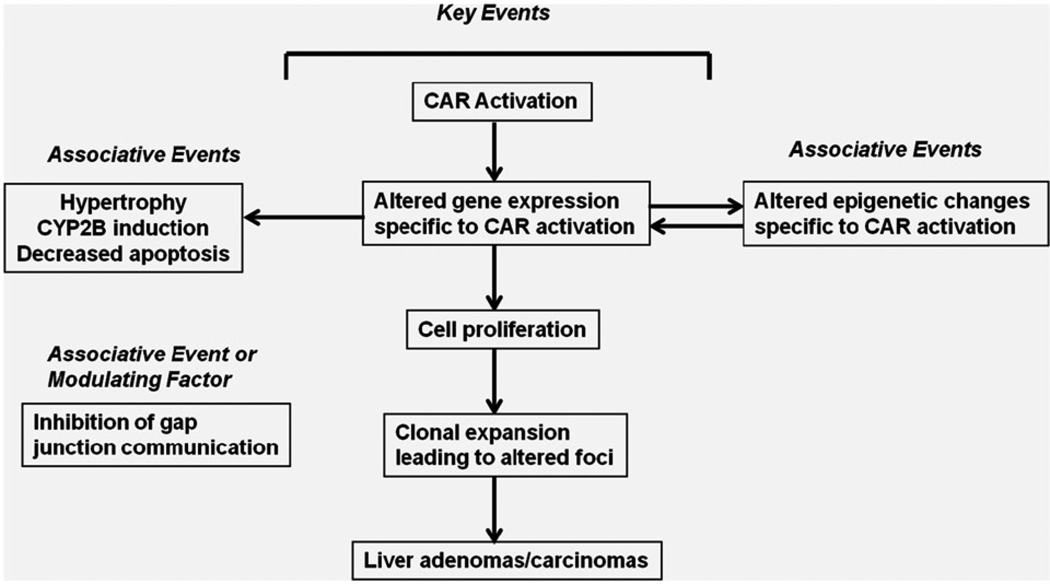
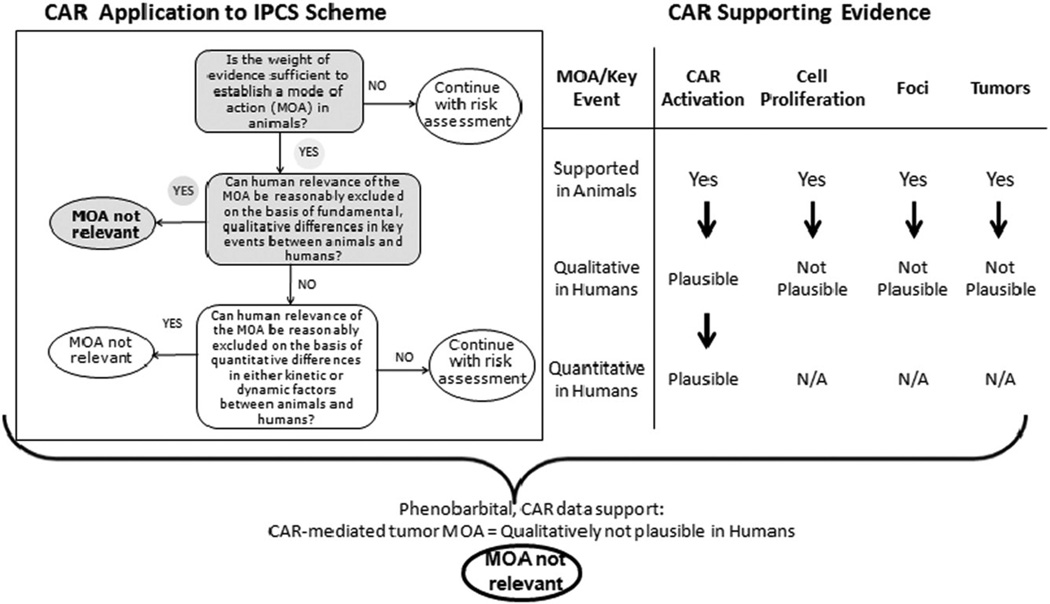
The constitutive androstane receptor (CAR) and pregnane X receptor (PXR) are important nuclear receptors involved in the regulation of cellular responses from exposure to many xenobiotics and various physiological processes. Phenobarbital (PB) is a non-genotoxic indirect CAR activator, which induces cytochrome P450 (CYP) and other xenobiotic metabolizing enzymes and is known to produce liver foci/tumors in mice and rats. From literature data, a mode of action (MOA) for PB-induced rodent liver tumor formation was developed. A MOA for PXR activators was not established owing to a lack of suitable data. The key events in the PB-induced liver tumor MOA comprise activation of CAR followed by altered gene expression specific to CAR activation, increased cell proliferation, formation of altered hepatic foci and ultimately the development of liver tumors. Associative events in the MOA include altered epigenetic changes, induction of hepatic CYP2B enzymes, liver hypertrophy and decreased apoptosis; with inhibition of gap junctional intercellular communication being an associative event or modulating factor. The MOA was evaluated using the modified Bradford Hill criteria for causality and other possible MOAs were excluded. While PB produces liver tumors in rodents, important species differences were identified including a lack of cell proliferation in cultured human hepatocytes. The MOA for PB-induced rodent liver tumor formation was considered to be qualitatively not plausible for humans. This conclusion is supported by data from a number of epidemiological studies conducted in human populations chronically exposed to PB in which there is no clear evidence for increased liver tumor risk.
Figures
References
-
- Aiges HW, Daum F, Olson M, et al. The effects of phenobarbital and diphenylhydantoin on liver function and morphology. J Pediatr. 1980;97:22–26. - PubMed
-
- Andersen ME, et al. Dose-response approaches for nuclear receptor-mediated modes of action for liver carcinogenicity: results of a workshop. Crit Rev Toxicol. 2013 In press. - PubMed
-
- Bachman AN, Kamendulis LM, Goodman JI. Diethanolamine and Phenobarbital produce an altered pattern of methylation in GC-rich regions of DNA in B6C3F1 mouse hepatocytes similar to that resulting from choline deficiency. Toxicol Sci. 2006;90:317–325. - PubMed
-
- Baker TK, Bachowski S, Stevenson DE, et al. Modulation of gap junctional intercellular communication in rodent, monkey and human hepatocyte by nongenotoxic compounds. Prog Clin Biol Res. 1995;391:71–780. - PubMed
Publication types
MeSH terms
Substances
Grants and funding
LinkOut - more resources
Full Text Sources
Other Literature Sources
Medical
Miscellaneous
