


Review
doi: 10.1016/j.neuron.2013.10.040.
Conduits of life's spark: a perspective on ion channel research since the birth of neuron
Affiliations
- PMID: 24183018
- PMCID: PMC3867263
- DOI: 10.1016/j.neuron.2013.10.040
Item in Clipboard
Review
Conduits of life's spark: a perspective on ion channel research since the birth of neuron
Neuron.
.
Abstract
Heartbeats, muscle twitches, and lightning-fast thoughts are all manifestations of bioelectricity and rely on the activity of a class of membrane proteins known as ion channels. The basic function of an ion channel can be distilled into, "The hole opens. Ions go through. The hole closes." Studies of the fundamental mechanisms by which this process happens and the consequences of such activity in the setting of excitable cells remains the central focus of much of the field. One might wonder after so many years of detailed poking at such a seemingly simple process, is there anything left to learn?
Copyright © 2013 Elsevier Inc. All rights reserved.
Figures

Ion channels, from concept to structure. A, Cartoon model of an ion channel, based on studies of voltage-gated sodium and voltage gated potassium channels (after (Hille, 1977a)). This cartoon embodies the basic understanding of voltage-gated ion channels when ‘Neuron’ was launched. B, Unrooted tree depicting amino acid sequence relations of the minimal pore regions of VGIC superfamily members (from (Yu and Catterall, 2004)). Indicated subfamilies are (clockwise): voltage-gated calcium and sodium channels (CaV and NaV) two pore (TPC) and transient receptor potential (TRP) channels, inwardly rectifying potassium channels (Kir), calcium activated potassium channels (KCa), voltage-gated potassium channels (KV1–9), K2P channels, voltage-gated potassium channels from the EAG family (Kv10–12), cyclic nucleotide gated channels (CNG), and hyperpolarization activated channels (HCN). ‘R’ indicates recognizable regulatory domains. C, Ribbon diagram model of a bacterial sodium channel (BacNaV). With the exception of the intracellular domains, which are often sites of modulation by cellular factors and contain assembly domains, all key features in ‘A’ are present the models derived from crystallographic studies as of 2013. Model is a composite of the NaVAb (Payandeh et al., 2011) and ‘pore-only’ NaVAe1p (Shaya et al., 2013) structures. Elements from two membrane subunits and four cytoplasmic subunits are shown. Arginines in the S4 voltage-sensor are shown as space filling models. D, Illustration of PD-VSD domain swapping as seen from the extracellular side of a VGICs based on NaVAb (Payandeh et al., 2011). Individual subunits are colored, orange, cyan, yellow, and blue. Selectivity filter is violet and is indicated. Pore domain (PD) and voltage sensor domain (VSD) of the cyan subunit are indicated.
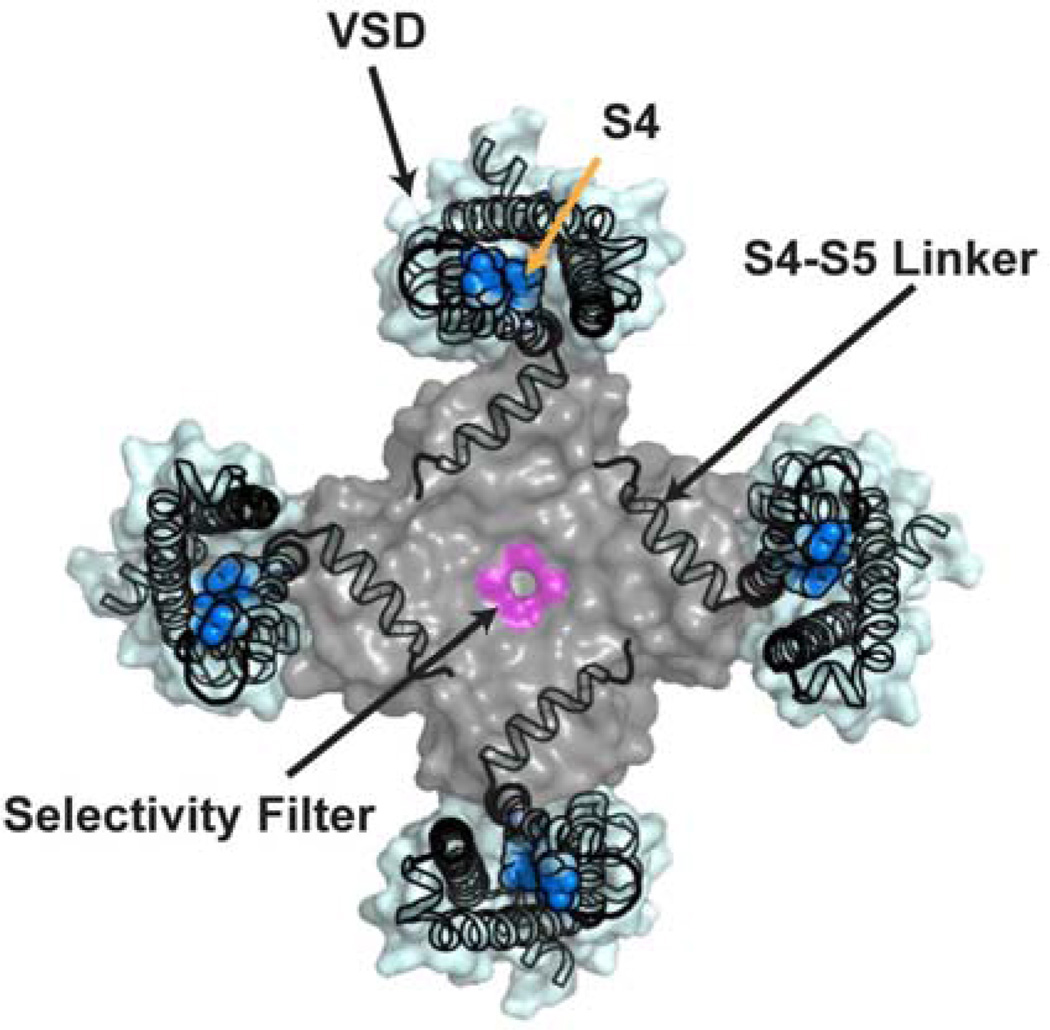
The five pores of a VGIC. Extracellular view of Figure 1D. Pore domain is grey and shown as semi-transparent to reveal positions of the S4-S5 linkers. Voltage sensor domains (VSD) are light blue. S4 segments are colored blue. S4 arginine side chains, which are shown as space filling, occupy the cation selective ‘gating pore’ or ‘omega pore’ within each VSD. The selectivity filter is violet and is indicated.
References
-
- Aggarwal SK, MacKinnon R. Contribution of the S4 segment to gating charge in the Shaker K+ channel. Neuron. 1996;16:1169–1177. - PubMed
Publication types
MeSH terms
Substances
Grants and funding
- R01-MH093603/MH/NIMH NIH HHS/United States
- R01 NS069229/NS/NINDS NIH HHS/United States
- R01 HL080050/HL/NHLBI NIH HHS/United States
- U54 GM094625/GM/NIGMS NIH HHS/United States
- R01 NS35549/NS/NINDS NIH HHS/United States
- HHMI/Howard Hughes Medical Institute/United States
- R01 MH093603/MH/NIMH NIH HHS/United States
- R01NS069229/NS/NINDS NIH HHS/United States
- R37 MH065334/MH/NIMH NIH HHS/United States
- R01 DC007664/DC/NIDCD NIH HHS/United States
- R01 NS035549/NS/NINDS NIH HHS/United States
- R01-HL080050/HL/NHLBI NIH HHS/United States
- R01-DC007664/DC/NIDCD NIH HHS/United States
- R37MH065334/MH/NIMH NIH HHS/United States
- U54-GM094625/GM/NIGMS NIH HHS/United States
LinkOut - more resources
Full Text Sources
Other Literature Sources
Molecular Biology Databases
