


Review
doi: 10.1016/j.drudis.2013.10.018.
Epub 2013 Nov 1.
DREADDs: novel tools for drug discovery and development
Affiliations
- PMID: 24184433
- PMCID: PMC4004703
- DOI: 10.1016/j.drudis.2013.10.018
Item in Clipboard
Review
DREADDs: novel tools for drug discovery and development
Drug Discov Today.
2014 Apr.
Abstract
Since the invention of the first designer receptors exclusively activated by designer drugs (DREADDs), these engineered G protein-coupled receptors (GPCRs) have been widely applied in investigations of biological processes and behaviors. DREADD technology has emerged as a powerful tool with great potential for drug discovery and development. DREADDs can facilitate the identification of druggable targets and enable researchers to explore the activities of novel drugs against both known and orphan GPCRs. Here, we discuss how DREADDs can be used as novel tools for drug discovery and development.
Copyright © 2013 Elsevier Ltd. All rights reserved.
Figures
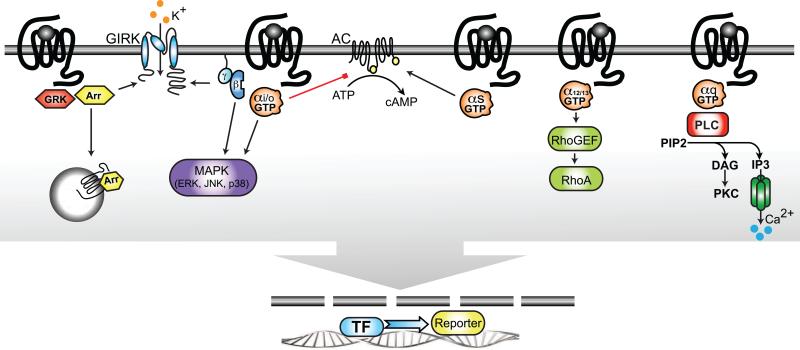
Receptor-mediated G protein activation. G protein-coupled receptors (GPCRs) are activated by a variety of external stimuli. Upon receptor activation, the G protein exchanges GDP for GTP, causing the dissociation of the GTP-bound ! and !/! subunits and triggering diverse signaling cascades (Gs, Gq, and Gi). Phosphorylation by G protein receptor kinases (GRKs) promotes translocation of the !-arrestins to bind to the receptor and promote internalization. Receptors coupled to different heterotrimeric G protein subtypes can utilize different scaffolds to activate the small G protein/mitogen-activated protein kinase (MAPK) cascade, which can have either stimulatory or inhibitory consequences for the downstream pathways. Owing to these varieties of signaling pathways, information about the signal transduction of GPCR targets is important for deciding which assays should be used to increase chances for success in drug discovery.
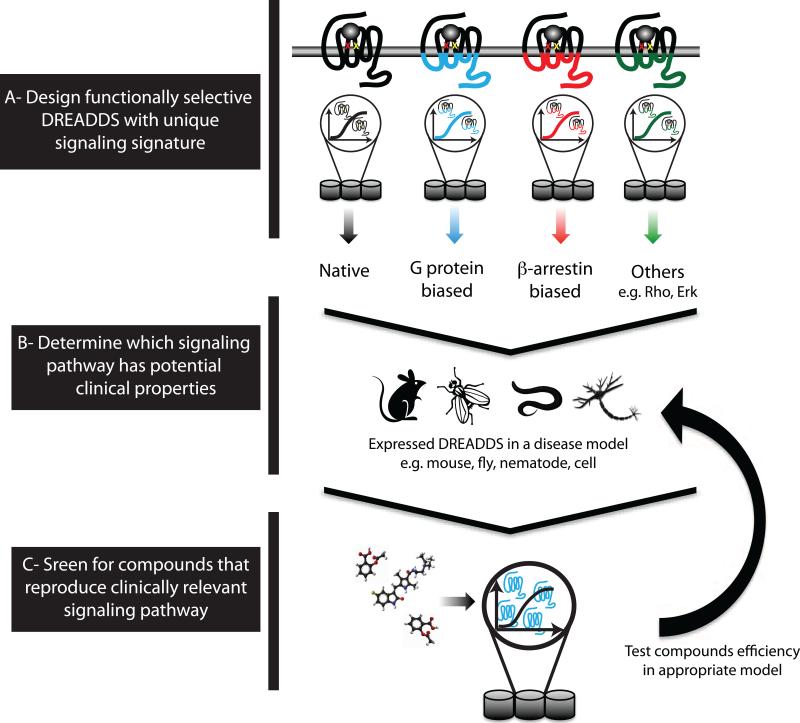
[LM4] Designer receptors exclusively activated by designer drugs (DREADDs)-based tools aimed at G protein-coupled receptor (GPCR) allosterism. (A) Engineered-functionally selective DREADDs can provide valuable information regarding the complexity of GPCRs in relation to their signaling and pharmacology. (B) After determining which signaling pathway has potential clinical properties, these DREADD variants could directly be applied to in vivo systems. (C) The results of this approach would provide insights into new therapeutic possibilities and novel profiles of drugs against GPCR targets.
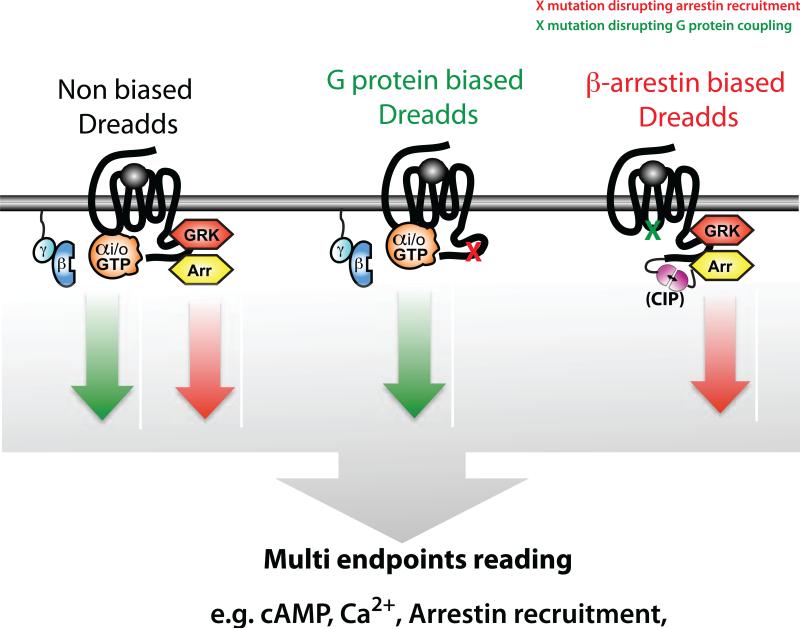
[LM5] Designer receptors exclusively activated by designer drugs (DREADDs)-dependent biased signal transduction. Nonbiased receptors coupled to different heterotrimeric G protein subtypes mediate different signal transductions. However, engineered DREADDs, either G protein biased or !-arrestin biased, could be used to gain a more complete understanding of G protein-coupled receptors (GPCRs) in relation to their signaling and pathophysiology. These concepts and technologies would help not only to understand the function of GPCRs in systemic engagement, but also to discover and develop novel drugs featuring better therapeutic efficacy and minimized adverse effects. Abbreviation: CIP, chemically induced proximity.
References
-
- Jarvis LM. New drug approvals hit 16-year high in 2012. Chem. Eng. News. 2013;91:15–17.
-
- Analysts GI. G-Protein Coupled Receptors (GPCRS) – A Global Market Report. Global Industry Analysts; 2012.
-
- Allen JA, Roth BL. Strategies to discover unexpected targets for drugs active at G protein-coupled receptors. Annu. Rev. Pharmacol. Toxicol. 2011;51:117–144. - PubMed
Publication types
MeSH terms
Substances
Grants and funding
LinkOut - more resources
Full Text Sources
Other Literature Sources
