An examination of end-of-life care in a safety net hospital system: a decade in review
- PMID: 24185162
- PMCID: PMC7292336
- DOI: 10.1353/hpu.2013.0179
An examination of end-of-life care in a safety net hospital system: a decade in review
Abstract
Objectives: To examine patterns of use of end-of-life care in patients receiving treatment at a large, urban safety-net hospital from 2000 to 2010.
Methods: Data from the Parkland Hospital palliative care database, which tracked all consults for this period, were analyzed. Logistic regression was used to identify predictors of hospice use, and Cox proportional hazards modeling to examine survival.
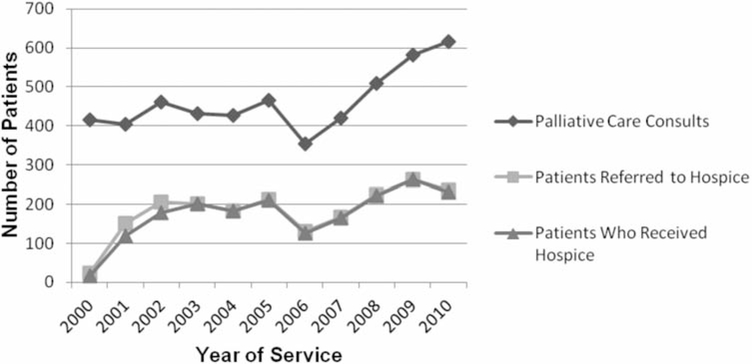
Results: There were 5,083 palliative care consults over the study period. More patients were Black (41%) or White (31%), and younger than 65 years old (75%). Cancer patients or those who received palliative care services longer were more likely to receive hospice; those who had no form of health care assistance were less likely. There were no racial/ethnic differences in hospice use.
Conclusion: In this cohort, there were no racial/ethnic disparities in hospice use. Those who had no form of health care assistance were less likely to receive hospice.
Figures
References
-
- Regenstein M, Huang J. Stresses to the Safety Net: The Public Hospital Perspective. Kaiser Commission on Medicaid and the Uninsured.
-
- Cancer Facts and Figures 2012. The American Cancer Society; Available at: http://www.cancer.org/acs
-
- Cohen LL. Racial/ethnic disparities in hospice care: a systematic review. J Palliat Med. 2008. June;11(5):763–8. - PubMed
-
- Connor SR, Elwert F, Spence C, Christakis NA. Racial disparity in hospice use in the United States in 2002. Palliat Med. 2008. April;22(3):205–213. - PubMed
Publication types
MeSH terms
Grants and funding
LinkOut - more resources
Full Text Sources
Other Literature Sources
Medical