


Review
doi: 10.1155/2013/617595.
Epub 2013 Sep 26.
Thymic regulatory T cell development: role of signalling pathways and transcription factors
Affiliations
- PMID: 24187564
- PMCID: PMC3803129
- DOI: 10.1155/2013/617595
Item in Clipboard
Review
Thymic regulatory T cell development: role of signalling pathways and transcription factors
Clin Dev Immunol.
2013.
Abstract
Regulatory T cells (Tregs) are a subset of CD4 T cells that are key mediators of immune tolerance. Most Tregs develop in the thymus. In this review we summarise recent findings on the role of diverse signalling pathways and downstream transcription factors in thymic Treg development.
Figures
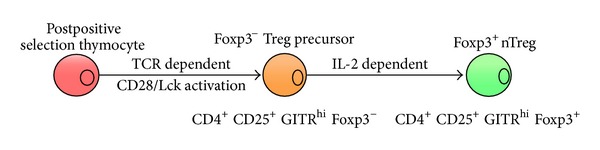
The stages of tTreg development. Thymic Treg development is achieved in two stages. Initially, postpositive selected thymocytes undergo TCR and CD28 dependent maturation into a Foxp3− tTreg precursor population. A subsequent IL-2 dependent step leads to the development of Foxp3 expressing mature tTregs.
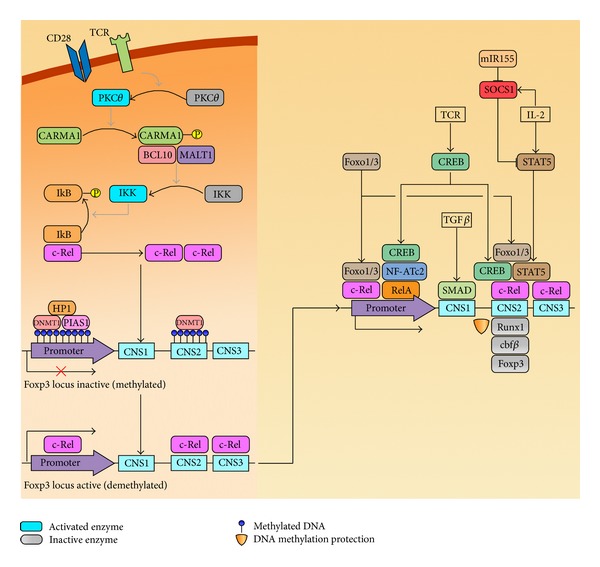
Transcription factors in tTreg development. Once engaged, cell surface receptors initiate c-Rel activation and nuclear entry. c-Rel binding to the Foxp3 promoter and Cns elements promotes epigenetic changes, including demethylation and chromatin remodelling (not pictured) of the Foxp3 locus. Several other transcription factors cooperate with c-Rel to initiate and preserve the stable expression of Foxp3 in tTregs.
Similar articles
-
Foxp3+ CD25+ regulatory T cells specific for a neo-self-antigen develop at the double-positive thymic stage.Proc Natl Acad Sci U S A. 2006 May 30;103(22):8453-8. doi: 10.1073/pnas.0603086103. Epub 2006 May 18. Proc Natl Acad Sci U S A. 2006. PMID: 16709665 Free PMC article.
-
Egress of mature murine regulatory T cells from the thymus requires RelA.J Immunol. 2015 Apr 1;194(7):3020-8. doi: 10.4049/jimmunol.1302756. Epub 2015 Feb 27. J Immunol. 2015. PMID: 25725099
-
Id1 expression promotes T regulatory cell differentiation by facilitating TCR costimulation.J Immunol. 2014 Jul 15;193(2):663-672. doi: 10.4049/jimmunol.1302554. Epub 2014 Jun 11. J Immunol. 2014. PMID: 24920844 Free PMC article.
-
Regulatory T cells: mechanisms of differentiation and function.Annu Rev Immunol. 2012;30:531-64. doi: 10.1146/annurev.immunol.25.022106.141623. Epub 2012 Jan 6. Annu Rev Immunol. 2012. PMID: 22224781 Free PMC article. Review.
-
Homeostasis and function of regulatory T cells (Tregs) in vivo: lessons from TCR-transgenic Tregs.Immunol Rev. 2014 May;259(1):23-39. doi: 10.1111/imr.12165. Immunol Rev. 2014. PMID: 24712457 Free PMC article. Review.
Cited by
-
Ubiquitin-dependent regulation of Foxp3 and Treg function.Immunol Rev. 2015 Jul;266(1):27-45. doi: 10.1111/imr.12312. Immunol Rev. 2015. PMID: 26085205 Free PMC article. Review.
-
Thymic function in the regulation of T cells, and molecular mechanisms underlying the modulation of cytokines and stress signaling (Review).Mol Med Rep. 2017 Nov;16(5):7175-7184. doi: 10.3892/mmr.2017.7525. Epub 2017 Sep 19. Mol Med Rep. 2017. PMID: 28944829 Free PMC article. Review.
-
NSrp70 is a lymphocyte-essential splicing factor that controls thymocyte development.Nucleic Acids Res. 2021 Jun 4;49(10):5760-5778. doi: 10.1093/nar/gkab389. Nucleic Acids Res. 2021. PMID: 34037780 Free PMC article.
-
T cell transgressions: Tales of T cell form and function in diverse disease states.Int Rev Immunol. 2022;41(5):475-516. doi: 10.1080/08830185.2021.1921764. Epub 2021 Jun 21. Int Rev Immunol. 2022. PMID: 34152881 Free PMC article. Review.
-
Cdc42 defect reveals insights into microvilli organization and function in T cell immunity.Proc Natl Acad Sci U S A. 2025 Jul 29;122(30):e2505291122. doi: 10.1073/pnas.2505291122. Epub 2025 Jul 25. Proc Natl Acad Sci U S A. 2025. PMID: 40711916 Free PMC article.
References
-
- Klein L, Hinterberger M, Wirnsberger G, Kyewski B. Antigen presentation in the thymus for positive selection and central tolerance induction. Nature Reviews Immunology. 2009;9(12):833–844. - PubMed
-
- Sakaguchi S, Sakaguchi N, Asano M, Itoh M, Toda M. Immunologic self-tolerance maintained by activated T cells expressing IL-2 receptor α-chains (CD25): breakdown of a single mechanism of self-tolerance causes various autoimmune diseases. Journal of Immunology. 1995;155(3):1151–1164. - PubMed
-
- Sakaguchi S, Yamaguchi T, Nomura T, Ono M. Regulatory T cells and immune tolerance. Cell. 2008;133(5):775–787. - PubMed
Publication types
MeSH terms
Substances
LinkOut - more resources
Full Text Sources
Other Literature Sources
Research Materials