


Interprofessional teamwork in the trauma setting: a scoping review
- PMID: 24188523
- PMCID: PMC3826522
- DOI: 10.1186/1478-4491-11-57
Interprofessional teamwork in the trauma setting: a scoping review
Abstract
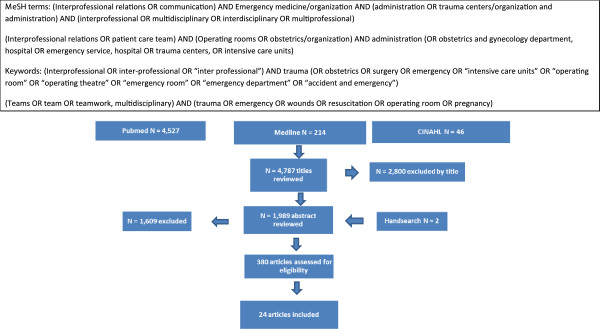
Approximately 70 to 80% of healthcare errors are due to poor team communication and understanding. High-risk environments such as the trauma setting (which covers a broad spectrum of departments in acute services) are where the majority of these errors occur. Despite the emphasis on interprofessional collaborative practice and patient safety, interprofessional teamworking in the trauma setting has received little attention. This paper presents the findings of a scoping review designed to identify the extent and nature of this literature in this setting. The MEDLINE (via OVID, using keywords and MeSH in OVID), and PubMed (via NCBI using MeSH), and CINAHL databases were searched from January 2000 to April 2013 for results of interprofessional teamworking in the trauma setting. A hand search was conducted by reviewing the reference lists of relevant articles. In total, 24 published articles were identified for inclusion in the review. Studies could be categorized into three main areas, and within each area were a number of themes: 1) descriptions of the organization of trauma teams (themes included interaction between team members, and leadership); 2) descriptions of team composition and structure (themes included maintaining team stability and core team members); and 3) evaluation of team work interventions (themes included activities in practice and activities in the classroom setting).Descriptive studies highlighted the fluid nature of team processes, the shared mental models, and the need for teamwork and communication. Evaluative studies placed a greater emphasis on specialized roles and individual tasks and activities. This reflects a multiprofessional as opposed to an interprofessional model of teamwork. Some of the characteristics of high-performing interprofessional teams described in this review are also evident in effective teams in the community rehabilitation and intermediate care setting. These characteristics may well be pertinent to other settings, and so provide a useful foundation for future investigations.
Figures
References
-
- WHO. Primary health care, Report of the International Conference on Primary Health Care. 6–12 September. Alma-Ata, USSR, Geneva, Switzerland: WHO; 1978.
-
- Institute of Medicine. Crossing the Quality Chasm: A New health System for the 21st Century. Washington, DC: National Academy of Sciences; 2001.
-
- Institute of Medicine. To Err Is Human: Building a Safer health System. Washington, DC: National Academy of Sciences; 1999.
Publication types
MeSH terms
LinkOut - more resources
Full Text Sources
Other Literature Sources
Medical
Miscellaneous
