


Onset of breast development in a longitudinal cohort
- PMID: 24190685
- PMCID: PMC3838525
- DOI: 10.1542/peds.2012-3773
Onset of breast development in a longitudinal cohort
Abstract
Background and objectives: There is growing evidence of pubertal maturation occurring at earlier ages, with many studies based on cross-sectional observations. This study examined age at onset of breast development (thelarche), and the impact of BMI and race/ethnicity, in the 3 puberty study sites of the Breast Cancer and the Environment Research Program, a prospective cohort of >1200 girls.
Methods: Girls, 6 to 8 years at enrollment, were followed longitudinally at regular intervals from 2004 to 2011 in 3 geographic areas: the San Francisco Bay Area, Greater Cincinnati, and New York City. Sexual maturity assessment using Tanner staging was conducted by using standardized observation and palpation methods by trained and certified staff. Kaplan-Meier analyses were used to describe age at onset of breast maturation by covariates.
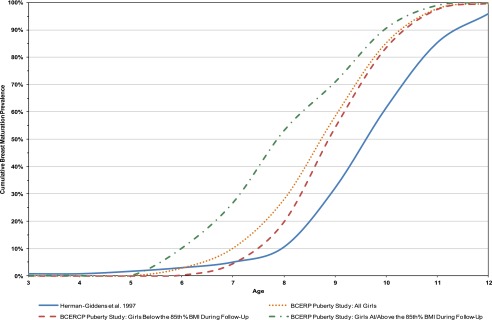
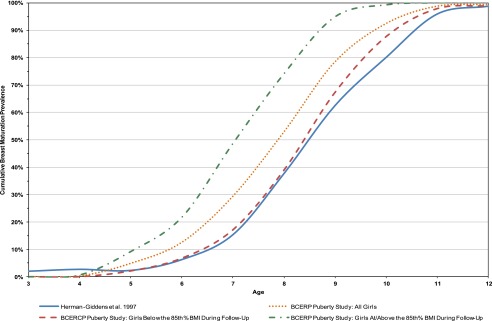
Results: The age at onset of breast stage 2 varied by race/ethnicity, BMI at baseline, and site. Median age at onset of breast stage 2 was 8.8, 9.3, 9.7, and 9.7 years for African American, Hispanic, white non-Hispanic, and Asian participants, respectively. Girls with greater BMI reached breast stage 2 at younger ages. Age-specific and standardized prevalence of breast maturation was contrasted to observations in 2 large cross-sectional studies conducted 10 to 20 years earlier (Pediatric Research in Office Settings and National Health and Nutrition Examination Survey III) and found to have occurred earlier among white, non-Hispanic, but not African American girls.
Conclusions: We observed the onset of thelarche at younger ages than previously documented, with important differences associated with race/ethnicity and BMI, confirming and extending patterns seen previously. These findings are consistent with temporal changes in BMI.
Keywords: breast development; girls; obesity; puberty.
Figures
Comment in
-
The enigmatic pursuit of puberty in girls.Pediatrics. 2013 Dec;132(6):1125-6. doi: 10.1542/peds.2013-3058. Epub 2013 Nov 4. Pediatrics. 2013. PMID: 24190683 No abstract available.
References
-
- Euling SY, Herman-Giddens ME, Lee PA, et al. Examination of US puberty-timing data from 1940 to 1994 for secular trends: panel findings. Pediatrics. 2008;121(suppl 3):S172–S191 - PubMed
-
- Aksglaede L, Sørensen K, Petersen JH, Skakkebaek NE, Juul A. Recent decline in age at breast development: the Copenhagen Puberty Study. Pediatrics. 2009;123(5). Available at: www.pediatrics.org/cgi/content/full/123/5/e932 - PubMed
-
- Kaplowitz PB, Slora EJ, Wasserman RC, Pedlow SE, Herman-Giddens ME. Earlier onset of puberty in girls: relation to increased body mass index and race. Pediatrics. 2001;108(2):347–353 - PubMed
-
- Rosenfield RL, Lipton RB, Drum ML. Thelarche, pubarche, and menarche attainment in children with normal and elevated body mass index. Pediatrics. 2009;123(1):84–88 - PubMed
-
- Biro FM, Galvez MP, Greenspan LC, et al. Pubertal assessment method and baseline characteristics in a mixed longitudinal study of girls. Pediatrics. 2010;126(3). Available at: www.pediatrics.org/cgi/content/full/126/3/e583 - PMC - PubMed
Publication types
MeSH terms
Grants and funding
- U01 ES012770/ES/NIEHS NIH HHS/United States
- U01 ES012800/ES/NIEHS NIH HHS/United States
- P01 ES009584/ES/NIEHS NIH HHS/United States
- UL1 RR024131/RR/NCRR NIH HHS/United States
- UL1 RR029887/RR/NCRR NIH HHS/United States
- T32 ES010957/ES/NIEHS NIH HHS/United States
- T32-ES10957/ES/NIEHS NIH HHS/United States
- U01ES012770/ES/NIEHS NIH HHS/United States
- U01 ES012771/ES/NIEHS NIH HHS/United States
- P30 ES006096/ES/NIEHS NIH HHS/United States
- CSTA-UL1RR029887/RR/NCRR NIH HHS/United States
- U01 ES012801/ES/NIEHS NIH HHS/United States
- U01 ES019453/ES/NIEHS NIH HHS/United States
- U01ES019453/ES/NIEHS NIH HHS/United States
- U01ES019457/ES/NIEHS NIH HHS/United States
- CSTA-UL1RR026314/RR/NCRR NIH HHS/United States
- UL1RR024131/RR/NCRR NIH HHS/United States
- U01 ES019457/ES/NIEHS NIH HHS/United States
- P30ES006096/ES/NIEHS NIH HHS/United States
- U01 ES019454/ES/NIEHS NIH HHS/United States
- U01ES012771/ES/NIEHS NIH HHS/United States
- U01ES019435/ES/NIEHS NIH HHS/United States
- P01ES009584/ES/NIEHS NIH HHS/United States
- UL1 TR000077/TR/NCATS NIH HHS/United States
- U01 ES019435/ES/NIEHS NIH HHS/United States
- U01ES012800/ES/NIEHS NIH HHS/United States
- UL1 RR026314/RR/NCRR NIH HHS/United States
- U01ES019454/ES/NIEHS NIH HHS/United States
LinkOut - more resources
Full Text Sources
Other Literature Sources
Medical
