


Early weight gain predicts outcome in two treatments for adolescent anorexia nervosa
- PMID: 24190844
- PMCID: PMC4341963
- DOI: 10.1002/eat.22221
Early weight gain predicts outcome in two treatments for adolescent anorexia nervosa
Abstract
Objective: Determine whether early weight gain predicts full remission at end-of-treatment (EOT) and follow-up in two different treatments for adolescent anorexia nervosa (AN), and to track the rate of weight gain throughout treatment and follow-up.
Method: Participants were 121 adolescents with AN (mean age = 14.4 years, SD = 1.6), from a two-site (Chicago and Stanford) randomized controlled trial. Adolescents were randomly assigned to family-based treatment (FBT) (n = 61) or individual adolescent focused therapy (AFT) (n = 60). Treatment response was assessed using percent of expected body weight (EBW) and the global score on the Eating Disorder Examination (EDE). Full remission was defined as having achieved ≥95% EBW and within one standard deviation of the community norms of the EDE. Full remission was assessed at EOT as well as 12-month follow-up.
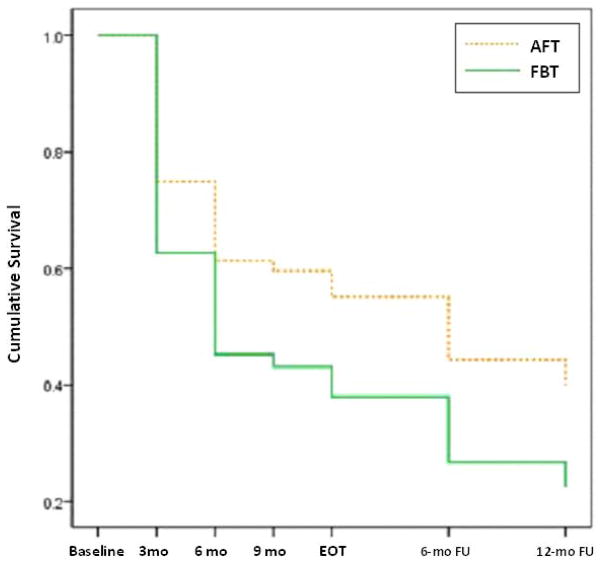
Results: Receiver operating characteristic analyses showed that the earliest predictor of remission at EOT was a gain of 5.8 pounds (2.65 kg) by session 3 in FBT (area under the curve (AUC) = 0.670; p = .043), and a gain of 7.1 pounds (3.20 kg) by session 4 in AFT (AUC = 0.754, p = .014). Early weight gain did not predict remission at follow-up for either treatment. A survival analysis showed that weight was marginally superior in FBT as opposed to AFT (Wald chi-square = 3.692, df = 1, p = .055).
Discussion: Adolescents with AN who receive either FBT or AFT, and show early weight gain, are likely to remit at EOT. However, FBT is superior to AFT in terms of weight gain throughout treatment and follow-up.
Keywords: adolescent anorexia nervosa; adolescent focused therapy; early treatment response; family-based treatment.
Copyright © 2013 Wiley Periodicals, Inc.
Figures
References
-
- Hartmann A, Wirth C, Zeeck A. Prediction of failure of inpatient treatment of anorexia nervosa from early weight gain. Psychotherapy Res. 2007;17:218–229.
-
- Fairburn CG, Agras WS, Walsh BT, Wilson GT, Stice E. Prediction of outcome in bulimia nervosa by early change in treatment. Am J Psychiatry. 2004;161:2322–2324. - PubMed
-
- Lock J, Couturier J, Bryson S, Agras WS. Predictors of dropout and remission in family therapy for adolescent anorexia nervosa in a randomized clinical trial. Int J Eat Disord. 2006;39:639–647. - PubMed
Publication types
MeSH terms
Grants and funding
LinkOut - more resources
Full Text Sources
Other Literature Sources
Miscellaneous
