


Review
doi: 10.1534/genetics.113.156521.
Exciting prospects for precise engineering of Caenorhabditis elegans genomes with CRISPR/Cas9
Affiliations
- PMID: 24190921
- PMCID: PMC3813854
- DOI: 10.1534/genetics.113.156521
Item in Clipboard
Review
Exciting prospects for precise engineering of Caenorhabditis elegans genomes with CRISPR/Cas9
Genetics.
2013 Nov.
Abstract
With remarkable speed, the CRISPR-Cas9 nuclease has become the genome-editing tool of choice for essentially all genetically tractable organisms. Targeting specific DNA sequences is conceptually simple because the Cas9 nuclease can be guided by a single, short RNA (sgRNA) to introduce double-strand DNA breaks (DSBs) at precise locations. Here I contrast and highlight protocols recently developed by eight different research groups, six of which are published in GENETICS, to modify the Caenorhabditis elegans genome using CRISPR/Cas9. This reverse engineering tool levels the playing field for experimental geneticists.
Figures
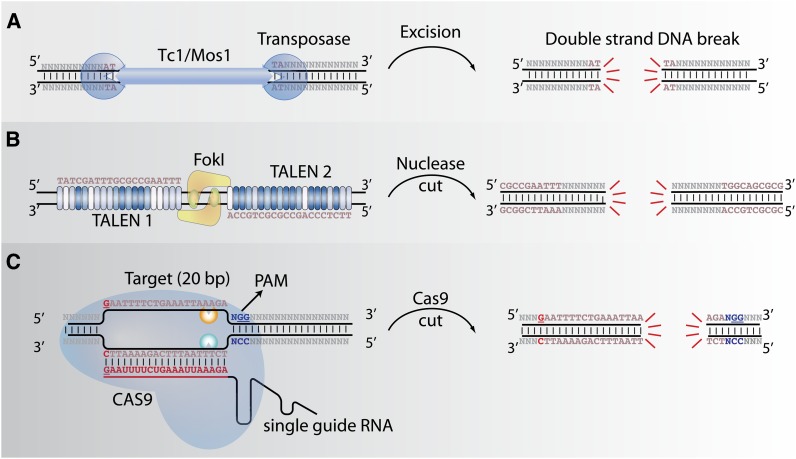
Ways to generate site-specific double-strand DNA breaks. (A) Transposition of the class II DNA transposons Tc1 or Mos1 is catalyzed by a single enzyme (the transposase) and excision results in a DSB. (B) TALENs are composed of sequential repeats that encode the DNA targeting specificity. To generate a DSB, two TALENs are targeted to adjacent sequences separated by 14–20 bp and upon dimerization the FokI nuclease domains cleave the intervening DNA. (C) The CRISPR–Cas9 enzyme is guided to the target site by a single-guide RNA (sgRNA). The target sequence is determined by the 20 nucleotides in red followed by the PAM sequence (NGG). The DSB is generated 3 bp upstream of the PAM.
Comment on
-
Transgene-free genome editing in Caenorhabditis elegans using CRISPR-Cas.Genetics. 2013 Nov;195(3):1167-71. doi: 10.1534/genetics.113.155879. Epub 2013 Aug 26. Genetics. 2013. PMID: 23979577 Free PMC article.
References
-
- Barrett P. L., Fleming J. T., Göbel V., 2004. Targeted gene alteration in Caenorhabditis elegans by gene conversion. Nat. Genet. 36: 1231–1237 - PubMed
-
- Bazopoulou D., Tavernarakis N., 2009. The NemaGENETAG initiative: large scale transposon insertion gene-tagging in Caenorhabditis elegans. Genetica 137: 39–46 - PubMed
-
- Bessereau, J.-L., Transposons in C. elegans (January 18, 2006), WormBook, ed. The C. elegans Research Community, WormBook, doi/10.1895/wormbook.1.70.1, http://www.wormbook.org.
-
- Bessereau J. L., Wright A., Williams D. C., Schuske K., Davis M. W., et al. , 2001. Mobilization of a Drosophila transposon in the Caenorhabditis elegans germ line. Nature 413: 70–74 - PubMed
Publication types
MeSH terms
Grants and funding
LinkOut - more resources
Full Text Sources
Other Literature Sources
