


National trends in heart failure hospitalization after acute myocardial infarction for Medicare beneficiaries: 1998-2010
- PMID: 24190958
- PMCID: PMC4415510
- DOI: 10.1161/CIRCULATIONAHA.113.003668
National trends in heart failure hospitalization after acute myocardial infarction for Medicare beneficiaries: 1998-2010
Abstract
Background: Previous studies have reported conflicting findings regarding how the incidence of heart failure (HF) after acute myocardial infarction (AMI) has changed over time, and data on contemporary national trends are sparse.
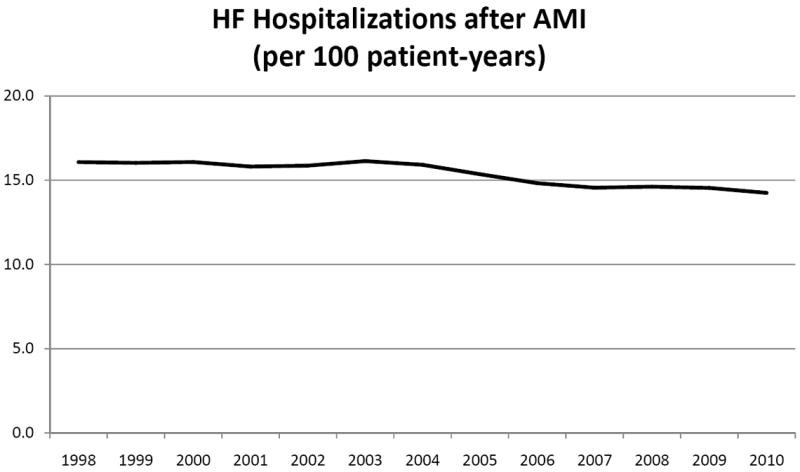
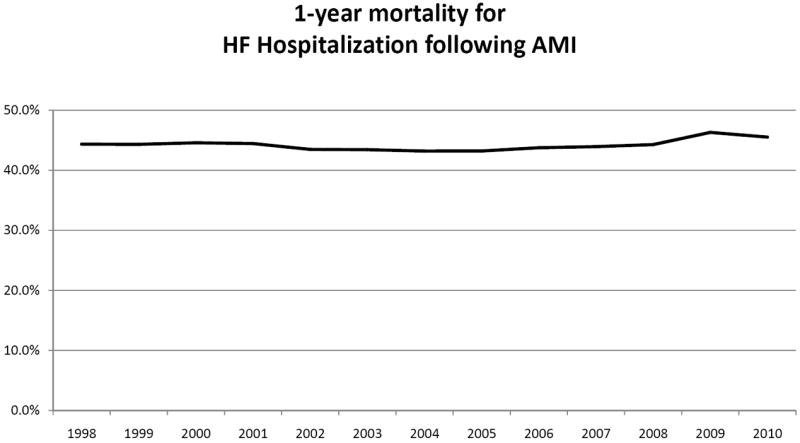
Methods and results: Using a complete national sample of 2 789 943 AMI hospitalizations of Medicare fee-for-service beneficiaries from 1998 through 2010, we evaluated annual changes in the incidence of subsequent HF hospitalization and mortality using Poisson and survival analysis models. The number of patients hospitalized for HF within 1 year after AMI declined modestly from 16.1 per 100 person-years in 1998 to 14.2 per 100 person years in 2010 (P<0.001). After adjusting for demographic factors, a relative 14.6% decline for HF hospitalizations after AMI was observed over the study period (incidence risk ratio, 0.854; 95% confidence interval, 0.809-0.901). Unadjusted 1-year mortality following HF hospitalization after AMI was 44.4% in 1998, which decreased to 43.2% in 2004 to 2005, but then increased to 45.5% by 2010. After adjusting for demographic factors and clinical comorbidities, this represented a 2.4% relative annual decline (hazard ratio, 0.976; 95% confidence interval, 0.974-0.978) from 1998 to 2007, but a 5.1% relative annual increase from 2007 to 2010 (hazard ratio, 1.051; 95% confidence interval, 1.039-1.064).
Conclusions: In a national sample of Medicare beneficiaries, HF hospitalization after AMI decreased from 1998 to 2010, which may indicate improvements in the management of AMI. In contrast, survival after HF following AMI remains poor, and has worsened from 2007 to 2010, demonstrating that challenges still remain for the treatment of this high-risk condition after AMI.
Keywords: epidemiology; heart failure; mortality; myocardial infarction.
Conflict of interest statement
Figures
Comment in
-
The message is clear: prevent as well as treat acute myocardial infarction.Circulation. 2013 Dec 17;128(24):2554-6. doi: 10.1161/CIRCULATIONAHA.113.006679. Epub 2013 Nov 4. Circulation. 2013. PMID: 24190957 No abstract available.
References
-
- Weir RA, McMurray JJ, Velazquez EJ. Epidemiology of heart failure and left ventricular systolic dysfunction after acute myocardial infarction: Prevalence, clinical characteristics, and prognostic importance. Am J Cardiol. 2006;97:13F–25F. - PubMed
-
- Steg PG, Dabbous OH, Feldman LJ, Cohen-Solal A, Aumont M-C, López-Sendón J, Budaj A, Goldberg RJ, Klein W, Anderson FA. Investigators for the Global Registry of Acute Coronary Events. Determinants and prognostic impact of heart failure complicating acute coronary syndromes: Observations from the Global Registry of Acute Coronary Events (GRACE) Circulation. 2004;109:494–499. - PubMed
-
- Velazquez EJ, Pfeffer MA. Acute heart failure complicating acute coronary syndromes: A deadly intersection. Circulation. 2004;109:440–442. - PubMed
-
- Goldberg RJ, Spencer FA, Yarzebski J, Lessard D, Gore JM, Alpert JS, Dalen JE. A 25-year perspective into the changing landscape of patients hospitalized with acute myocardial infarction (the Worcester Heart Attack Study) Am J Cardiol. 2004;94:1373–1378. - PubMed
-
- Hellermann JP, Goraya TY, Jacobsen SJ, Weston SA, Reeder GS, Gersh BJ, Redfield MM, Rodeheffer RJ, Yawn BP, Roger VL. Incidence of heart failure after myocardial infarction: Is it changing over time? Am J Epidemiol. 2003;157:1101–1107. - PubMed
Publication types
MeSH terms
Grants and funding
LinkOut - more resources
Full Text Sources
Other Literature Sources
Medical
Research Materials
Miscellaneous
