


Ecological momentary assessment of posttraumatic stress disorder symptoms during a smoking quit attempt
- PMID: 24191981
- PMCID: PMC3954422
- DOI: 10.1093/ntr/ntt167
Ecological momentary assessment of posttraumatic stress disorder symptoms during a smoking quit attempt
Abstract
Introduction: Smokers with posttraumatic stress disorder (PTSD) tend to lapse more quickly following a quit attempt, which might be explained by changes in PTSD symptoms during a quit attempt. The present study examines changes in PTSD symptoms, negative affect, and craving before and during a quit attempt.
Methods: Participants in this study were 52 smokers with PTSD who completed random-alarm ecological momentary assessments of PTSD symptoms, negative affect, cigarette craving, and smoking behavior throughout a prequit phase of ad hoc smoking, a phase of abstinence from smoking, and a postlapse phase.
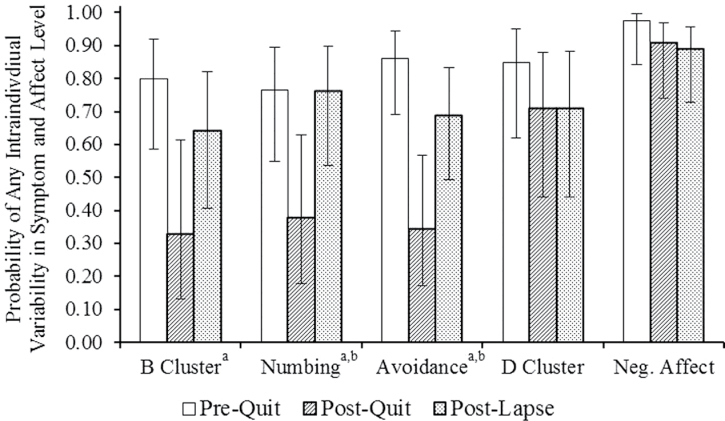
Results: Relative to the prequit phase, the abstinent phase was marked by decreases in PTSD reexperiencing, avoidance, and numbing clusters (ps ≤ .01). The odds of PTSD symptom or negative affect variability from one reading in the ecological momentary assessment (EMA)to the next reading was decreased in PTSD reexperiencing, avoidance, and numbing clusters (ps ≤ .02). Smoking cravings were also mildly decreased in the abstinent and postlapse phases (ps < .01), although some cravings in both phases were rated at the maximum intensity. Increased craving was predicted by the previous EMA reading of PTSD symptoms.
Conclusions: Results suggested that smoking abstinence is not associated with exacerbation of PTSD symptoms, but PTSD symptoms during abstinence were related to craving levels during the quit attempt.
Figures
References
-
- American Psychiatric Association (1994). Diagnostic and statistical manual of mental disorders (4th ed.). Washington, DC: American Psychiatric Association
-
- Beckham J.C., Calhoun P.S., Dennis M.F., Wilson S.M., Johnson Y.C., Dedert E.A. (2013). Predictors of lapse in the first week of smoking abstinence in posttraumatic stress disorder and non-posttraumatic stress disorder smokers. Nicotine & Tobacco Research, 15, 1122–1129. 10.1093/ntr/nts252 - PMC - PubMed
-
- Beckham J.C., Feldman M.E., Vrana S.R., Mozley S.L., Erkanli A., Clancy C.P., Rose J.E. (2005). Immediate antecedents of cigarette smoking in smokers with and without posttraumatic stress disorder: A preliminary study. Experimental and Clinical Psychopharmacology, 13, 218–228 doi:10.1037/1064-1297.13.3.219 - PubMed
-
- Beckham J.C., Kirby A.C., Feldman M.E., Hertzberg M.A., Moore S.D., Crawford A.L., Fairbank J.A. (1997). Prevalence and correlates of heavy smoking in Vietnam veterans with chronic posttraumatic stress disorder. Addictive Behaviors, 22, 637–647 doi:0.1016/S0306- 4603(96)00071-8 - PubMed
Publication types
MeSH terms
Grants and funding
LinkOut - more resources
Full Text Sources
Other Literature Sources
Medical
Research Materials
