


Factors influencing health-related quality of life after total hip replacement--a comparison of data from the Swedish and Danish hip arthroplasty registers
- PMID: 24192304
- PMCID: PMC4228371
- DOI: 10.1186/1471-2474-14-316
Factors influencing health-related quality of life after total hip replacement--a comparison of data from the Swedish and Danish hip arthroplasty registers
Abstract
Background: There is an increasing focus on measuring patient-reported outcomes (PROs) as part of routine medical practice, particularly in fields such as joint replacement surgery where pain relief and improvement in health-related quality of life (HRQoL) are primary outcomes. Between-country comparisons of PROs may present difficulties due to cultural differences and differences in the provision of health care. However, in order to understand how these differences affect PROs, common predictors for poor and good outcomes need to be investigated. This cross-sectional study investigates factors influencing health-related quality of life (HRQoL) one year after total hip replacement (THR) surgery in Sweden and in Denmark.
Methods: Data was retrieved from the Swedish (n = 14,560 patients) and Danish (n = 632 patients) Hip Arthroplasty Registers according to preset selection criteria. Using linear regression models, we examined how sex, age, comorbidity and country of surgery were associated with different aspects of HRQoL as measured by the EQ-5D index and EQ VAS.
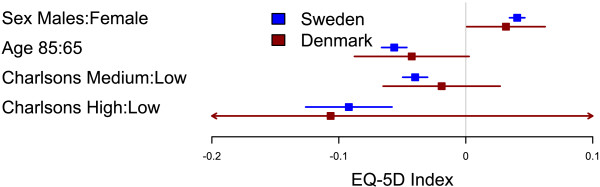
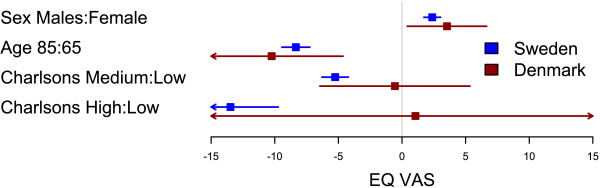
Results: Danish patients had an overall higher EQ-5D index and EQ VAS than Swedish patients (p < 0.001). After regression analysis, the estimated coefficients for sex, age, or the Charlson score did not differ between countries for either the EQ-5D index (p = 0.83) or EQ VAS (p = 0.41) one year after THR.
Conclusions: We conclude that there are clear similarities in how basic predictors influence patient-reported outcomes (PROs) in patients with THR in Sweden and Denmark and these known predictors of good or poor HRQoL outcomes are not specific for each country.
Figures
Comment in
-
Patient-reported outcome measures in arthroplasty registries Report of the Patient-Reported Outcome Measures Working Group of the International Society of Arthroplasty Registries Part II. Recommendations for selection, administration, and analysis.Acta Orthop. 2016 Jul;87 Suppl 1(Suppl 1):9-23. doi: 10.1080/17453674.2016.1181816. Epub 2016 May 26. Acta Orthop. 2016. PMID: 27228230 Free PMC article.
References
-
- Konig HH, Bernert S, Angermeyer MC, Matschinger H, Martinez M, Vilagut G, Haro JM, de Girolamo G, de Graaf R, Kovess V. et al. Comparison of population health status in six european countries: results of a representative survey using the EQ-5D questionnaire. Med Care. 2009;47(2):255–261. doi: 10.1097/MLR.0b013e318184759e. - DOI - PubMed
-
- Bernert S, Fernandez A, Haro JM, Konig HH, Alonso J, Vilagut G, Sevilla-Dedieu C, de Graaf R, Matschinger H, Heider D. et al. Comparison of different valuation methods for population health status measured by the EQ-5D in three European countries. Value Health. 2009;12(5):750–758. doi: 10.1111/j.1524-4733.2009.00509.x. - DOI - PubMed
Publication types
MeSH terms
LinkOut - more resources
Full Text Sources
Other Literature Sources
Medical
Miscellaneous
