


Vaccination coverage among children in Germany estimated by analysis of health insurance claims data
- PMID: 24192604
- PMCID: PMC4185903
- DOI: 10.4161/hv.26986
Vaccination coverage among children in Germany estimated by analysis of health insurance claims data
Abstract
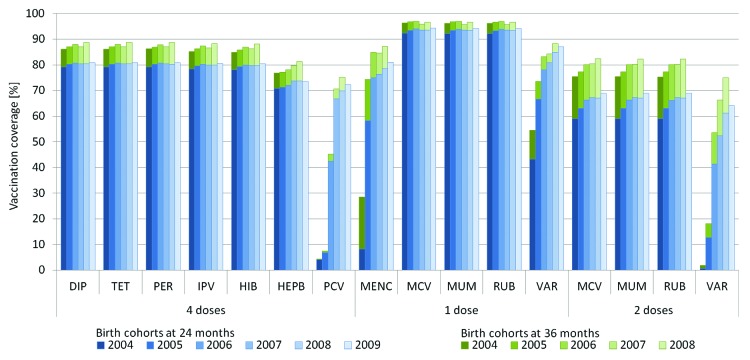
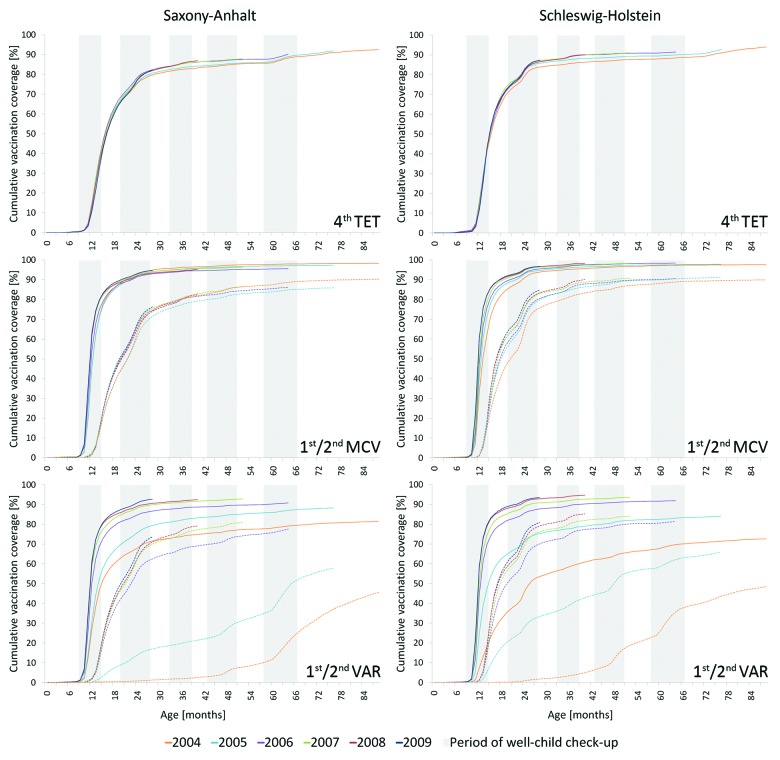
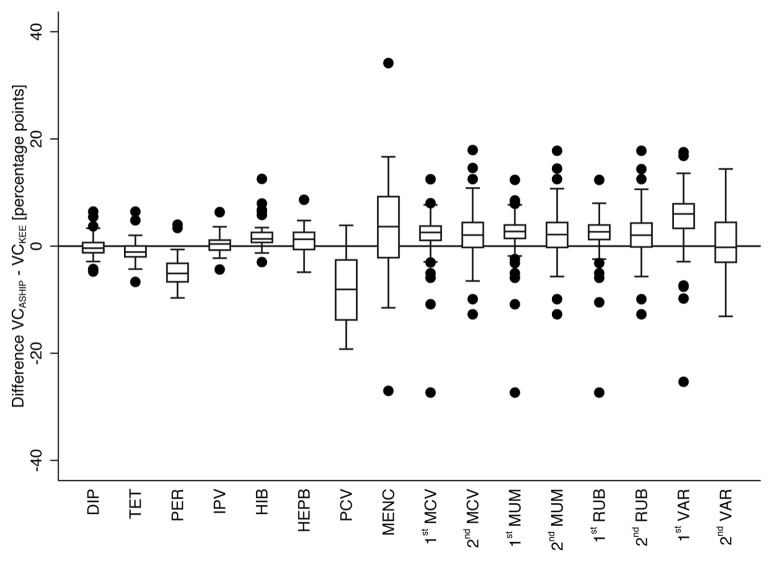
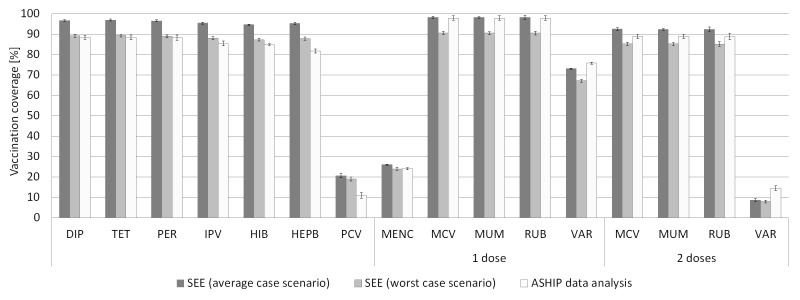
In Germany, the national routine childhood immunization schedule comprises 12 vaccinations. Primary immunizations should be completed by 24 mo of age. However, nationwide monitoring of vaccination coverage (VC) is performed only at school entry. We utilized health insurance claims data covering ~85% of the total population with the objectives to (1) assess VC of all recommended childhood vaccinations in birth-cohorts 2004-2009, (2) analyze cross-sectional (at 24 and 36 mo) and longitudinal trends, and (3) validate the method internally and externally. Counting vaccine doses in a retrospective cohort fashion, we assembled individual vaccination histories and summarized VC to nationwide figures. For most long-established vaccinations, VC at 24 mo was at moderate levels (~73-80%) and increased slightly across birth-cohorts. One dose measles VC was high (94%), but low (69%) for the second dose. VC with a full course of recently introduced varicella, pneumococcal, and meningococcal C vaccines increased across birth-cohorts from below 10% above 60%, 70%, and 80%, respectively. At 36 mo, VC had increased further by up to 15 percentage points depending on vaccination. Longitudinal analysis suggested a continued VC increase until school entry. Validation of VC figures with primary data showed an overall good agreement. In conclusion, analysis of health insurance claims data allows for the estimation of VC among children in Germany considering completeness and timeliness of vaccination series. This approach provides valid nationwide VC figures for all currently recommended pediatric vaccinations and fills the information gap between early infancy and late assessment at school entry.
Keywords: Germany; childhood; health services research; vaccination coverage; vaccines.
Figures
References
-
- Robert Koch Institute Mitteilung der Ständigen Impfkommission am Robert Koch-Institut (RKI). Empfehlungen der Ständigen Impfkommission (STIKO) am Robert Koch-Institut / Stand: Juli 2012. Epid Bulletin. 2012;30:283–310.
-
- German Standing Committee on Vaccination. Vaccination schedule (English). 2012.
-
- World Health Organization. WHO vaccine-preventable diseases: monitoring system: 2010 global summary. 2010. Available from: http://whqlibdoc.who.int/hq/2010/WHO_IVB_2010_eng.pdf
-
- Poggensee G, Reuss A, Reiter S, Siedler A. [Overview and assessment of available data sources to determine incidence of vaccine preventable diseases, vaccination coverage, and immune status in Germany] Bundesgesundheitsblatt Gesundheitsforschung Gesundheitsschutz. 2009;11:1019–28. doi: 10.1007/s00103-009-0952-z. - DOI - PubMed
Publication types
MeSH terms
LinkOut - more resources
Full Text Sources
Other Literature Sources
Medical
Molecular Biology Databases
Miscellaneous
