. 2014 Jan 15;20(2):372-81.
doi: 10.1158/1078-0432.CCR-13-1252. Epub 2013 Nov 5.

Oncogenic function of SCCRO5/DCUN1D5 requires its Neddylation E3 activity and nuclear localization

Affiliations

Oncogenic function of SCCRO5/DCUN1D5 requires its Neddylation E3 activity and nuclear localization

Claire C Bommeljé et al. Clin Cancer Res. .

Abstract

Purpose: To determine mechanisms by which SCCRO5 (aka DCUN1D5) promotes oncogenesis.

Experimental design: SCCRO5 mRNA and protein expression were assessed in 203 randomly selected primary cancer tissue samples, matched histologically normal tissues, and cell lines by use of real-time PCR and Western blot analysis. SCCRO5 overexpression was correlated with survival. The effect of SCCRO5 knockdown on viability was assessed in selected cancer cell lines. Structure-function studies were performed to determine the SCCRO5 residues required for binding to the neddylation components, for neddylation-promoting activity, and for transformation.

Results: In oral and lung squamous cell carcinomas, SCCRO5 mRNA levels corresponded with protein levels and overexpression correlated with decreased disease-specific survival. Knockdown of SCCRO5 by RNAi resulted in a selective decrease in the viability of cancer cells with high endogenous levels, suggesting the presence of oncogene addiction. SCCRO5 promoted cullin neddylation while maintaining conserved reaction processivity paradigms involved in ubiquitin and ubiquitin-like protein conjugation, establishing it as a component of the neddylation E3. Neddylation activities in vitro required the potentiating of neddylation (PONY) domain but not the nuclear localization sequence (NLS) domain. In contrast, both the NLS domain and the PONY domain were required for transformation of NIH-3T3 cells.

Conclusions: Our data suggest that SCCRO5 has oncogenic potential that requires its function as a component of the neddylation E3. Neddylation activity and nuclear localization of SCCRO5 are important for its in vivo function.


Figures

FIGURE 1
FIGURE 1
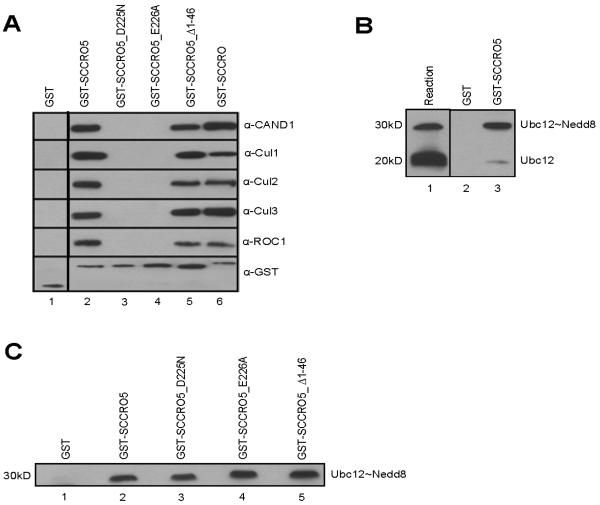
SCCRO5 interacts with components of the neddylation pathway. A, Western blot analysis of the products of GST-SCCRO, GST-SCCRO5, and selected GST-SCCRO5 mutants after pull-down assays from HeLa lysates probed with the indicated antibodies, which shows that, like SCCRO, SCCRO5 binds to CAND1, Cul1, Cul2, Cul3, and ROC1. Mutations in the PONY domain (SCCRO5_D225N and SCCRO5_E226A), but not the N-terminal NLS (SCCRO5_Δ1-46), result in loss of binding. The dividing line between lane 1 and lane 2 indicates the position of omitted lanes from the same gel. B, Western blot analysis of Ubc12 after GST and GST-SCCRO5 pull-down assays on products from a thioester reaction (lane 1), which shows preferential binding to Ubc12~Nedd8, even in the presence of excess free Ubc12. C, Western blot analysis of Ubc12 after pull-down assays on products of thioester reaction, which shows that GST-SCCRO5 and PONY and NLS mutants bind equally to Ubc12~Nedd8.
FIGURE 2
FIGURE 2
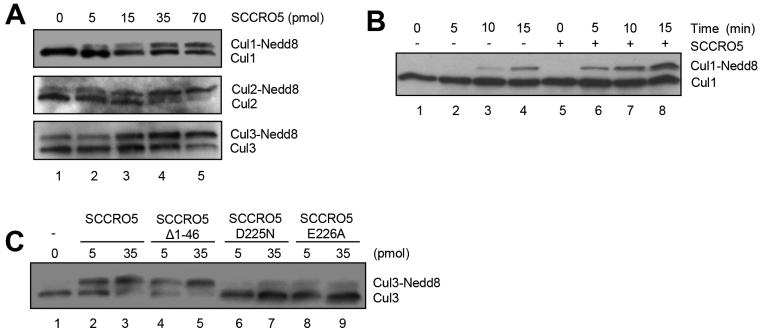
SCCRO5 augments cullin neddylation. A, Western blot analysis of the indicated cullins on products of an in vitro neddylation reaction using HeLa lysates as a source for Cullin-ROC1 complexes supplemented with a gradient of SCCRO5, which shows a dose-dependent increase in neddylation of Cul1, Cul2, and Cul3 with the addition of recombinant SCCRO5. B, Western blot analysis of Cul1 on products of an in vitro neddylation reaction with (lanes 5-8) or without (lanes 1-4) the addition of SCCRO5, which shows enhanced efficiency of Cul1 neddylation by SCCRO5. C, Western blot analysis of Cul3 on products of an in vitro neddylation reaction with concentration gradients of SCCRO5, SCCRO5_Δ1-46, SCCRO5_D225N, or SCCRO5_E226A (quantities in pmol), which shows a dose-dependent increase in neddylation of Cul3 with SCCRO5 and SCCRO5_Δ1-46 but not with SCCRO5_D225N or SCCRO5_E226A.
FIGURE 3
FIGURE 3
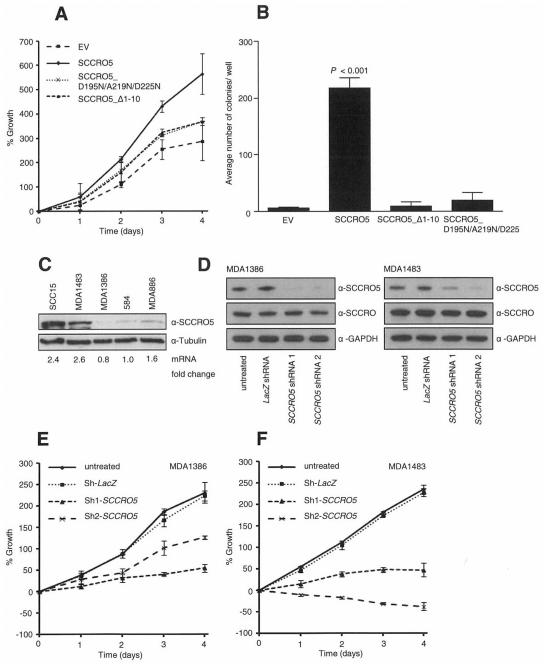
Transgenic expression of SCCRO5 promotes proliferation and anchorage-independent growth. A, Graph showing results from an MTS assay on NIH-3T3 cells stably expressing SCCRO5 and indicated mutants, which shows increased proliferation in plasmids expressing SCCRO5 but not NLS (SCCRO5_Δ1-10) or PONY (SCCRO5_D195N/A219N/D225N) domain mutants. B, Results from a soft agar assay, which shows increased colony formation in NIH-3T3 cells stably transfected with SCCRO5, compared with that in cells transfected with empty vector and SCCRO5 NLS and PONY domain mutants (bars represent the mean ± SD number of colonies per well of 6-well plates; P < 0.001). C, Western blot analysis, which shows SCCRO5 protein levels and corresponding mRNA levels, on the basis of real-time PCR, in head and neck cancer cell lines. D, Western blot analysis of SCCRO5, with GAPDH as a loading control, on lysates from MDA1386 (low endogenous SCCRO5) and MDA1483 (high endogenous SCCRO5), before and after transfection of two independent shRNA constructs against SCCRO5 or lacZ control, which shows efficient and specific knockdown of SCCRO5. E and F, Graphs from MTS assays showing a more pronounced decrease in the viability of MDA1483 cells, compared with MDA1386 cells, with knockdown of SCCRO5.
FIGURE 4
FIGURE 4
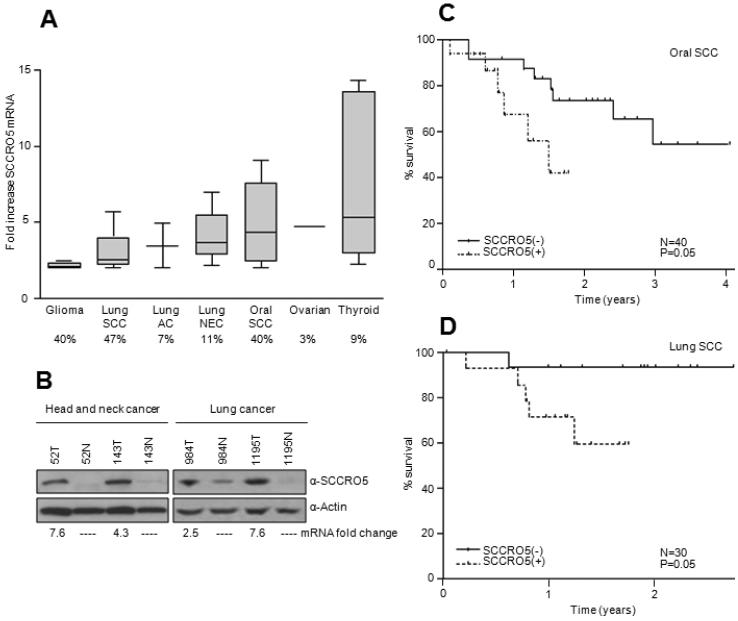
SCCRO5 overexpression is common in human tumors and correlates with outcomes. A, Box plot showing fold increase in SCCRO5 mRNA expression, analyzed by qRT-PCR, in 10 gliomas, 30 lung squamous cell carcinomas (SCCs), 27 lung adenocarcinomas (ACs), 54 lung neuroendocrine (NEC) tumors, 40 oral SCCs, 40 ovarian carcinomas, and 56 thyroid carcinomas, compared with matched normal tissues (boxes represent the lower through the upper quartile; the median is shown as a horizontal line; whiskers represent minimum and maximum levels). The percentage of cases with overexpression is given below each plot. B, Western blot analysis showing SCCRO5 protein expression in representative head and neck and lung SCCs (T) and matched normal (N) samples. The corresponding fold change in mRNA levels, determined by real-time PCR, is noted below. C, Kaplan-Meier survival curves from post-hoc analysis showing recurrence-free survival based on SCCRO5 mRNA expression status in primary oral SCCs. D, Kaplan-Meier survival curves showing recurrence-free survival from post-hoc analysis based on SCCRO5 mRNA expression status in primary lung SCCs.

References

    1. Liu Z, Zanata SM, Kim J, Peterson MA, Di Vizio D, Chirieac LR, et al. The ubiquitin-specific protease USP2a prevents endocytosis-mediated EGFR degradation. Oncogene. 2013;32:1660–9. - PMC - PubMed
    1. Grim JE, Knoblaugh SE, Guthrie KA, Hagar A, Swanger J, Hespelt J, et al. Fbw7 and p53 cooperatively suppress advanced and chromosomally unstable intestinal cancer. Mol Cell Biol. 2012;32:2160–7. - PMC - PubMed
    1. Soucy TA, Dick LR, Smith PG, Milhollen MA, Brownell JE. The NEDD8 conjugation pathway and its relevance in cancer biology and therapy. Genes Cancer. 2010;1:708–16. - PMC - PubMed
    1. Hsu JM, Lee YC, Yu CT, Huang CY. Fbx7 functions in the SCF complex regulating Cdk1-cyclin B-phosphorylated hepatoma up-regulated protein (HURP) proteolysis by a proline-rich region. J Biol Chem. 2004;279:32592–602. - PubMed
    1. Lehman NL, van de Rijn M, Jackson PK. Screening of tissue microarrays for ubiquitin proteasome system components in tumors. Methods Enzymol. 2005;399:334–55. - PubMed

Publication types

MeSH terms