


Impact of atherosclerosis detection by carotid ultrasound on physician behavior and risk-factor management in asymptomatic hypertensive subjects
- PMID: 24193449
- PMCID: PMC6649369
- DOI: 10.1002/clc.22220
Impact of atherosclerosis detection by carotid ultrasound on physician behavior and risk-factor management in asymptomatic hypertensive subjects
Abstract
Background: There are limited data regarding the impact of atherosclerosis detection by carotid ultrasound (CUS) on physician prevention efforts and risk-factor management for cardiovascular disease.
Hypothesis: Atherosclerosis detection by CUS in asymptomatic hypertensive patients would lead to physician prevention efforts, including target low-density lipoprotein cholesterol (LDL-C) level and prescription. Also, it may improve risk-factor management.
Methods: A total of 347 asymptomatic hypertensive subjects (age 61 ± 8 years, 189 men) were prospectively recruited from 22 hospitals. Prior to CUS, physicians were surveyed regarding target LDL-C level. After CUS, patients were classified into positive CUS (n = 182) and negative CUS (n = 165) groups based on CUS results. Physicians were resurveyed to assess whether the initial target LDL-C goals were changed. At 6 months, cardiovascular risk-factor modification status was reassessed.
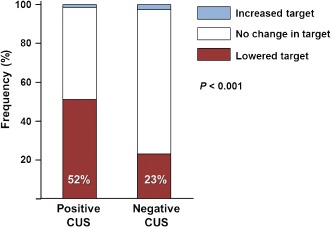
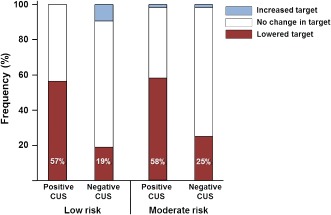
Results: The proportion of lowered target LDL-C levels was significantly larger in the positive CUS group than in the negative CUS group (52% vs 23%, P < 0.001). These results were observed even in subjects who had low and moderate risk according to National Cholesterol Education Program-Adult Treatment Panel III guidelines. Lipid-lowering agents were similarly added or switched to another class in both groups (7% in the positive CUS group vs 11% in the negative CUS group, P = 0.153). LDL-C was significantly decreased in the positive CUS group (Δ = -24 ± 38 mg/dL, P < 0.001), whereas it was not significantly decreased in the negative CUS group (Δ = -6 ± 31 mg/dL, P = 0.105).
Conclusions: Atherosclerosis detection by CUS lowered physicians' target LDL-C level and improved cardiovascular risk management in terms of LDL-C reduction.
© 2013 Wiley Periodicals, Inc.
Figures
References
-
- Wyman RA, Gimelli G, McBride PE, et al. Does detection of carotid plaque affect physician behavior or motivate patients? Am Heart J. 2007;154:1072–1077. - PubMed
-
- McEvoy JW, Blaha MJ, Nasir K, et al. Impact of coronary computed tomographic angiography results on patient and physician behavior in a low‐risk population. Arch Intern Med. 2011;171:1260–1268. - PubMed
Publication types
MeSH terms
Substances
LinkOut - more resources
Full Text Sources
Other Literature Sources
Medical
