


Purposeful Sampling for Qualitative Data Collection and Analysis in Mixed Method Implementation Research
- PMID: 24193818
- PMCID: PMC4012002
- DOI: 10.1007/s10488-013-0528-y
Purposeful Sampling for Qualitative Data Collection and Analysis in Mixed Method Implementation Research
Abstract
Purposeful sampling is widely used in qualitative research for the identification and selection of information-rich cases related to the phenomenon of interest. Although there are several different purposeful sampling strategies, criterion sampling appears to be used most commonly in implementation research. However, combining sampling strategies may be more appropriate to the aims of implementation research and more consistent with recent developments in quantitative methods. This paper reviews the principles and practice of purposeful sampling in implementation research, summarizes types and categories of purposeful sampling strategies and provides a set of recommendations for use of single strategy or multistage strategy designs, particularly for state implementation research.
Figures
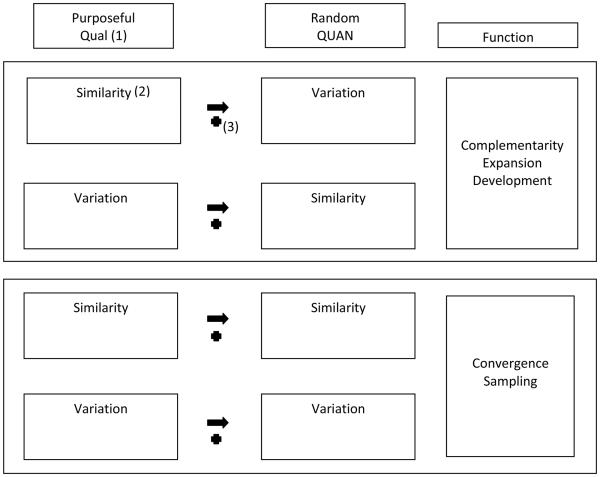
- (1)
Priority and sequencing of Qualitative (QUAL) and Quantitative (QUAN) can be reversed.
- (2)
Refers to emphasis of sampling strategy.
- (3)
 Refers to sequential structure;
  refers to simultaneous structure.
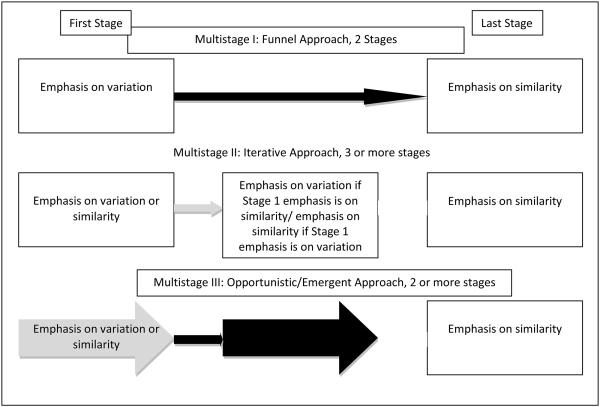
References
-
- Aarons GA, Palinkas LA. Implementation of evidence-based practice in child welfare: service provider perspectives. Administration and Policy in Mental Health and Mental Health Services Research. 2007;34:411–419. - PubMed
-
- Bachman MO, O’Brien M, Husbands C, Shreeve A, Jones N, Watson J, Reading R, Thoburn J, Mugford M, the National Evaluation of Children’s Trusts Team Integrating children’s services in England: national evaluation of children’s trusts. Child: Care, Health and Development. 2009;35:257–265. - PubMed
-
- Bernard HR. Research methods in anthropology: Qualitative and quantitative approaches. 3rd Alta Mira Press; Walnut Creek, CA: 2002.
-
- Bloom HS, Michalopoulos C. When is the story in the subgroups? Strategies for interpreting and reporting intervention effects for subgroups. Prevention Science. 2013;14:179–188. - PubMed
Publication types
MeSH terms
Grants and funding
LinkOut - more resources
Full Text Sources
Other Literature Sources
Medical
