Increasing objectively measured sedentary time increases clustered cardiometabolic risk: a 6 year analysis of the ProActive study
- PMID: 24194101
- PMCID: PMC3889989
- DOI: 10.1007/s00125-013-3102-y
Increasing objectively measured sedentary time increases clustered cardiometabolic risk: a 6 year analysis of the ProActive study
Abstract
Aims/hypothesis: We aimed to quantify the associations between change in objectively measured sedentary and moderate-to-vigorous physical activity (MVPA) times and self-reported television viewing over 6 years and change in a clustered cardiometabolic risk score (CCMR), including and excluding waist circumference (CCMR without adiposity component, CCMR no adip ), and its individual components, among the adult children of people with type 2 diabetes.
Methods: In 171 adults (mean ± SD age 42.52 ± 6.30 years; 46% men) with a parental history of diabetes (ProActive UK), physical activity accelerometer measures and self-reported television viewing were assessed at baseline and a mean ± SD of 6.27 ± 0.46 years later. Associations between change in sedentary time, MVPA time and television viewing and cardiometabolic risk and mediation by adiposity change were examined by multiple linear regression and the product of coefficients method, respectively.
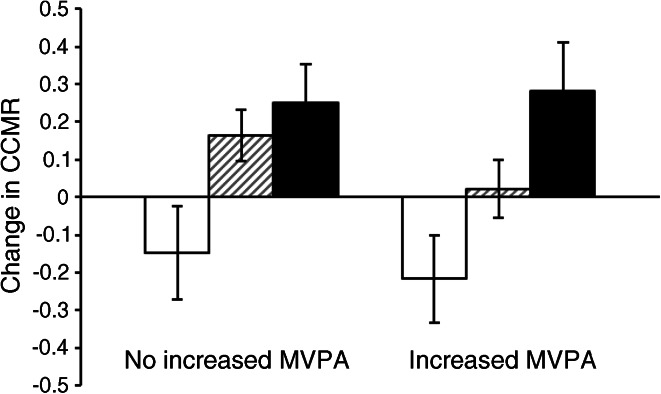
Results: Greater increases in sedentary time (h/day) were associated with larger increases in clustered cardiometabolic risk (CCMR: 0.08 [95% CI 0.01, 0.15]; CCMR no adip : 0.08 [0.01, 0.16]) and triacylglycerol (0.15 [0.01, 0.29]), independent of baseline sedentary and MVPA times, change in MVPA time and other confounders. No evidence was found for mediation by change in waist circumference and BMI for the associations with CCMR no adip and triacylglycerol. Greater increases in MVPA time (h/day) were associated with larger decreases in waist circumference (-3.86 [-7.58, -0.14]), independently of baseline MVPA and sedentary times, change in sedentary time and other confounders. Television viewing was not independently associated with any of the cardiometabolic outcomes.
Conclusions/interpretation: Increasing sedentary time is independently related to increasing clustered cardiometabolic risk and triacylglycerol in adults at high risk of developing diabetes. Strategies to prevent diabetes might target reducing sedentary time. Trial registration ISRCTN61323766.
Figures
Similar articles
-
Prospective associations between sedentary time, physical activity, fitness and cardiometabolic risk factors in people with type 2 diabetes.Diabetologia. 2016 Jan;59(1):110-120. doi: 10.1007/s00125-015-3756-8. Epub 2015 Oct 30. Diabetologia. 2016. PMID: 26518682 Free PMC article.
-
Ten-year change in sedentary behaviour, moderate-to-vigorous physical activity, cardiorespiratory fitness and cardiometabolic risk: independent associations and mediation analysis.Br J Sports Med. 2018 Aug;52(16):1063-1068. doi: 10.1136/bjsports-2016-096083. Epub 2016 Aug 4. Br J Sports Med. 2018. PMID: 27491779 Free PMC article.
-
Associations of objectively measured sedentary behaviour and physical activity with markers of cardiometabolic health.Diabetologia. 2013 May;56(5):1012-20. doi: 10.1007/s00125-013-2845-9. Epub 2013 Mar 1. Diabetologia. 2013. PMID: 23456209 Clinical Trial.
-
The prospective association between objectively measured sedentary time, moderate-to-vigorous physical activity and cardiometabolic risk factors in youth: a systematic review and meta-analysis.Obes Rev. 2019 Jan;20(1):55-74. doi: 10.1111/obr.12758. Epub 2018 Sep 30. Obes Rev. 2019. PMID: 30270500
-
Interventions outside the workplace for reducing sedentary behaviour in adults under 60 years of age.Cochrane Database Syst Rev. 2020 Jul 17;7(7):CD012554. doi: 10.1002/14651858.CD012554.pub2. Cochrane Database Syst Rev. 2020. PMID: 32678471 Free PMC article.
Cited by
-
TV time, physical activity, sedentary behaviour and cardiometabolic biomarkers in pregnancy-NHANES 2003-2006.Can J Public Health. 2022 Oct;113(5):726-735. doi: 10.17269/s41997-022-00634-8. Epub 2022 May 19. Can J Public Health. 2022. PMID: 35587307 Free PMC article.
-
Targeting Reductions in Sitting Time to Increase Physical Activity and Improve Health.Med Sci Sports Exerc. 2017 Aug;49(8):1572-1582. doi: 10.1249/MSS.0000000000001257. Med Sci Sports Exerc. 2017. PMID: 28272267 Free PMC article. Review.
-
Improving Cardiometabolic Health with Diet, Physical Activity, and Breaking Up Sitting: What about Sleep?Front Physiol. 2017 Nov 8;8:865. doi: 10.3389/fphys.2017.00865. eCollection 2017. Front Physiol. 2017. PMID: 29167645 Free PMC article.
-
Leisure-time physical activity, sedentary behaviors, sleep, and cardiometabolic risk factors at baseline in the PREDIMED-PLUS intervention trial: A cross-sectional analysis.PLoS One. 2017 Mar 8;12(3):e0172253. doi: 10.1371/journal.pone.0172253. eCollection 2017. PLoS One. 2017. PMID: 28273154 Free PMC article. Clinical Trial.
-
Sedentary Behavior and Body Weight and Composition in Adults: A Systematic Review and Meta-analysis of Prospective Studies.Sports Med. 2018 Mar;48(3):585-595. doi: 10.1007/s40279-017-0828-6. Sports Med. 2018. PMID: 29189928
References
Publication types
MeSH terms
Associated data
Grants and funding
LinkOut - more resources
Full Text Sources
Other Literature Sources
Medical
