. 2013 Nov 5;4(6):e00860-13.
doi: 10.1128/mBio.00860-13.

Frequent replenishment sustains the beneficial microbiome of Drosophila melanogaster

Affiliations

Frequent replenishment sustains the beneficial microbiome of Drosophila melanogaster

Jessamina E Blum et al. mBio. .

Abstract

We report that establishment and maintenance of the Drosophila melanogaster microbiome depend on ingestion of bacteria. Frequent transfer of flies to sterile food prevented establishment of the microbiome in newly emerged flies and reduced the predominant members, Acetobacter and Lactobacillus spp., by 10- to 1,000-fold in older flies. Flies with a normal microbiome were less susceptible than germfree flies to infection by Serratia marcescens and Pseudomonas aeruginosa. Augmentation of the normal microbiome with higher populations of Lactobacillus plantarum, a Drosophila commensal and probiotic used in humans, further protected the fly from infection. Replenishment represents an unexplored strategy by which animals can sustain a gut microbial community. Moreover, the population behavior and health benefits of L. plantarum resemble features of certain probiotic bacteria administered to humans. As such, L. plantarum in the fly gut may serve as a simple model for dissecting the population dynamics and mode of action of probiotics in animal hosts.

Importance: Previous studies have defined the composition of the Drosophila melanogaster microbiome in laboratory and wild-caught flies. Our study advances current knowledge in this field by demonstrating that Drosophila must consume bacteria to establish and maintain its microbiome. This finding suggests that the dominant Drosophila symbionts remain associated with their host because of repeated reintroduction rather than internal growth. Furthermore, our study shows that one member of the microbiome, Lactobacillus plantarum, protects the fly from intestinal pathogens. These results suggest that, although not always present, the microbiota can promote salubrious effects for the host. In sum, our work provides a previously unexplored mechanism of microbiome maintenance and an in vivo model system for investigating the mechanisms of action of probiotic bacteria.


Figures
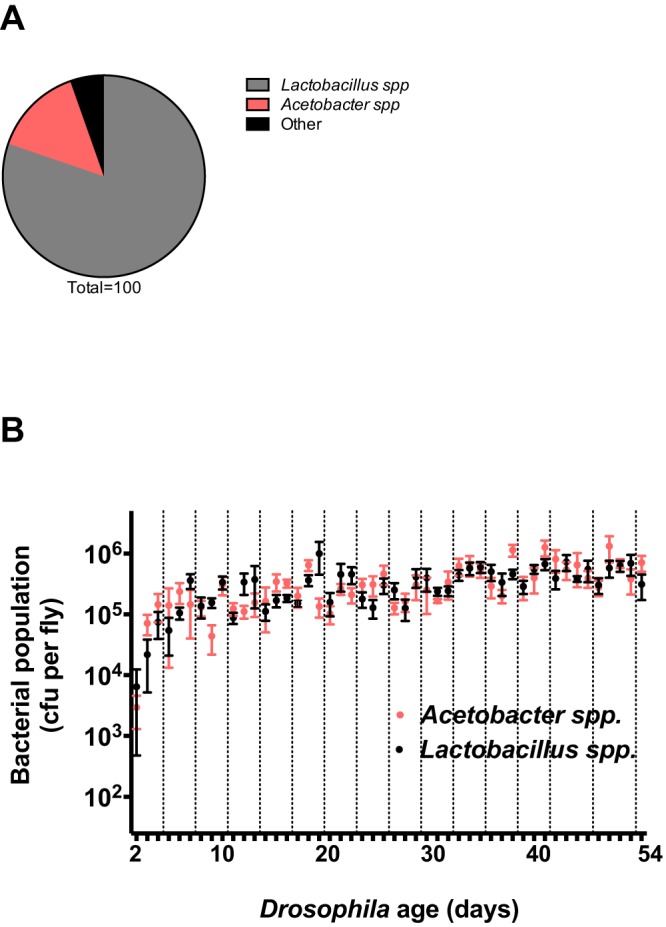
FIG 1
FIG 1
Populations within the adult Drosophila microbiome. (A) One- to 2-day-old surface-sterilized adults were analyzed for bacterial community membership by 454 tag pyrosequencing. The proportions of the community represented by the two most abundant taxa, Lactobacillus and Acetobacter, which represent 94% of the community, are shown. (B) Two- to 54-day-old adult Drosophila were sampled daily (points at 43, 45, 50, and 51 days were omitted). Five adult females were sampled at most time points (with three samples on days 14, 21, 25, and 44 and four samples on days 16, 17, 19, 20, 26, 28, and 46). Values represent mean bacterial population per fly ± the standard error of the mean as estimated by culturing. The limit of detection is 25 CFU per fly. Dashed lines represent transfer of flies to sterile vials.
FIG 2
FIG 2
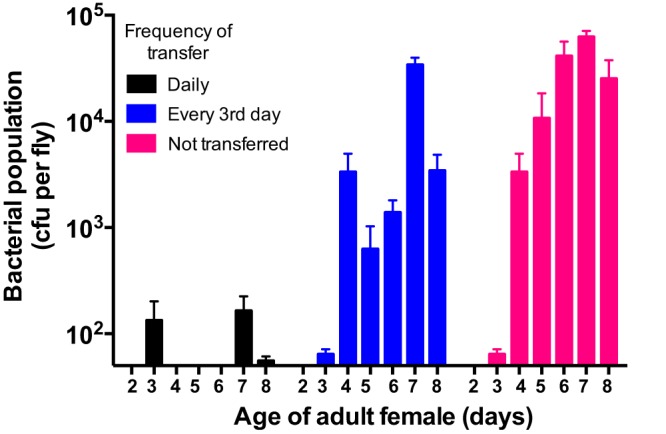
Establishment of the Drosophila microbiome requires frequent consumption of bacteria. Cultured populations of Acetobacter and Lactobacillus spp. in newly emerged Drosophila subjected to various transfer regimens were measured. (B) Following eclosion, flies were transferred to fresh food daily (black), every 3rd day (blue), or not at all (pink) for 7 days. A total of nine females obtained from three vials (three/vial) were sampled daily throughout the 7-day period. The height of each bar represents the mean bacterial population (Lactobacillus and Acetobacter spp.) in flies sampled that day ± the standard error of the mean.
FIG 3
FIG 3
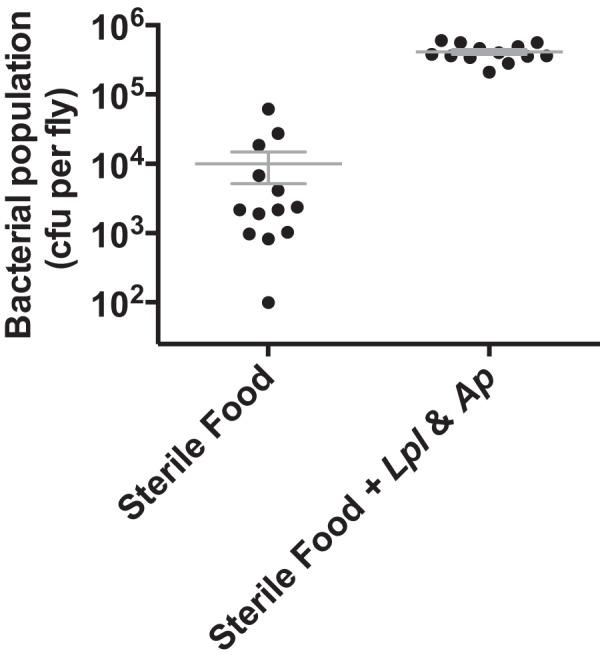
Maintenance of the Drosophila microbiome requires frequent consumption of bacteria. Cultured populations of Acetobacter and Lactobacillus spp. in conventionally reared flies introduced into environments with or without exogenous bacteria. Sixteen-day-old flies were transferred twice daily to sterile food or sterile food amended with A. pasteurianus and L. plantarum. Three to five female Drosophila were sampled every 3rd day for 9 days after transfer to either environment. Data points represent the mean total bacterial population (Lactobacillus and Acetobacter spp.) ± the standard error of the mean in flies sampled on days 3, 6, and 9. An unpaired two-tailed t test revealed significant differences (P < 0.0001) between bacterial populations under the two rearing regimens.
FIG 4
FIG 4
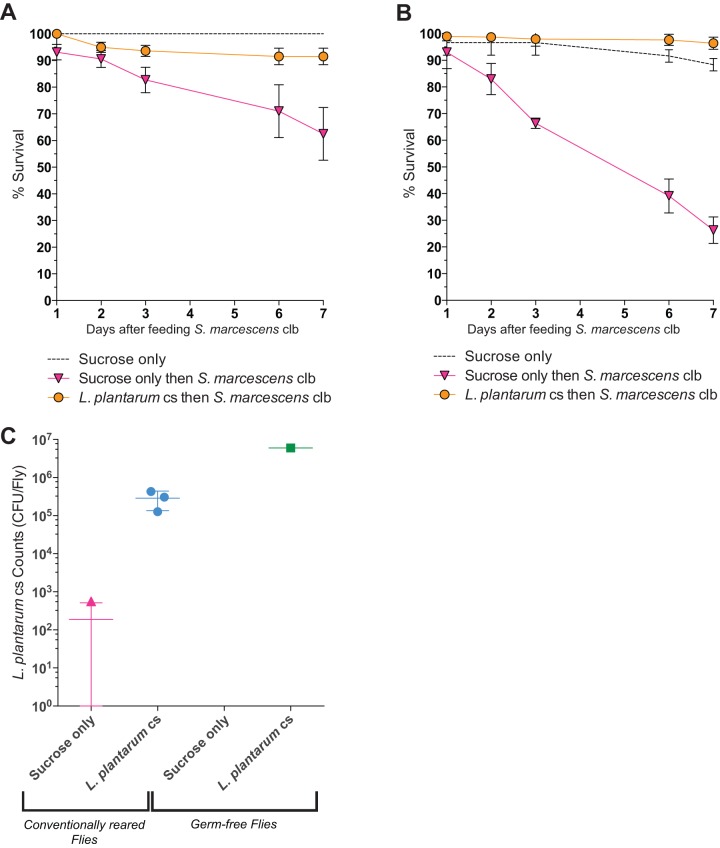
Lactobacillus plantarum protects flies from Serratia marcescens infection. (A and B) Conventionally reared (A) or germfree (B) flies were fed L. plantarum for 3 days prior to S. marcescens challenge. Flies were fed a sucrose suspension of S. marcescens for 2 days and then transferred to clean bottles with sterile sucrose solution. Fly mortality was recorded over time. n was 20 flies per treatment. Error bars represent the standard deviation of the mean for three replicate groups per treatment. (C) Cultured populations of L. plantarum in conventionally reared and germfree flies were measured 3 days after feeding. L. plantarum cs is an isolate from Canton-S Drosophila in our laboratory; S. marcescens clb is an isolate from cottonwood leaf beetle.
FIG 5
FIG 5
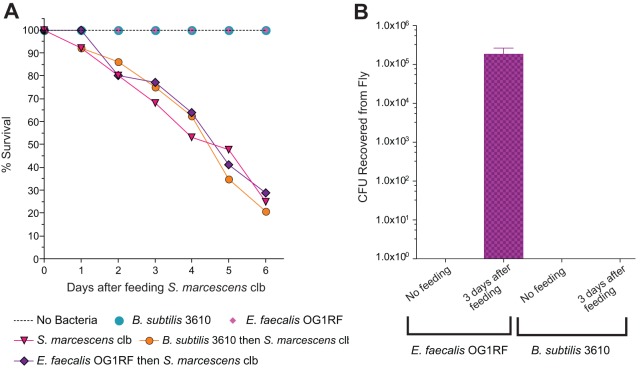
Enterococcus faecalis and Bacillus subtilis do not protect flies from Serratia marcescens infection. (A) Conventionally reared flies were fed E. faecalis or B. subtilis for 3 days prior to S. marcescens challenge. Flies were fed a sucrose solution containing S. marcescens for 2 days and then transferred to clean bottles with sterile sucrose solution. Fly mortality was recorded over time. n was 20 flies per treatment. (B) Conventionally reared flies were fed E. faecalis, B. subtilis, or sterile sucrose solution (“no feeding”) for 3 days. Cultured populations of E. faecalis or B. subtilis were measured 3 days after feeding. n was 20 per treatment; data from one representative of three experiments are shown. Error bars represent the standard deviation of the mean of five flies.
FIG 6
FIG 6
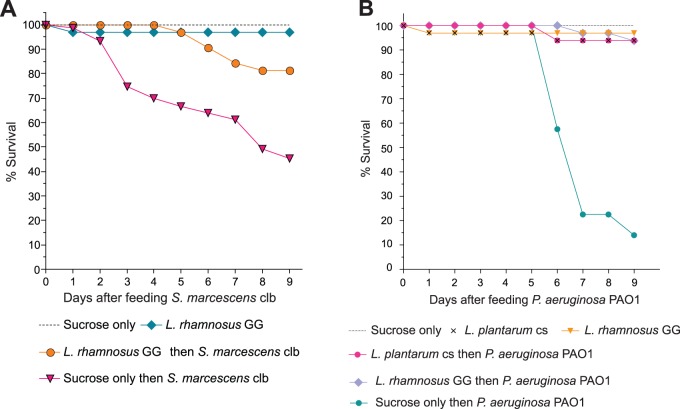
The probiotic fly model extends to other probiotics and pathogens. Lactobacillus plantarum and L. rhamnosus GG reduce fly death from Serratia marcescens and Pseudomonas aeruginosa when fed prior to infection. (A) Conventionally reared flies were fed L. rhamnosus GG for 3 days prior to S. marcescens challenge. Flies were fed a sucrose suspension of S. marcescens for 2 days and then transferred to clean bottles with sterile sucrose solution. Fly mortality was recorded over time. n was 20 per treatment; one representative experiment of three is shown. (B) Conventionally reared flies were fed L. plantarum or L. rhamnosus GG for 3 days prior to P. aeruginosa challenge. Flies were fed a sucrose suspension of P. aeruginosa for the duration of the assay. Fly mortality was recorded over time. n was 20 per treatment; data from one representative of three experiments are shown.

References

    1. Morgan XC, Segata N, Huttenhower C. 2013. Biodiversity and functional genomics in the human microbiome. Trends Genet. 29:51–58 - PMC - PubMed
    1. Microbiome Human, Project Consortium 2012. Structure, function and diversity of the healthy human microbiome. Nature 486:207–214 - PMC - PubMed
    1. Venema K. 2010. Role of gut microbiome in the control of energy and carbohydrate metabolism. Curr. Opin. Clin. Nutr. Metab. Care 13:432–438 - PubMed
    1. Hooper LV, Midtvedt T, Gordon JI. 2002. How host-microbial interactions shape the nutrient environment of the mammalian intestine. Annu. Rev. Nutr. 22:283–307 - PubMed
    1. Ivanov II, Atarashi K, Manel N, Brodie EL, Shima T, Karaoz U, Wei D, Goldfarb KC, Santee CA, Lynch SV, Tanoue T, Imaoka A, Itoh K, Takeda K, Umesaki Y, Honda K, Littman DR. 2009. Induction of intestinal Th17 cells by segmented filamentous bacteria. Cell 139:485–498 - PMC - PubMed

Publication types

LinkOut - more resources