


Friedreich's ataxia, frataxin, PIP5K1B: echo of a distant fracas
- PMID: 24194977
- PMCID: PMC3806116
- DOI: 10.1155/2013/725635
Friedreich's ataxia, frataxin, PIP5K1B: echo of a distant fracas
Abstract
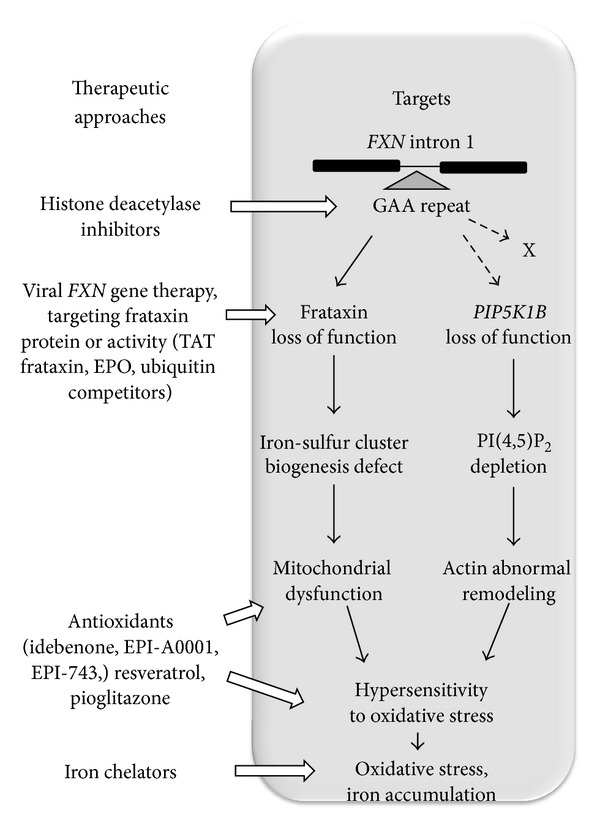
"Frataxin fracas" were the words used when referring to the frataxin-encoding gene (FXN) burst in as a motive to disqualify an alternative candidate gene, PIP5K1B, as an actor in Friedreich's ataxia (FRDA) (Campuzano et al., 1996; Cossee et al., 1997; Carvajal et al., 1996). The instrumental role in the disease of large triplet expansions in the first intron of FXN has been thereafter fully confirmed, and this no longer suffers any dispute (Koeppen, 2011). On the other hand, a recent study suggests that the consequences of these large expansions in FXN are wider than previously thought and that the expression of surrounding genes, including PIP5K1B, could be concurrently modulated by these large expansions (Bayot et al., 2013). This recent observation raises a number of important and yet unanswered questions for scientists and clinicians working on FRDA; these questions are the substratum of this paper.
Figures


References
-
- Harding AE. Friedreich’s ataxia: a clinical and genetic study of 90 families with an analysis of early diagnostic criteria and intrafamilial clustering of clinical features. Brain. 1981;104(3):589–620. - PubMed
-
- Dürr A, Cossee M, Agid Y, et al. Clinical and genetic abnormalities in patients with Friedreich’s ataxia. The New England Journal of Medicine. 1996;335(16):1169–1175. - PubMed
-
- Bidichandani SI, Delatycki MB. Friedreich ataxia. In: Pagon RA, Adam MP, Bird TD, Dolan CR, Fong CT, Stephens K, editors. GeneReviews. 1993–2012. Seattle, Wash, USA: University of Washington; 1998. - PubMed
-
- de Castro M, García-Planells J, Monrós E, et al. Genotype and phenotype analysis of Friedreich’s ataxia compound heterozygous patients. Human Genetics. 2000;106(1):86–92. - PubMed
Publication types
MeSH terms
Substances
LinkOut - more resources
Full Text Sources
Other Literature Sources
Medical
