Review
. 2013 Nov 6:11:282.
doi: 10.1186/1479-5876-11-282.

Cariporide and other new and powerful NHE1 inhibitors as potentially selective anticancer drugs--an integral molecular/biochemical/metabolic/clinical approach after one hundred years of cancer research

Affiliations
Review

Cariporide and other new and powerful NHE1 inhibitors as potentially selective anticancer drugs--an integral molecular/biochemical/metabolic/clinical approach after one hundred years of cancer research

Salvador Harguindey et al. J Transl Med. .

Abstract

In recent years an increasing number of publications have emphasized the growing importance of hydrogen ion dynamics in modern cancer research, from etiopathogenesis and treatment. A proton [H+]-related mechanism underlying the initiation and progression of the neoplastic process has been recently described by different research groups as a new paradigm in which all cancer cells and tissues, regardless of their origin and genetic background, have a pivotal energetic and homeostatic disturbance of their metabolism that is completely different from all normal tissues: an aberrant regulation of hydrogen ion dynamics leading to a reversal of the pH gradient in cancer cells and tissues (↑pHi/↓pHe, or "proton reversal"). Tumor cells survive their hostile microenvironment due to membrane-bound proton pumps and transporters, and their main defensive strategy is to never allow internal acidification because that could lead to their death through apoptosis. In this context, one of the primary and best studied regulators of both pHi and pHe in tumors is the Na+/H+ exchanger isoform 1 (NHE1). An elevated NHE1 activity can be correlated with both an increase in cell pH and a decrease in the extracellular pH of tumors, and such proton reversal is associated with the origin, local growth, activation and further progression of the metastatic process. Consequently, NHE1 pharmaceutical inhibition by new and potent NHE1 inhibitors represents a potential and highly selective target in anticancer therapy. Cariporide, being one of the better studied specific and powerful NHE1 inhibitors, has proven to be well tolerated by humans in the cardiological context, however some side-effects, mainly related to drug accumulation and cerebrovascular complications were reported. Thus, cariporide could become a new, slightly toxic and effective anticancer agent in different human malignancies.


Figures
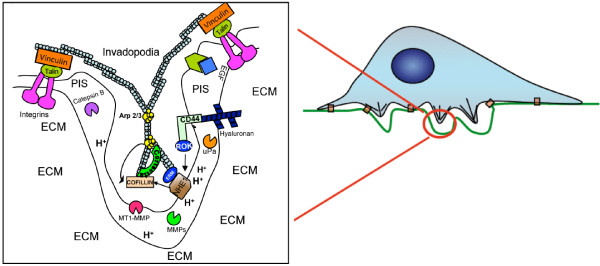
Figure 1
Figure 1
Model of localization and role of NHE1 in invadopodia. The insert is a magnification of the F-actin-enriched cellular protrusions into the ECM that are responsible for ECM degradation and are known as invadopodia. Invadopodia formation is activated by integrin binding to the ECM and their activity further increased through the CD44 (activated by its ligand Hyaluronan) and EGFR receptors located in the membrane. The integrin receptors are connected to the cytoskeleton (blue circles) through the proteins Talin and Vinculin. The proteases cathepsin B, D and L, Urokinase Plasminogen Activator and the matrix metalloproteinases MMP-2 and MMP-9 are released extracellularly while the MT1-MMP is localized within the membrane and participates together with Cathepsin B in the processing of inactive pro-MMP-2 into active MMP-2. Glycolytic enzymes are enriched in invadopodia, leading to the localized production of protons. These protons are secreted via an active NHE1 that is recruited to the invadopodia through integrin binding and further stimulated by CD44 and EGFR. NHE1 with its two functions (scaffolding protein and ion exchanger) leads to membrane protrusion and proteolysis. As a proton transporter, NHE1 promotes invasion through its control of the acidification of the peri-invadopodial space where NHE1 proton secreting activity and proteases act in concert to degrade the ECM during invasion. Further, the NHE1-dependent alkalinization of the invadopodia cytosol results in a phosphorylation of cortactin with the subsequent release of cofilin which promotes actin polymerization, growth of the invadopodia cytoskeleton and invadopodia protrusion. Secondly, NHE1 also promotes invadopodial formation via its interaction with the cytoskeleton through its binding to the actin anchoring protein, ezrin, which, reciprocally is responsible for the localization of NHE1 to the invadopodia in response to ECM and growth factor receptor activation. PIS: PeriInvadopodia Space; ECM: ExtraCellular Matrix. Please see text for discussion and references.
Figure 2
Figure 2
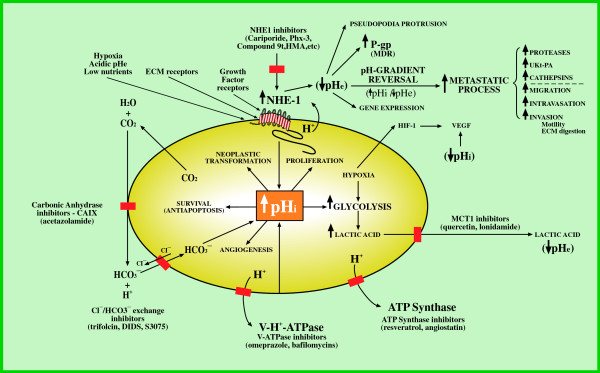
Dysregulated pH-control systems in cancer cells. Targets for proton transport inhibitors (PTIs) as anticancer agents. Nos. 1, 2, 3, 4, 5 and 6: Mechanisms that induce intracellular alkalinisation as the key factor in cell transformation and progression with its secondary abnormalities. Secondary pHi-dependent extracellular acidification, pH-gradient reversal and hypoxia as triggers for the metastatic process. Five targets for inhibition of proton extrusion of cancer cells as targets for metabolically-directed anticancer treatment and examples of drugs of the different proton transport inhibitors at the sites of their activity. For further details see text and ref. [5] Abbreviations: NHE1: Na+/H+ exchanger: HMA; 5-(N,N-hexamethylene)-amiloride; Phx-3: 2-aminophenoxazine-3-one; Compound 9 t: 5-aryl-4-(4-(5-methyl-1H-imidazol-4-yl) piperididn-1-yl)pyrimidine analog; HIF-1: hypoxia-inducible factor; MCT1: monocarboxylate transporter or H+-lactate co-transporter; CAIX: carbonic anhydrase IX; V-H+-ATPase: vacuolar H+-ATPase; VEGF: vasoendothelial growth factor; UKT-PA: urokinase-type plasminogen activator; P-gp: P-glycoprotein; MDR: multiple drug resistance; pHi: intracellular pH; pHe: extracellular/interstitial tumoral pH.
Figure 3
Figure 3
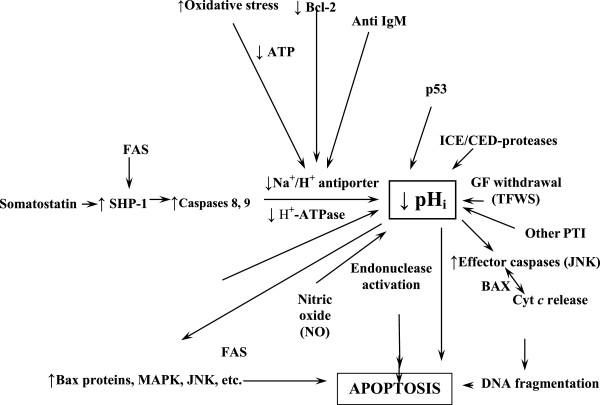
Intracellular signaling factors and mechanisms targeting pHi and the Na+/H+ exchanger in the apoptosis of cancer cells. This integrated and homeostatic pH-related perspective can help to foretell pro-apoptotic and anti-apoptotic factors in order to find synergistic therapies and potential antagonisms (MDR) in anticancer treatment. Abbreviations: ↑: Stimulation; ↓: inhibition; SST: somatostatin; SHP1: protein tyrosine phosphatase; MDR: multiple drug resistance; GFs: growth factors; Cyt C: cytochrome C; NO: nitric oxide. TFWS: trophic factor withdrawal syndrome; αCD95 (Fas/Apo-1) death receptor; JNK: Jun-terminal kinase; MAPK: mitogen-activated protein kinase; PTI: proton transport inhibitors; ICE: interleukin-1β-converting enzyme. (For further details, see text and refs. [5,29,30]. (Modified from refs. [5,29] by permission from Dove Medical Press, Ltd., and Anticancer Research).
Figure 4
Figure 4
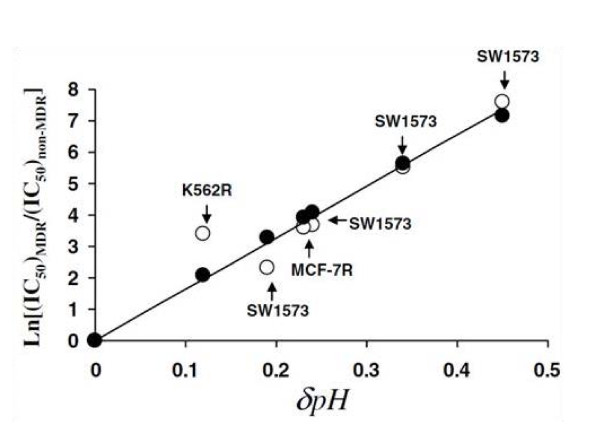
Impact of the changes in intracellular pH on doxorubicin resistance in different cancer cells. Multidrug resistance in cancer has been associated with the alkalization of the cytosol due to overexpression of proton pumps at the level of the cell membrane and/or expression of drug transporters. In this context it is believed that weak base drugs are protonated and as a result cannot cross the membrane bilayer, a feature that adds to the efficiency of drug transporters. Albeit this model (drug protonation and transporter) has been used over decades, the high pH of the cytosol can drive drug resistance through a different mechanism. The hypothesis made by us was that the change in cytosolic pH makes the membrane less permeable to drugs due to hydrogen-lipid interactions. To test this, a model of hydrogen-lipid interaction was formulated and compared with experimental data. In the figure the X-axis represents the positive increment in the cytosolic pH when cells switch their state from being sensitive to resistant to drugs. The Y-axis represents the ratio of the logarithm values of the concentration of drugs to kill 50% drug resistant vs. sensitive cells. The blank dots represent the experimental data. The black dots show the result expected from the theoretical modelling. The straight line represents the linear trend (best fit) from experimental data. Finally, the best fit passes across all the dots modelled by the theory. For further details see ref. [169].

References

    1. Cardone RA, Casavola V, Reshkin SJ. The role of disturbed pH dynamics and the Na+/H+ exchanger in metastasis. Nat Rev Cancer. 2005;5:786–795. doi: 10.1038/nrc1713. - DOI - PubMed
    1. Webb BA, Chimenti M, Jacobson MP, Barber DL. Dysregulated pH: a perfect storm for cancer progression. Nat Rev Cancer. 2011;11:671–677. doi: 10.1038/nrc3110. - DOI - PubMed
    1. Neri D, Supuran CT. Interfering with pH regulation in tumours as a therapeutic strategy. Nat Rev Drug Discov. 2011;10:767–777. doi: 10.1038/nrd3554. - DOI - PubMed
    1. Reshkin SJ, Cardone RA, Harguindey S. Na+-H+ exchanger, pH regulation and cancer. Recent Pat Anticancer Drug Discov. 2013;8:85–99. - PubMed
    1. Harguindey S, Arranz JL, Wahl ML, Orive G, Reshkin SJ. Proton transport inhibitors as potentially selective anticancer drugs. Anticancer Res. 2009;29:2127–2136. - PubMed

Publication types

MeSH terms