


The neuronal code(s) of the cerebellum
- PMID: 24198351
- PMCID: PMC3818542
- DOI: 10.1523/JNEUROSCI.2759-13.2013
The neuronal code(s) of the cerebellum
Abstract
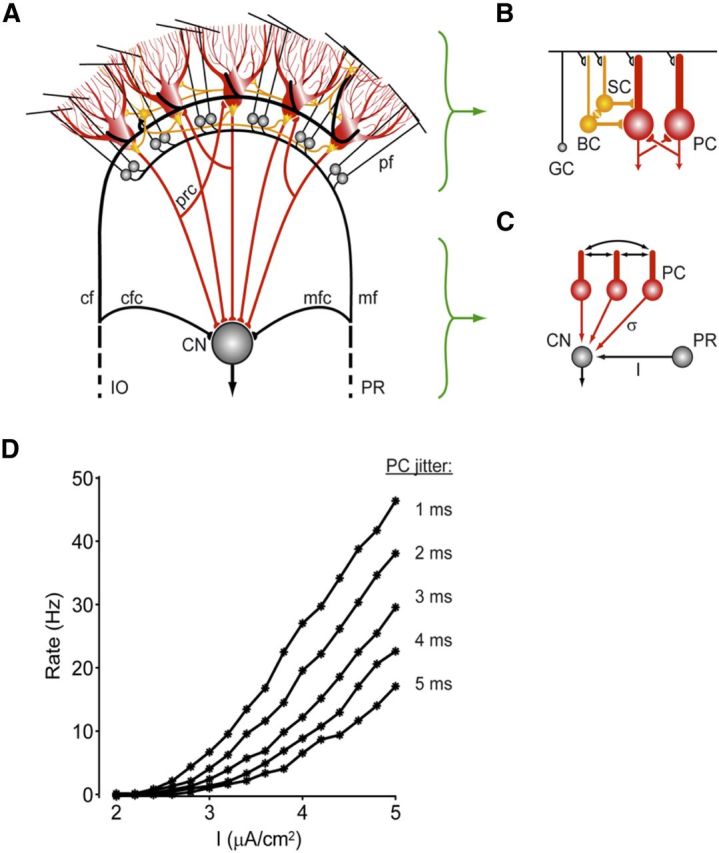
Understanding how neurons encode information in sequences of action potentials is of fundamental importance to neuroscience. The cerebellum is widely recognized for its involvement in the coordination of movements, which requires muscle activation patterns to be controlled with millisecond precision. Understanding how cerebellar neurons accomplish such high temporal precision is critical to understanding cerebellar function. Inhibitory Purkinje cells, the only output neurons of the cerebellar cortex, and their postsynaptic target neurons in the cerebellar nuclei, fire action potentials at high, sustained frequencies, suggesting spike rate modulation as a possible code. Yet, millisecond precise spatiotemporal spike activity patterns in Purkinje cells and inferior olivary neurons have also been observed. These results and ongoing studies suggest that the neuronal code used by cerebellar neurons may span a wide time scale from millisecond precision to slow rate modulations, likely depending on the behavioral context.
Figures
References
-
- Albus JS. A theory of cerebellar function. Math Biosci. 1971;10:25–61. doi: 10.1016/0025-5564(71)90051-4. - DOI
Publication types
MeSH terms
Grants and funding
LinkOut - more resources
Full Text Sources
Other Literature Sources
