


Flexibility is not Related to Stretch-Induced Deficits in Force or Power
- PMID: 24198679
- PMCID: PMC3818672
Flexibility is not Related to Stretch-Induced Deficits in Force or Power
Abstract
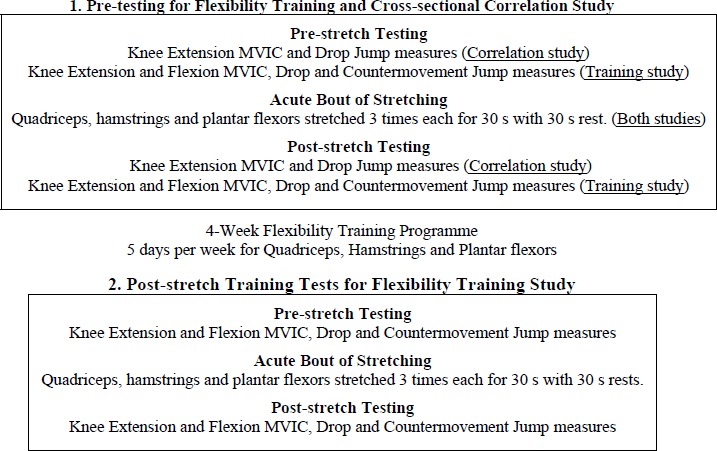
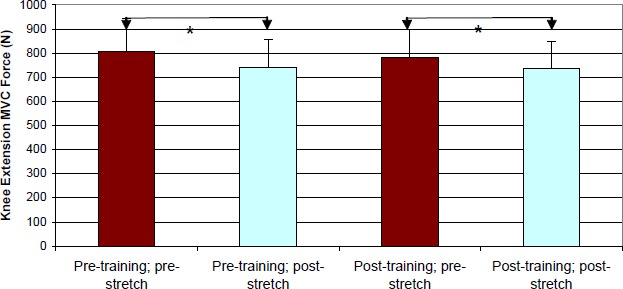
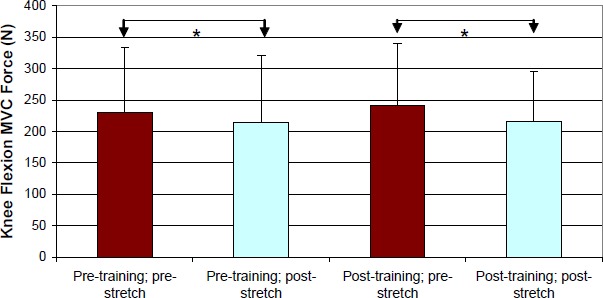
Previous studies have demonstrated that an acute bout of static stretching may cause significant performance impairments. However, there are no studies investigating the effect of prolonged stretch training on stretch-induced decrements. It was hypothesized that individuals exhibiting a greater range of motion (ROM) in the correlation study or those who attained a greater ROM with flexibility training would experience less stretch-induced deficits. A correlation study had 18 participants (25 ± 8.3 years, 1.68 ± 0.93 m, 73.5 ± 14.4 kg) stretch their quadriceps, hamstrings and plantar flexors three times each for 30 s with 30 s recovery. Subjects were tested pre- and post-stretch for ROM, knee extension maximum voluntary isometric contraction (MVIC) force and drop jump measures. A separate training study with 12 subjects (21.9 ± 2.1 years, 1.77 ± 0.11 m 79.8 ± 12.4 kg) involved a four-week, five-days per week, flexibility training programme that involved stretching of the quadriceps, hamstrings and plantar flexors. Pre- and post-training testing included ROM as well as knee extension and flexion MVIC, drop and countermovement jump measures conducted before and after an acute bout of stretching. An acute bout of stretching incurred significant impairments for knee extension (-6.1% to -8.2%; p < 0.05) and flexion (-6.6% to -10.7%; p < 0.05) MVIC, drop jump contact time (5.4% to 7.4%; p < 0.01) and countermovement jump height (-5.5% to -5.7%; p < 0.01). The correlation study showed no significant relationship between ROM and stretch-induced deficits. There was also no significant effect of flexibility training on the stretch-induced decrements. It is probable that because the stretches were held to the point of discomfort with all testing, the relative stress on the muscle was similar resulting in similar impairments irrespective of the ROM or tolerance to stretching of the muscle. Key PointsA correlation and training study were used to examine the effects of increased range of motion on stretch-induced changes in force and jump measuresAn acute bout of stretching incurred significant impairments for knee extension and flexion MVIC, drop jump contact time and countermovement jump height.Neither study showed any significant relationship between ROM and stretch-induced deficits.
Keywords: Flexibility; force; jumps; static stretching.
Figures
References
-
- Alter M.J. (1996) Science of Flexibility. Human Kinetics Publ. Windsor, Ontario, Canada: 123-156
-
- Avela J., Kyröläinen H., Komi P.V. (1999) Altered reflex sensitivity after repeated and prolonged passive muscle stretching. Journal of Applied Physiology 86, 1283-1291 - PubMed
-
- Bandy W.D., Irion J.M. (1994) The effect of time on the static stretch of the hamstrings muscles. Physical Therapy 74, 845-850 - PubMed
-
- Bandy W.D., Irion J.M, Briggler M. (1997) The effect of time and frequency of static stretching on flexibility of the hamstring muscles. Physical Therapy 77, 1090-1096 - PubMed
-
- Behm D.G., Bambury A., Cahill F., Power K. (2004) Effect of acute static stretching on force, balance, reaction time, and movement time. Medicine and Science in Sports and Exercise 36, 1397-1402 - PubMed
LinkOut - more resources
Full Text Sources
Medical