Review
. 2013 Oct 31:4:434.
doi: 10.3389/fpls.2013.00434.

Understanding the roles of the thylakoid lumen in photosynthesis regulation

Affiliations
Review

Understanding the roles of the thylakoid lumen in photosynthesis regulation

Sari Järvi et al. Front Plant Sci. .

Abstract

It has been known for a long time that the thylakoid lumen provides the environment for oxygen evolution, plastocyanin-mediated electron transfer, and photoprotection. More recently lumenal proteins have been revealed to play roles in numerous processes, most often linked with regulating thylakoid biogenesis and the activity and turnover of photosynthetic protein complexes, especially the photosystem II and NAD(P)H dehydrogenase-like complexes. Still, the functions of the majority of lumenal proteins in Arabidopsis thaliana are unknown. Interestingly, while the thylakoid lumen proteome of at least 80 proteins contains several large protein families, individual members of many protein families have highly divergent roles. This is indicative of evolutionary pressure leading to neofunctionalization of lumenal proteins, emphasizing the important role of the thylakoid lumen for photosynthetic electron transfer and ultimately for plant fitness. Furthermore, the involvement of anterograde and retrograde signaling networks that regulate the expression and activity of lumen proteins is increasingly pertinent. Recent studies have also highlighted the importance of thiol/disulfide modulation in controlling the functions of many lumenal proteins and photosynthetic regulation pathways.

Keywords: NAD(P)H dehydrogenase; photosystem; proteome; thioredoxin; thylakoid lumen.


Figures
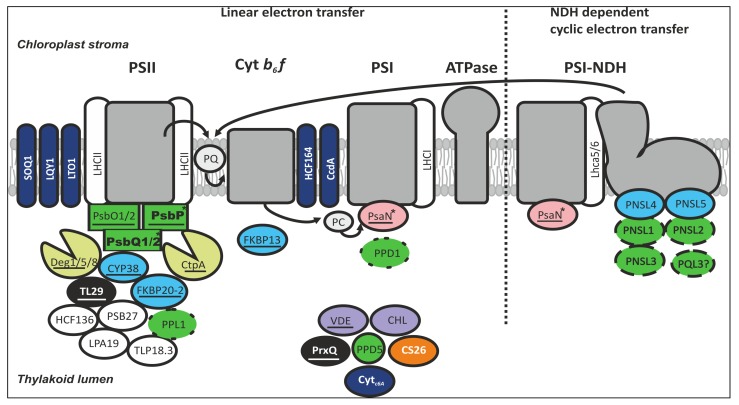
FIGURE 1
FIGURE 1
The majority of thylakoid lumen proteins with experimentally verified roles are involved in the function of either the PSII complex or the PSI–NDH supercomplex. The most abundant protein families in the thylakoid lumen are the OEC and OEC-like proteins (green), the immunophilins (blue), and proteases (yellow). In addition, the lumen proteome comprises peroxidases (black), photoprotective enzymes (purple), and several auxiliary proteins. The OEC proteins are proposed to function in water oxidation (square boxes), granal stacking (bolded), photosystem assembly (dotted outline), strigolactone biosynthesis (circle box), and NDH-dependent cyclic electron transfer (dashed outline). A high proportion of lumen proteins are thioredoxin targets (underlined). Regulation of thylakoid redox reactions involves membrane-embedded and soluble proteins (dark blue), and other lumen proteins are also implicated (white typeface). Lumen proteins with phosphorylation sites (asterisked) may be regulated by TLP18.3 phosphatase. Based on current knowledge, verified components of lumenal NDH subcomplex are not under post-translational regulation. No characterized lumenal proteins have so far been linked to the function of ATP synthase.
FIGURE 2
FIGURE 2
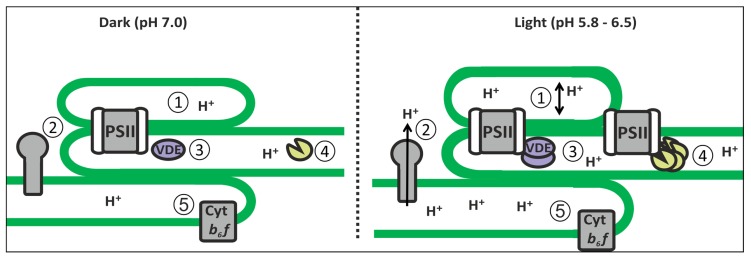
Lumenal processes under pH regulation. (1) Light-induced expansion of the lumen volume facilitating plastocyanin migration and (2) enhancement of ATP synthase activity; (3) Light-induced activation of VDE and PsbS by protonation for photoprotection; (4) Deg oligomerization for PSII repair; and (5) induction of photosynthetic control via cyt b6f.

References

    1. Albiniak A. M., Baglieri J., Robinson C. (2012). Targeting of lumenal proteins across the thylakoid membrane. J. Exp. Bot. 63 1689–1698 10.1093/jxb/err444 - DOI - PubMed
    1. Allahverdiyeva Y., Suorsa M., Rossi F., Pavesi A., Kater M. M., Antonacci A., et al. (2013). Arabidopsis plants lacking PsbQ and PsbR subunits of the oxygen-evolving complex show altered PSII super-complex organization and short-term adaptive mechanisms. Plant J. 75 671–684 10.1111/tpj.12230 - DOI - PubMed
    1. Anbudurai P. R., Mor T. S., Ohad I., Shestakov S. V., Pakrasi H. B. (1994). The ctpA gene encodes the C-terminal processing protease for the D1 protein of the photosystem II reaction center complex. Proc. Natl. Acad. Sci. U.S.A. 91 8082–8086 10.1073/pnas.91.17.8082 - DOI - PMC - PubMed
    1. Arnoux P., Morosinotto T., Saga G., Bassi R., Pignol D. (2009). A structural basis for the pH-dependent xanthophyll cycle in Arabidopsis thaliana. Plant Cell 21 2036–2044 10.1105/tpc.109.068007 - DOI - PMC - PubMed
    1. Baena-González E., Aro E. M. (2002). Biogenesis, assembly and turnover of photosystem II units. Philos. Trans. R. Soc. Lond. B Biol. Sci. 357 1451–1460 10.1098/rstb.2002.1141 - DOI - PMC - PubMed