


Review
doi: 10.1155/2013/560105.
Epub 2013 Oct 2.
Hepatitis delta virus: a peculiar virus
Affiliations
- PMID: 24198831
- PMCID: PMC3807834
- DOI: 10.1155/2013/560105
Item in Clipboard
Review
Hepatitis delta virus: a peculiar virus
Adv Virol.
2013.
Abstract
The hepatitis delta virus (HDV) is distributed worldwide and related to the most severe form of viral hepatitis. HDV is a satellite RNA virus dependent on hepatitis B surface antigens to assemble its envelope and thus form new virions and propagate infection. HDV has a small 1.7 Kb genome making it the smallest known human virus. This deceivingly simple virus has unique biological features and many aspects of its life cycle remain elusive. The present review endeavors to gather the available information on HDV epidemiology and clinical features as well as HDV biology.
Figures
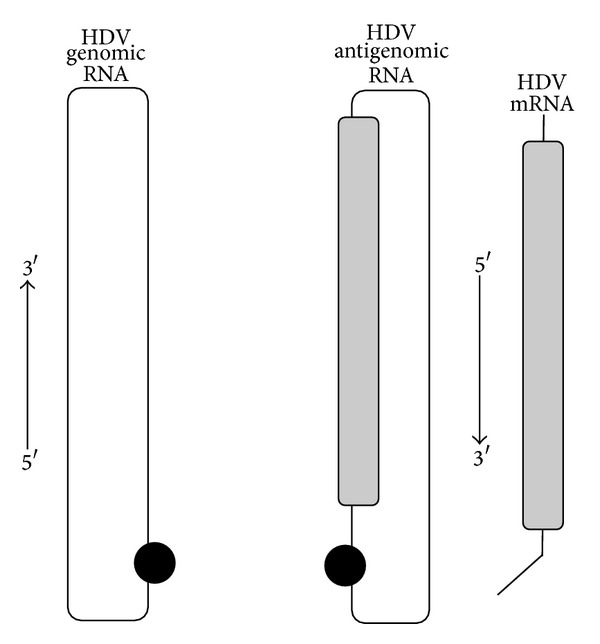
Schematic representation of three HDV RNA species. The HDV genomic RNA is a single-stranded circular RNA with ~1700 nucleotides. It forms an unbranched rod-like structure due to intramolecular base pairing. The HDV antigenomic RNA is the exact complement of the genomic RNA, and both RNAs have site-specific ribozymes indicated by the black circle. The HDV antigenomic RNA contains the open reading frame for the delta antigen, represented in grey, but the antigen is translated from another RNA species, the mRNA. The mRNA is ~800 nucleotides long with a 5′-cap and a 3′-polyadenylated tail.
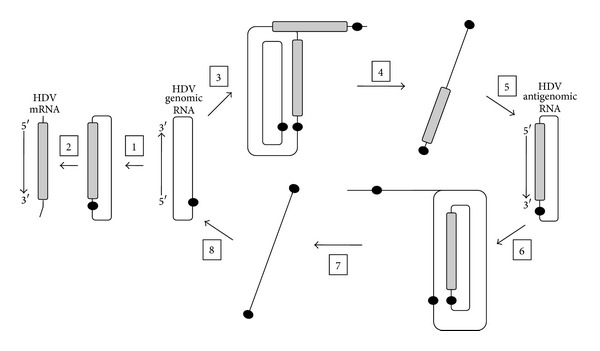
Model of HDV replication through a rolling-circle mechanism. The HDV genomic RNA is used as a template for the precursors of HDV mRNA (Steps 1-2) and also acts as a template for multimeric RNAs of antigenomic polarity (Step 3). These multimeric RNAs contain at least two copies of the HDV ribozyme and are thus self-cleaved to produce linear unit-length HDV antigenomes (Step 4), which are then ligated to produce circular antigenomic RNA (Step 5). In turn, the new antigenomic RNA is a template for multimeric RNAs of genomic polarity (Step 6) that are similarly self-cleaved and subsequently ligated to produce new circular genomic RNA (Steps 7-8).

Functional domains of S-HDAg and L-HDAg. The delta antigens share most of their sequence differing only in the 19-amino-acid extension at the C-terminal of L-HDAg. They have, within the common sequence, as represented, a coiled-coil domain (CCD), a nuclear localization signal (NLS), and an RNA binding domain (RBD). Also indicated on L-HDAg are the nuclear export signal (NES) and the unique cysteine, residue 211, which is the target for farnesylation. The numbers indicate the position of the amino acid residues.
References
-
- Rizzetto M. Hepatitis D: thirty years after. Journal of Hepatology. 2009;50(5):1043–1050. - PubMed
-
- Murphy FA. Virus taxonomy. In: Fields BN, Knipe DM, Howley PM, editors. Fields Virology. 3rd edition. Vol. 2. 1996. pp. 15–57.
-
- Rizzetto M, Ciancio A. Epidemiology of hepatitis D. Seminars in Liver Disease. 2012;32(3):211–219. - PubMed
-
- Bahcecioglu IH, Aygun C, Gozel N, Poyrazoglu OK, Bulut Y, Yalniz M. Prevalence of hepatitis delta virus (HDV) infection in chronic hepatitis B patients in eastern Turkey: still a serious problem to consider. Journal of Viral Hepatitis. 2011;18(7):518–524. - PubMed
Publication types
LinkOut - more resources
Full Text Sources
Other Literature Sources
