Convergence and rate analysis of neural networks for sparse approximation
- PMID: 24199030
- PMCID: PMC3816963
- DOI: 10.1109/TNNLS.2012.2202400
Convergence and rate analysis of neural networks for sparse approximation
Erratum in
- IEEE Trans Neural Netw Learn Syst. 2014 Aug;25(8):1595-6
Abstract
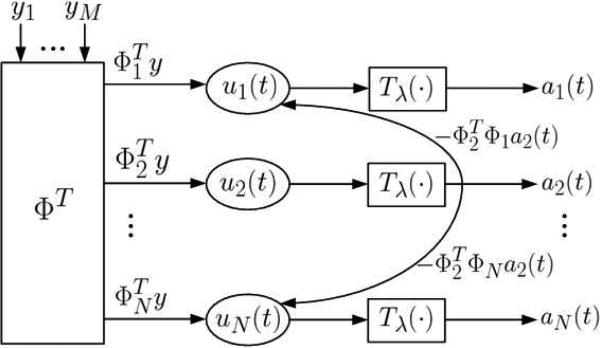
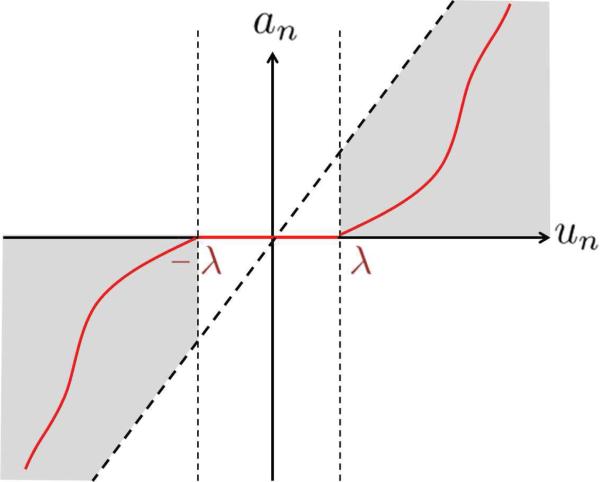
We present an analysis of the Locally Competitive Algorithm (LCA), which is a Hopfield-style neural network that efficiently solves sparse approximation problems (e.g., approximating a vector from a dictionary using just a few nonzero coefficients). This class of problems plays a significant role in both theories of neural coding and applications in signal processing. However, the LCA lacks analysis of its convergence properties, and previous results on neural networks for nonsmooth optimization do not apply to the specifics of the LCA architecture. We show that the LCA has desirable convergence properties, such as stability and global convergence to the optimum of the objective function when it is unique. Under some mild conditions, the support of the solution is also proven to be reached in finite time. Furthermore, some restrictions on the problem specifics allow us to characterize the convergence rate of the system by showing that the LCA converges exponentially fast with an analytically bounded convergence rate. We support our analysis with several illustrative simulations.
Figures



References
-
- Balavoine A, Rozell CJ, Romberg J. Global convergence of the locally competitive algorithm. Proc. IEEE Digital Signal Process. Workshop. 2011 Jan;:431–436.
-
- Elad M, Figueiredo MAT, Ma Y. On the role of sparse and redundant representations in image processing. Proc. IEEE. 2010 Jun;98(6):972–982.
-
- Olshausen BA, Field DJ. Sparse coding of sensory inputs. Current Opinion Neurobiol. 2004 Aug;14(4):481–487. - PubMed
-
- Olshausen BA, Field DJ. Emergence of simple-cell receptive field properties by learning a sparse code for natural images. Nature. 1996 Jun.381(6583):607–609. - PubMed
-
- Olshausen BA, Field DJ. Sparse coding with an overcomplete basis set: A strategy employed by V1? Vis. Res. 1997 Dec.37(23):3311–3325. - PubMed
Publication types
MeSH terms
Grants and funding
LinkOut - more resources
Full Text Sources
Other Literature Sources
Research Materials