


Item response theory analyses of DSM-IV and DSM-5 stimulant use disorder criteria in an American Indian community sample
- PMID: 24200103
- PMCID: PMC3915779
- DOI: 10.1016/j.drugalcdep.2013.10.010
Item response theory analyses of DSM-IV and DSM-5 stimulant use disorder criteria in an American Indian community sample
Abstract
Background: Native Americans experience some of the highest rates of DSM-IV stimulant dependence (SD) of all U.S. ethnic groups. This report compares DSM-IV and DSM-5 stimulant use disorder (SUD) diagnostic criteria in an American Indian community sample.
Methods: Demographic information, stimulant (methamphetamine or cocaine) use, and lifetime DSM-IV and DSM-5 diagnoses were assessed in 858 adult American Indians. Item Response Theory (IRT) analyses were used to assess SUD criteria in both DSM-IV and DSM-5 criteria sets along an underlying latent trait severity continuum and the effect of demographic variables on differential item functioning (DIF) in those criteria.
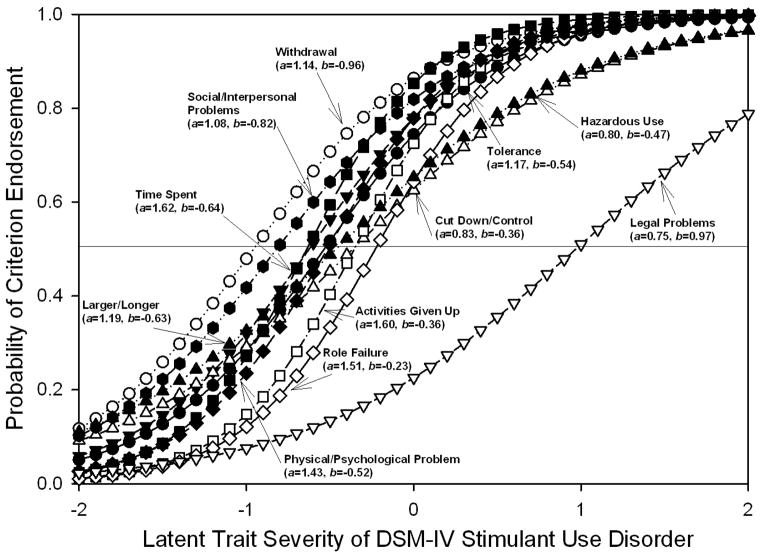
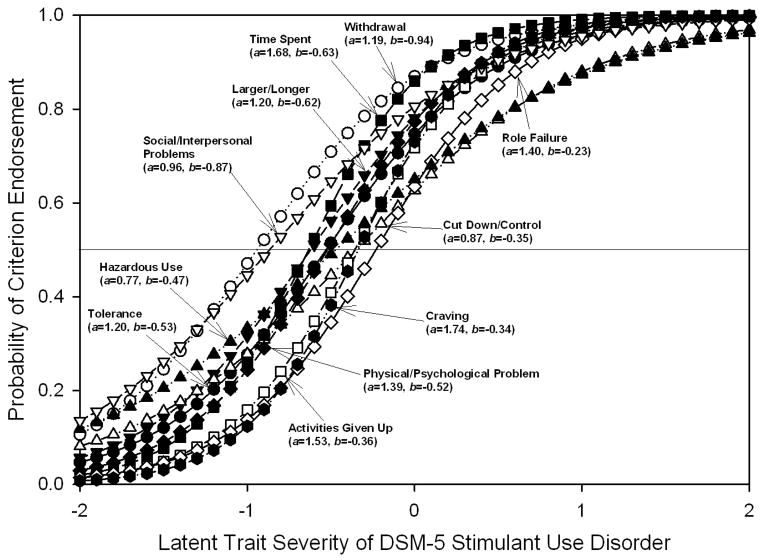
Results: The overall rate of DSM-IV SD was 33%, of DSM-IV SUD was 38%, and of DSM-5 SUD was 36% with no gender differences. All SUD symptoms in both the DSM-IV and DSM-5 datasets functioned on the moderate portion of the underlying severity continuum. "Craving" discriminated better than any other criterion at its level of severity in indicating the presence or absence of SUD. There was little DIF in groups defined by gender or any other demographic variable in either the DSM-IV or DSM-5 datasets.
Conclusions: These findings indicate that in this American Indian sample, diagnostic criteria for DSM-IV and DSM-5 SUD function similarly in terms of severity and DIF and that the abolition of the DSM-IV distinction between stimulant abuse and dependence in DSM-5 is warranted.
Keywords: American Indians; DSM-5; DSM-IV; Stimulant Use Disorders.
Copyright © 2013 Elsevier Ireland Ltd. All rights reserved.
Conflict of interest statement
All authors declare that there are no conflicts of interest.
Figures
References
-
- American Psychiatric Association, Task Force on DSM-IV. Diagnostic and statistical manual of mental disorders (DSM-IV) American Psychiatric Association; Washington, DC: 1994.
-
- American Psychiatric Association. Diagnostic and statistical manual of mental disorders (DSM-5) 5. American Psychiatric Publishing; Washington, DC: 2013.
-
- Bucholz KK, Cadoret R, Cloninger CR, Dinwiddie SH, Hesselbrock VM, Nurnberger JI, Jr, Reich T, Schmidt I, Schuckit MA. A new, semi-structured psychiatric interview for use in genetic linkage studies: a report on the reliability of the SSAGA. J Stud Alcohol. 1994;55:149–158. - PubMed
-
- Compton WM, Grant BF, Colliver JD, Glantz MD, Stinson FS. Prevalence of marijuana use disorders in the United States: 1991–1992 and 2001–2002. JAMA. 2004;291:2114–2121. - PubMed
-
- Compton WM, Conway KP, Stinson FS, Colliver JD, Grant BF. Prevalence, correlates, and comorbidity of DSM-IV antisocial personality syndromes and alcohol and specific drug use disorders in the United States: results from the national epidemiologic survey on alcohol and related conditions. J Clin Psychiatry. 2005;66:677–685. - PubMed
MeSH terms
Substances
Grants and funding
LinkOut - more resources
Full Text Sources
Other Literature Sources
Medical
Molecular Biology Databases
