


Association of brain network efficiency with aging, depression, and cognition
- PMID: 24200596
- PMCID: PMC3947188
- DOI: 10.1016/j.jagp.2013.10.004
Association of brain network efficiency with aging, depression, and cognition
Abstract
Objective: Newly developed techniques for understanding brain connectivity have emerged with the application of graph theory-based measures to neuroimaging modalities. However, the cognitive correlates of these measures, particularly in the context of clinical diagnoses like major depression, are still poorly understood. The purpose of this study was to compare four measures of network efficiency derived from novel techniques for understanding white matter connectivity on their associations with aging, depression, and cognition.
Methods: In a cross-sectional neuroimaging study, we recruited from the general community 43 healthy comparison subjects and 40 subjects with major depressive disorder who volunteered in response to advertisements. Brain network efficiency measures were generated from diffusion tensor imaging-derived structural connectivity matrices using the Brain Connectivity Toolbox. Information processing speed and decision making were assessed with the Trail Making Test and the Object Alternation task, respectively.
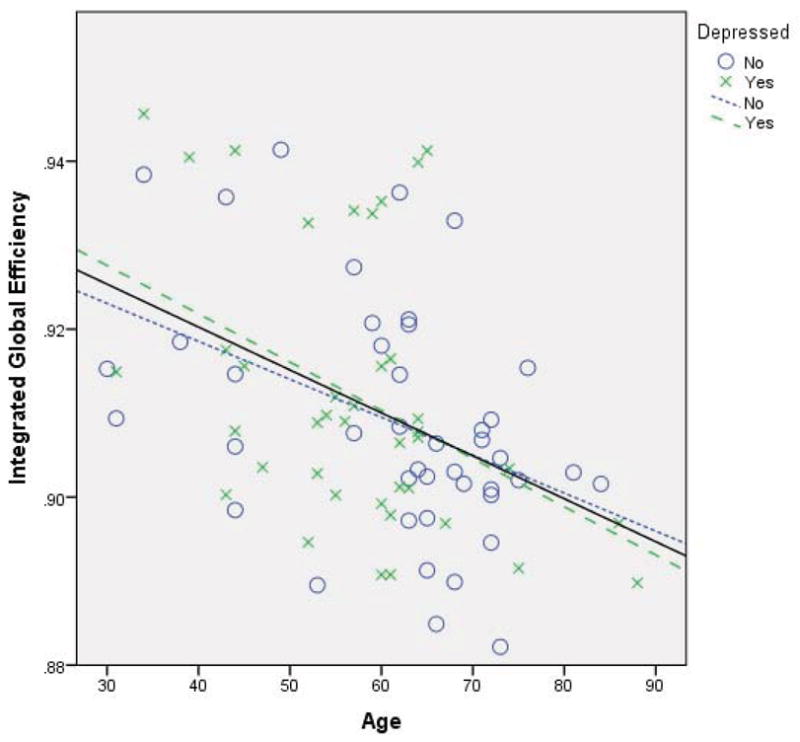
Results: All four network efficiency measures correlated negatively with age. In the depressed group, normalized global efficiency was negatively correlated with depression severity, whereas increasing global efficiency was associated with poorer performance on Object Alternation.
Conclusion: Brain network efficiency measures may represent different aspects of underlying network organization depending on the population and behaviors in question.
Keywords: Aging; cognition; connectivity; depression; network analysis.
Copyright © 2014 American Association for Geriatric Psychiatry. Published by Elsevier Inc. All rights reserved.
Figures
References
-
- Benjamini Y, Hochberg Y. Controlling the false discovery rate: a practical and powerful approach to multiple testing. Journal of the Royal Statistical Society, Series B (Methodological) 1995;57:289–300.
-
- Carrillo MC, Brashear HR, Logovinsky V, et al. Can we prevent Alzheimer’s disease? Secondary “prevention” trials in Alzheimer’s disease. Alzheimers Dement. 2013
Publication types
MeSH terms
Grants and funding
LinkOut - more resources
Full Text Sources
Other Literature Sources
Medical
