Risk of first venous thromboembolism in pregnant women in hospital: population based cohort study from England
- PMID: 24201164
- PMCID: PMC3898207
- DOI: 10.1136/bmj.f6099
Risk of first venous thromboembolism in pregnant women in hospital: population based cohort study from England
Abstract
Objective: To examine the potential for preventing venous thromboembolism during and after antepartum hospital admissions in pregnant women.
Design: Cohort study using linked primary (Clinical Practice Research Datalink) and secondary (Hospital Episode Statistics) care records.
Setting: Primary and secondary care centres, England.
Participants: 206,785 women aged 15-44 who had one or more pregnancies from 1997 up to 2010.
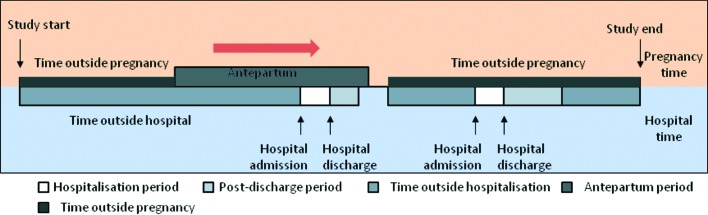
Main outcome measure: Risk of first venous thromboembolism in pregnant women admitted to hospital for one or more days for reasons other than delivery or venous thromboembolism. Risk was assessed by calculating the absolute rate of venous thromboembolism and comparing these rates with those observed during follow-up time not associated with hospital admission using a Poisson regression model to estimate incidence rate ratios.
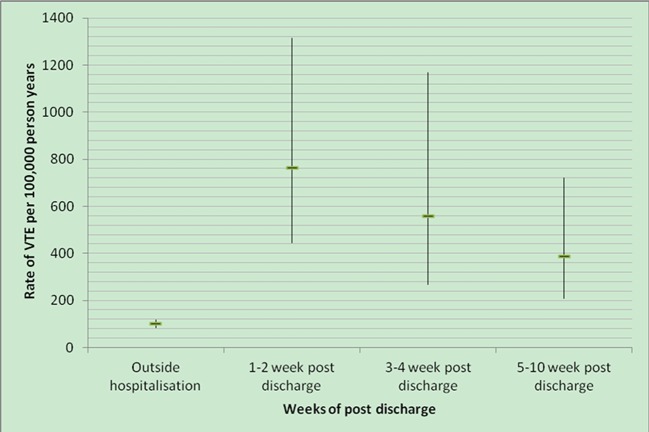
Results: Admission to hospital in pregnancy was associated with an increased risk of venous thromboembolism (absolute rate 1752/100,000 person years; incidence rate ratio 17.5, 95% confidence interval 7.69 to 40.0) compared with time outside hospital. The rate of venous thromboembolism was also high during the 28 days after discharge (absolute rate 676; 6.27, 3.74 to 10.5). The rate during and after admission combined was highest in the third trimester (961; 5.57, 3.32 to 9.34) and in those aged ≥ 35 years (1756; 21.7, 9.62 to 49.0). While the absolute rate in the combined period was highest for those with three or more days in hospital (1511; 12.2, 6.65 to 22.7), there was also a fourfold increase (558; 4.05, 2.23 to 7.38) in the risk of venous thromboembolism for those admitted to hospital for less than three days.
Conclusion: The overall risk of first venous thromboembolism in pregnant women increased during admissions to hospital not related to delivery, and remained significantly higher in the 28 days after discharge. During these periods need for thromboprophylaxis should receive careful consideration.
Conflict of interest statement
Competing interests: All authors have completed the ICMJE uniform disclosure form at
Figures
Comment in
-
Risk of venous thromboembolism in pregnancy and risks from unnecessary investigations must both be minimised.BMJ. 2013 Dec 23;347:f7498. doi: 10.1136/bmj.f7498. BMJ. 2013. PMID: 24366485 No abstract available.
-
Women admitted to hospital during pregnancy have increased risk of venous thromboembolism that persists up to 28 days postdischarge.Evid Based Nurs. 2014 Oct;17(4):103. doi: 10.1136/eb-2013-101706. Epub 2014 Mar 18. Evid Based Nurs. 2014. PMID: 24644302 No abstract available.
References
-
- Saving Mothers’ Lives: Reviewing maternal deaths to make motherhood safer: 2006-2008. Br J Obetet Gynaecol 2011;118:1-203. - PubMed
-
- Drife J. Thromboembolism. Br Med Bull 2003;67:177-90. - PubMed
-
- Wik H, Jacobsen A, Sandvik L, Sandset P. Prevalence and predictors for post-thrombotic syndrome 3 to 16 years after pregnancy-related venous thrombosis: a population-based, cross-sectional, case-control study. J Thromb Haemost 2012;10:840-7. - PubMed
-
- Jacobsen AF, Skjeldestad FE, Sandset PM. Ante- and postnatal risk factors of venous thrombosis: a hospital-based case-control study. J Thromb Haemost 2008;6:905-12. - PubMed
-
- Knight M. Antenatal pulmonary embolism: risk factors, management and outcomes. Br J Obstet Gynaecol 2008;115:453-61. - PubMed
Publication types
MeSH terms
LinkOut - more resources
Full Text Sources
Other Literature Sources