Challenges in elucidating the genetics of diabetic retinopathy
- PMID: 24201651
- PMCID: PMC3947937
- DOI: 10.1001/jamaophthalmol.2013.5024
Challenges in elucidating the genetics of diabetic retinopathy
Abstract
Importance: In the past decade, significant progress in genomic medicine and technologic developments has revolutionized our approach to common complex disorders in many areas of medicine, including ophthalmology. A disorder that still needs major genetic progress is diabetic retinopathy (DR), one of the leading causes of blindness in adults.
Objective: To perform a literature review, present the current findings, and highlight some key challenges in DR genetics.
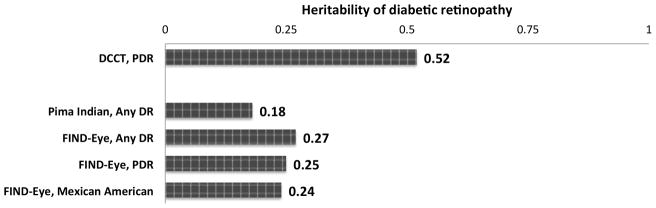
Design, setting, and participants: We performed a thorough literature review of the genetic factors for DR, including heritability scores, twin studies, family studies, candidate gene studies, linkage studies, and genome-wide association studies (GWASs).
Main outcome measures: Environmental and genetic factors for DR.
Results: Although there is clear demonstration of a genetic contribution in the development and progression of DR, the identification of susceptibility loci through candidate gene approaches, linkage studies, and GWASs is still in its infancy. The greatest obstacles remain a lack of power because of small sample size of available studies and a lack of phenotype standardization.
Conclusions and relevance: The field of DR genetics is still in its infancy and is a challenge because of the complexity of the disease. This review outlines some strategies and lessons for future investigation to improve our understanding of this complex genetic disorder.
Conflict of interest statement
References
-
- Klein R, Klein BE, Moss SE, Cruickshanks KJ. The Wisconsin Epidemiologic Study of Diabetic Retinopathy: XVII. The 14-year incidence and progression of diabetic retinopathy and associated risk factors in type 1 diabetes. Ophthalmology. 1998;105(10):1801–1815. - PubMed
Publication types
MeSH terms
Grants and funding
- UL1 RR033176/RR/NCRR NIH HHS/United States
- P01 HL060030/HL/NHLBI NIH HHS/United States
- R01 HL088457/HL/NHLBI NIH HHS/United States
- UL1 TR000124/TR/NCATS NIH HHS/United States
- EY014684/EY/NEI NIH HHS/United States
- P30 DK063491/DK/NIDDK NIH HHS/United States
- R01 EY014684/EY/NEI NIH HHS/United States
- EY014684-03S1/EY/NEI NIH HHS/United States
- EY014684-04S1/EY/NEI NIH HHS/United States
- UL1TR000124/TR/NCATS NIH HHS/United States
- R01 HL067974/HL/NHLBI NIH HHS/United States
- R01 HL071205/HL/NHLBI NIH HHS/United States
- DK063491/DK/NIDDK NIH HHS/United States
LinkOut - more resources
Full Text Sources
Other Literature Sources
Medical
Miscellaneous