


Obstetric complications, neonatal morbidity, and indications for cesarean delivery by maternal age
- PMID: 24201681
- PMCID: PMC4189107
- DOI: 10.1097/AOG.0000000000000017
Obstetric complications, neonatal morbidity, and indications for cesarean delivery by maternal age
Abstract
Objective: To delineate adverse obstetric and neonatal outcomes as well as indications for cesarean delivery by maternal age in a contemporaneous large national cohort.
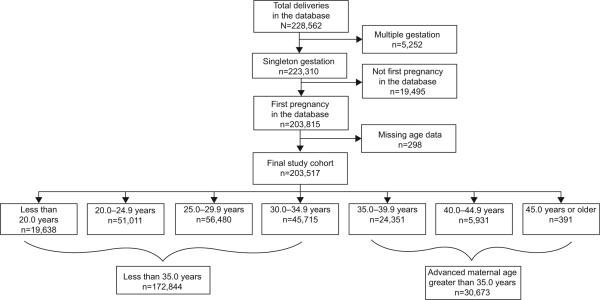
Methods: This was a retrospective analysis of electronic medical records from 12 centers and 203,517 (30,673 women aged 35 years or older) women with singleton gestations stratified by maternal age. Logistic regression was performed to investigate maternal and neonatal outcomes for each maternal age strata (referent group, age 25.0-29.9 years), adjusting for race, parity, body mass index, insurance, pre-existing medical conditions, substance and tobacco use, and site. Documented indications for cesarean delivery were analyzed.
Results: Neonates born to women aged 25.0-29.9 years had the lowest risk of birth weight less than 2,500 g (7.2%; P<.001), admission to neonatal intensive care unit (11.5%; P<.001), and perinatal mortality (0.7%; P<.001). Hypertensive disorders of pregnancy were higher in women aged 35 years or older (cumulative rate 8.5% compared with 7.8%; 25.0-29.9 years; P<.001). Previous uterine scar was the leading indication for cesarean delivery in women aged 25.0 years or older (36.9%; P<.001). For younger women, failure to progress or cephalopelvic disproportion (37.0% for those younger than age 20.0 years and 31.1% for those aged 20.0-24.9-years; P<.001) and nonreassuring fetal heart tracing (28.7% for those younger than 20.0 years and 21.2% for those aged 20.0-24.9-years; P<.001) predominated as indications. Truly elective cesarean delivery rate was 20.2% for women aged 45.0 years or older (adjusted odds ratio 1.85 [99% confidence interval 1.03-3.32] compared with the referent age group of 25.0-29.9 years).
Conclusions: Maternal and obstetric complications differed by maternal age, as did rates of elective cesarean delivery. Women aged 25.0-29.9 years had the lowest rate of serious neonatal morbidity.
Level of evidence: : II.
Figures
References
-
- Ecker JL, Chen KT, Cohen AP, Riley LE, Lieberman ES. Increased risk of cesarean delivery with advancing maternal age: Indications and associated factors in nulliparous women. Am J Obstet Gynecol. 2001;185:883–7. - PubMed
-
- Bianco A, Stone J, Lynch L, Lapinski R, Berkowitz G, Berkowitz RL. Pregnancy outcome at age 40 and older. Obstet Gynecol. 1996;87:917–22. - PubMed
-
- Ziadeh S, Yahaya A. Pregnancy outcome at age 40 and older. Arch Gynecol Obstet. 2001;265:30–3. - PubMed
-
- Paulson RJ, Boostanfar R, Saadat P, Mor E, Tourgeman DE, Slater CC, et al. Pregnancy in the sixth decade of life: obstetric outcomes in women of advanced reproductive age. JAMA. 2002;288:2320–3. - PubMed
-
- Cleary-Goldman J, Malone FD, Vidaver J, Ball RH, Nyberg DA, Comstock CH, et al. Impact of maternal age on obstetric outcome. Obstet Gynecol. 2005;105:983–90. - PubMed
Publication types
MeSH terms
Grants and funding
LinkOut - more resources
Full Text Sources
Other Literature Sources
Medical
