


Characteristics associated with discontinuation of long-acting reversible contraception within the first 6 months of use
- PMID: 24201685
- PMCID: PMC4051392
- DOI: 10.1097/01.AOG.0000435452.86108.59
Characteristics associated with discontinuation of long-acting reversible contraception within the first 6 months of use
Abstract
Objective: To measure discontinuation within 6 months among users of the levonorgestrel intrauterine system, copper intrauterine device (IUD), and etonogestrel implant and identify baseline characteristics associated with early discontinuation.
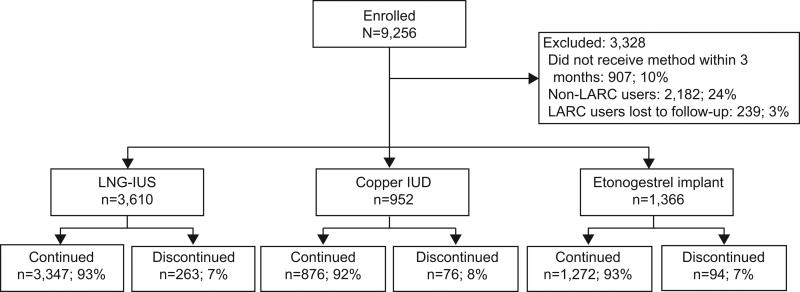
Methods: This was an analysis of the Contraceptive CHOICE Project, a cohort study of 9,256 participants provided with no-cost contraception and followed with telephone interviews at 3 and 6 months. We used logistic regression to investigate characteristics associated with early discontinuation of the two IUDs and implant and described reasons for discontinuation.
Results: A total of 6,167 participants were eligible for this analysis. Follow-up data were available for 5,928 participants; 5,495 (93%) were using their method at 6 months and 433 (7%) had discontinued. Discontinuation rates were 7.3%, 8.0%, and 6.9% for the levonorgestrel intrauterine system, copper IUD, and implant, respectively. After adjusting for age, race, marital status, low socioeconomic status, and history of sexually transmitted infection, we found that unmarried women were slightly more likely to discontinue compared with married women (adjusted odds ratio [OR] 1.26, 95% confidence interval [CI] 1.01-1.59 and adjusted OR 1.62, 95% CI 1.11-2.37, respectively). No other baseline characteristics, including younger age (14-19 years), were associated with early discontinuation. The most common reason given for discontinuation was cramping among IUD users and irregular or frequent bleeding among implant users.
Conclusion: Rates of discontinuation of long-acting reversible contraception at 6 months is low and not increased in adolescents and young women. Intrauterine devices and the implant should be considered as first-line contraceptive options among all women to reduce unintended pregnancy.
Level of evidence: : II.
Figures
References
-
- Singh S, Sedgh G, Hussain R. Unintended pregnancy: worldwide levels, trends, and outcomes. Stud Fam Plann. 2010;41:241–250. - PubMed
-
- Finer LB, Henshaw SK. Disparities in rates of unintended pregnancy in the United States, 1994 and 2001. Perspect Sex Reprod Health. 2006;38:90–96. - PubMed
-
- Gipson JD, Koenig MA, Hindin MJ. The effects of unintended pregnancy on infant, child, and parental health: a review of the literature. Stud Fam Plann. 2008;39:18–38. - PubMed
-
- Winner B, Peipert JF, Zhao Q, et al. Effectiveness of long-acting reversible contraception. N Engl J Med. 2012;366:1998–2007. - PubMed
Publication types
MeSH terms
Substances
Grants and funding
LinkOut - more resources
Full Text Sources
Other Literature Sources
Medical
Research Materials
