Review
. 2013 Nov 5:7:157.
doi: 10.3389/fncom.2013.00157.

Creating new functional circuits for action via brain-machine interfaces

Affiliations
Review

Creating new functional circuits for action via brain-machine interfaces

Amy L Orsborn et al. Front Comput Neurosci. .

Abstract

Brain-machine interfaces (BMIs) are an emerging technology with great promise for developing restorative therapies for those with disabilities. BMIs also create novel, well-defined functional circuits for action that are distinct from the natural sensorimotor apparatus. Closed-loop control of BMI systems can also actively engage learning and adaptation. These properties make BMIs uniquely suited to study learning of motor and non-physical, abstract skills. Recent work used motor BMIs to shed light on the neural representations of skill formation and motor adaptation. Emerging work in sensory BMIs, and other novel interface systems, also highlight the promise of using BMI systems to study fundamental questions in learning and sensorimotor control. This paper outlines the interpretation of BMIs as novel closed-loop systems and the benefits of these systems for studying learning. We review BMI learning studies, their relation to motor control, and propose future directions for this nascent field. Understanding learning in BMIs may both elucidate mechanisms of natural motor and abstract skill learning, and aid in developing the next generation of neuroprostheses.

Keywords: brain-machine interfaces; motor learning; neural plasticity; sensorimotor systems; volitional control.


Figures
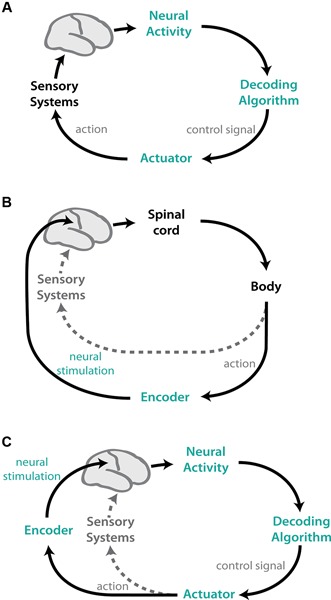
Figure 1
Figure 1
Schematic representations of BMI systems. Components of the natural CNS are shown in black/grey; artificial, experimenter-controlled elements are colored. (A) Motor (efferent) BMIs map recorded neural activity into control signals for a device via a decoding algorithm. These systems typically use natural sensory systems, such as vision, to provide feedback to the user, creating a closed-loop system. (B) Sensory (afferent) BMIs use the natural motor apparatus to perform actions, but close the control loop using feedback conveyed via neural stimulation. Environmental variables are encoded into patterns of stimulation delivered to select brain regions. The artificial feedback can also be combined with natural sensory stimuli (grey dotted). (C) Afferent and efferent BMIs can be combined, where actions are decoded from neural activity and feedback is provided via encoded neural stimulation. Again, the artificial sensory feedback can be combined with natural sensory systems (grey dotted).

References

    1. Berg J. A., Dammann J. F., Tenore F. V., Tabot G. A., Boback J. L., Manfredi L. R., et al. (2013). Behavioral demonstration of a somatosensory neuroprosthesis. IEEE Trans. Neural Syst. Rehabil. Eng. 21, 500–507 10.1109/tnsre.2013.2244616 - DOI - PubMed
    1. Carmena J. M., Lebedev M. A., Crist R. E., O’Doherty J. E., Santucci D. M., Dimitrov D. F., et al. (2003). Learning to control a brain–machine interface for reaching and grasping by primates. PLoS Biol. 1:e42 10.1371/journal.pbio.0000042 - DOI - PMC - PubMed
    1. Cerf M., Thiruvengadam N., Mormann F., Kraskov A., Quiroga R. Q., Koch C., et al. (2010). On-line, voluntary control of human temporal lobe neurons. Nature 467, 1104–1108 10.1038/nature09510 - DOI - PMC - PubMed
    1. Chapin J. K., Moxon K. A., Markowitz R. S., Nicolelis M. A. (1999). Real-time control of a robot arm using simultaneously recorded neurons in the motor cortex. Nat. Neurosci. 2, 664–670 10.1038/10223 - DOI - PubMed
    1. Chase S. M., Kass R. E., Schwartz A. B. (2012). Behavioral and neural correlates of visuomotor adaptation observed through a brain-computer interface in primary motor cortex. J. Neurophysiol. 108, 624–644 10.1152/jn.00371.2011 - DOI - PMC - PubMed
