Review
. 2013 Nov 5:4:315.
doi: 10.3389/fmicb.2013.00315.

Life at high salt concentrations, intracellular KCl concentrations, and acidic proteomes

Affiliations
Review

Life at high salt concentrations, intracellular KCl concentrations, and acidic proteomes

Aharon Oren. Front Microbiol. .

Abstract

Extremely halophilic microorganisms that accumulate KCl for osmotic balance (the Halobacteriaceae, Salinibacter) have a large excess of acidic amino acids in their proteins. This minireview explores the occurrence of acidic proteomes in halophiles of different physiology and phylogenetic affiliation. For fermentative bacteria of the order Halanaerobiales, known to accumulate KCl, an acidic proteome was predicted. However, this is not confirmed by genome analysis. The reported excess of acidic amino acids is due to a high content of Gln and Asn, which yield Glu and Asp upon acid hydrolysis. The closely related Halorhodospira halophila and Halorhodospira halochloris use different strategies to cope with high salt. The first has an acidic proteome and accumulates high KCl concentrations at high salt concentrations; the second does not accumulate KCl and lacks an acidic proteome. Acidic proteomes can be predicted from the genomes of some moderately halophilic aerobes that accumulate organic osmotic solutes (Halomonas elongata, Chromohalobacter salexigens) and some marine bacteria. Based on the information on cultured species it is possible to understand the pI profiles predicted from metagenomic data from hypersaline environments.

Keywords: Halanaerobiaceae; acidic proteins; anaerobic; halophilic; marine bacteria; osmotic adaptation.


Figures
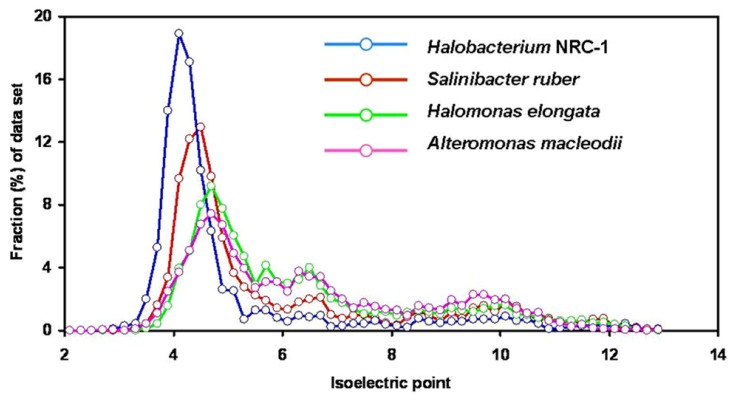
FIGURE 1
FIGURE 1
Isoelectric point profiles, calculated at 0.2 intervals, of predicted proteins encoded by the genomes of Halobacterium NRC-1 (2,675 proteins; median pI 5.03), the extreme halophilic bacterium Salinibacter ruber (2,845 proteins; median pI 5.92), the aerobic moderately halophilic bacterium Halomonas elongata (3,474 proteins; median pI 6.32) and the aerobic marine bacterium Alteromonas macleodii (4,396 proteins; median pI 6.46). From the genome annotations (Ng et al., 2000; Mongodin et al., 2005; Schwibbert et al., 2011) sequences encoding proteins or putative proteins were extracted, and for each protein sequence the predicted the pI value was calculated using the programs in the Galaxy platform (; Giardine et al., 2005; Blankenberg et al., 2010; Goecks et al., 2010). With kind permission from Springer Science+Business Media: Extremophiles, Elevi Bardavid and Oren (2012b), compiled from data presented in Figures 1–3.
FIGURE 2
FIGURE 2
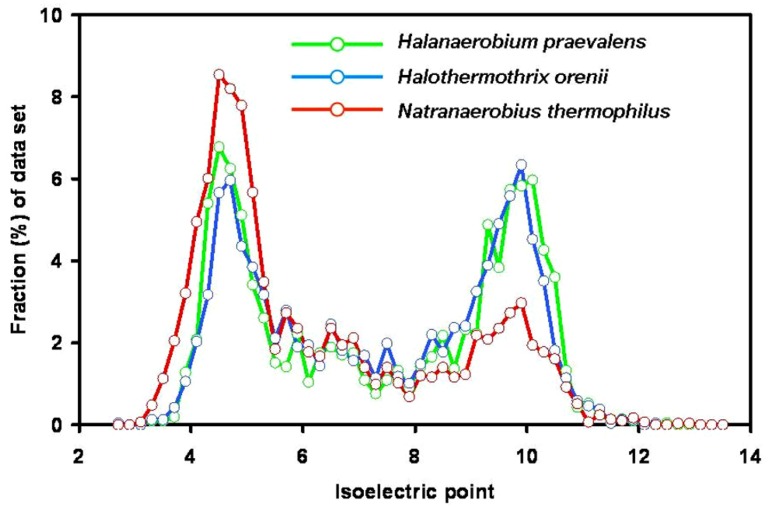
Isoelectric point profiles, calculated at 0.2 intervals, of predicted proteins encoded by the genomes of the three fermentative halophilic anaerobes: Halanaerobium praevalens GSLT (2,110 proteins; median pI 7.42), the thermophilic Halothermothrix orenii H168T (2,365 proteins, median pI 7.41) and the alkaliphilic and thermophilic Natranaerobius thermophilus JW.NM-WN-LFT (2,906 proteins; median pI 6.27). From the genome annotations (Mavromatis et al., 2009; Ivanova et al., 2011; Zhao et al., 2011) sequences encoding proteins or putative proteins were extracted, and pI profiles were calculated as for Figure 1. With kind permission from Springer Science+Business Media: Extremophiles, compiled from data presented in Elevi Bardavid and Oren (2012a) – Figure 1, and Elevi Bardavid and Oren (2012b) – Figure 4.

References

    1. Antón J., Oren A., Benlloch S., Rodríguez-Valera F., Amann R, Rosselló-Móra R. (2002). Salinibacter ruber gen. nov., sp. nov., a novel extreme halophilic member of the Bacteria from saltern crystallizer ponds. Int. J. Syst. Evol. Microbiol. 52 485–491 10.1128/AEM.66.7.3052-3057.2000 - DOI - PubMed
    1. Blankenberg D., Von Kuster G., Coraor N., Ananda G., Lazarus R., Mangan M., et al. (2010). Galaxy: a web-based genome analysis tool for experimentalists. Curr. Protoc. Mol. Biol. Chapter 19, Unit 19. 10 1–21 10.1002/0471142727.mb1910s89 - DOI - PMC - PubMed
    1. Brown S. D., Begemann M. B., Mormile M. R., Wall J. D., Han C. S., Goodwin L. A., et al. (2011). Complete genome sequence of the haloalkaliphilic, hydrogen-producing bacterium Halanaerobium hydrogeniformans. J. Bacteriol. 193 3682–3683 10.1128/JB.05209-11 - DOI - PMC - PubMed
    1. Cayol J.-L., Ollivier B., Patel B. K. C., Prensier G., Guezennec J., Garcia J.-L. (1994). Isolation and characterization of Halothermothrix orenii gen. nov., sp. nov., a halophilic, thermophilic, fermentative, strictly anaerobic bacterium. Int. J. Syst. Bacteriol. 44 534–540 10.1099/00207713-44-3-534 - DOI - PubMed
    1. Detkova E. N., Boltyanskaya Y. V. (2006). Relationships between the osmoadaptation strategy, amino acid composition of bulk protein, and properties of certain enzymes of haloalkaliphilic bacteria. Mikrobiologiya 75 259–265 - PubMed