Review
. 2013 Nov 5:4:441.
doi: 10.3389/fpls.2013.00441.

Differential growth at the apical hook: all roads lead to auxin

Affiliations
Review

Differential growth at the apical hook: all roads lead to auxin

Mohamad Abbas et al. Front Plant Sci. .

Abstract

The apical hook is a developmentally regulated structure that appears in dicotyledonous seedlings when seeds germinate buried in the soil. It protects the shoot apical meristem and cotyledons from damage while the seedling is pushing upwards seeking for light, and it is formed by differential cell expansion between both sides of the upper part of the hypocotyl. Its apparent simplicity and the fact that it is dispensable when seedlings are grown in vitro have converted the apical hook in one of the favorite experimental models to study the regulation of differential growth. The involvement of hormones -especially auxin-in this process was manifested already in the early studies. Remarkably, a gradient of this hormone across the hook curvature is instrumental to complete its development, similar to what has been proposed for other processes involving the bending of an organ, such as tropic responses. In agreement with this, other hormones-mainly gibberellins and ethylene-and the light, regulate in a timely and interconnected manner the auxin gradient to promote hook development and its opening, respectively. Here, we review the latest findings obtained mainly with the apical hook of Arabidopsis thaliana, paying special attention to the molecular mechanisms for the cross-regulation between the different hormone signaling pathways that underlie this developmental process.

Keywords: apical hook; auxin; development; ethylene; gibberellin; hormone interaction.


Figures
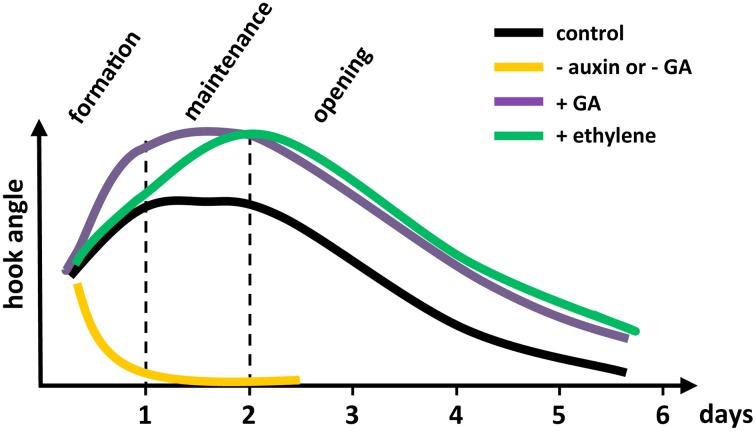
Figure 1
Figure 1
Schematic illustration showing the dynamics of hormone actions in apical hook development in Arabidopsis. The - auxin was produced by treating with the auxin transport inhibitor naphthylphthalamic acid (NPA); - GA, by GA biosynthesis inhibitor paclobutrazol; and + ethylene, by adding the immediate ethylene precursor, ACC. The + GA shows the GA action constitutively revealed by the use of a dellaKO mutant.
Figure 2
Figure 2
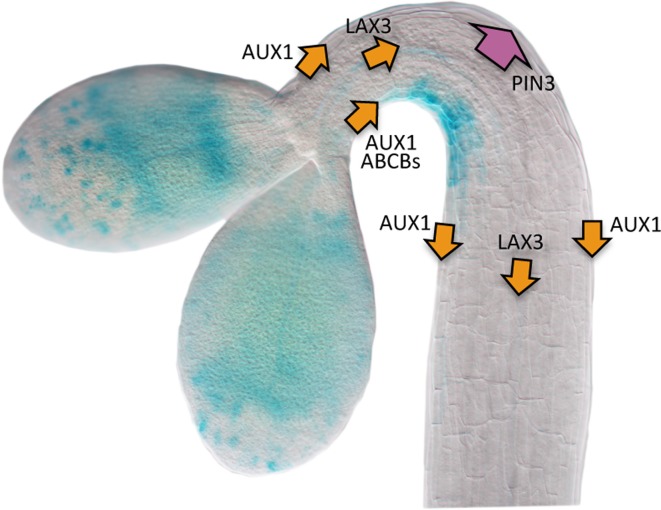
Scheme of the transport machinery involved in the generation of the auxin gradient in the apical hook. The auxin flow directed by influx and efflux carriers is represented by orange and purple arrows, respectively. The wide arrow representing PIN3 activity means that this carrier performs a major role driving auxin toward the outer side of the hook. The image represents a DR5::GUS seedling during the formation phase. Picture courtesy of Dr. Javier Gallego-Bartolomé.
Figure 3
Figure 3
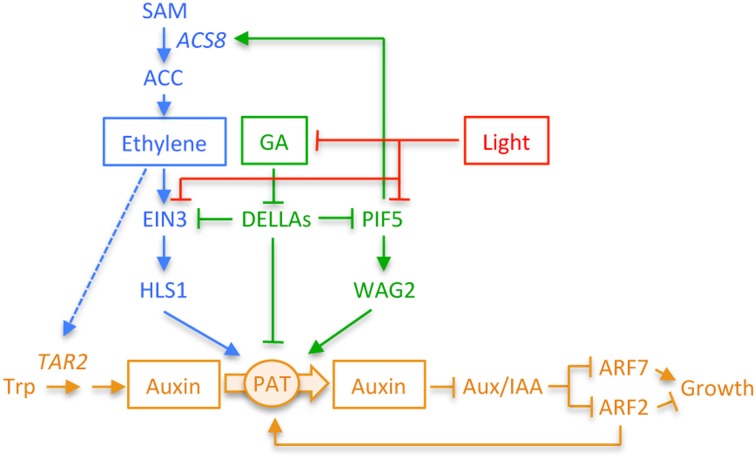
Diagram depicting the interactions between GAs, ethylene, and light signaling pathways in Arabidopsis and how they modulate the auxin response in the apical hook. Not all interactions take place simultaneously. The differential auxin response is required during the whole process of hook development, and it is modulated by GAs and/or ethylene depending on the phase. GAs are relevant during the formation phase, whereas the role of ethylene during this phase seems to be minor. The mechanism by which GAs control the auxin response during the formation phase is unknown, although it will likely involve HLS1 regulation. Both GAs and ethylene are, however, important to prevent opening, and thus the interactions between both hormones will take place during maintenance. The signaling elements involved in the regulation of TAR2 by ethylene are unknown (discontinuous blue line). Light may provoke hook opening at any stage of hook development. Bars and arrowheads indicate negative and positive effects, respectively. PAT, polar auxin transport.
Figure 4
Figure 4
High-resolution images of a single Arabidopsis seedling undergoing hook opening during de-etiolation. From left to right: 2-day-old dark-grown seedling at the end of the maintenance phase; the same seedling 2, 4, and 8 h after illumination, respectively. The middle part of hypocotyls was removed—white oblique lines—to prepare the final images showing both the bottom and apical parts of hypocotyls. Pictures courtesy of Dr. Javier Gallego-Bartolomé.

References

    1. Achard P., Liao L., Jiang C., Desnos T., Bartlett J., Fu X., et al. (2007). DELLAs contribute to plant photomorphogenesis. Plant Physiol. 143, 1163–1172 10.1104/pp.106.092254 - DOI - PMC - PubMed
    1. Achard P., Vriezen W. H., Van Der Straeten D., Harberd N. P. (2003). Ethylene regulates arabidopsis development via the modulation of DELLA protein growth repressor function. Plant Cell 15, 2816–2825 10.1105/tpc.015685 - DOI - PMC - PubMed
    1. Alabadí D., Blázquez M. A., Carbonell J., Ferrándiz C., Pérez-Amador M. A. (2009). Instructive roles for hormones in plant development. Int. J. Dev. Biol. 53, 1597–1608 10.1387/ijdb.072423da - DOI - PubMed
    1. Alabadí D., Gil J., Blázquez M. A., García-Martínez J. L. (2004). Gibberellins repress photomorphogenesis in darkness. Plant Physiol. 134, 1050–1057 10.1104/pp.103.035451 - DOI - PMC - PubMed
    1. An F., Zhang X., Zhu Z., Ji Y., He W., Jiang Z., et al. (2012). Coordinated regulation of apical hook development by gibberellins and ethylene in etiolated Arabidopsis seedlings. Cell Res. 22, 915–927 10.1038/cr.2012.29 - DOI - PMC - PubMed