. 2013 Oct 18;8(10):e76413.
doi: 10.1371/journal.pone.0076413. eCollection 2013.

New avian paramyxoviruses type I strains identified in Africa provide new outcomes for phylogeny reconstruction and genotype classification

Affiliations

New avian paramyxoviruses type I strains identified in Africa provide new outcomes for phylogeny reconstruction and genotype classification

Renata Servan de Almeida et al. PLoS One. .

Abstract

Newcastle disease (ND) is one of the most lethal diseases of poultry worldwide. It is caused by an avian paramyxovirus 1 that has high genomic diversity. In the framework of an international surveillance program launched in 2007, several thousand samples from domestic and wild birds in Africa were collected and analyzed. ND viruses (NDV) were detected and isolated in apparently healthy fowls and wild birds. However, two thirds of the isolates collected in this study were classified as virulent strains of NDV based on the molecular analysis of the fusion protein and experimental in vivo challenges with two representative isolates. Phylogenetic analysis based on the F and HN genes showed that isolates recovered from poultry in Mali and Ethiopia form new groups, herein proposed as genotypes XIV and sub-genotype VIf with reference to the new nomenclature described by Diel's group. In Madagascar, the circulation of NDV strains of genotype XI, originally reported elsewhere, is also confirmed. Full genome sequencing of five African isolates was generated and an extensive phylogeny reconstruction was carried out based on the nucleotide sequences. The evolutionary distances between groups and the specific amino acid signatures of each cluster allowed us to refine the genotype nomenclature.


Conflict of interest statement

Competing Interests: The authors have declared that no competing interests exist.

Figures

Figure 1
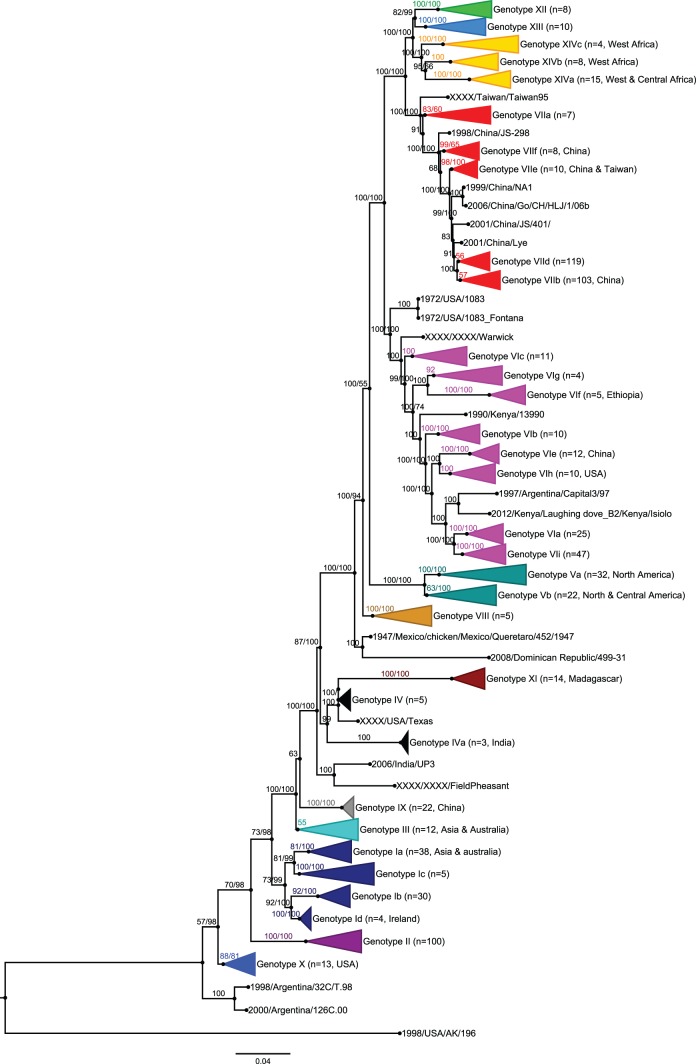
Figure 1. Phylogenetic analysis of 741 complete F nucleic acid sequences of NDV.
Trees were constructed using Bayesian inference with 16,806,000 iterations and 1/1000 tree sampled in the chain. Minimal average ESS for all parameters was 1681, and PSRF were between 0.99996 and 1.00084. A class 1 virus sequence was introduced as an outgroup. Consensus tree posterior probabilities are indicated on the branch (first number). A Bayesian inference based on 323 complete HN nucleic acid sequences was also done (all details in Figure S3A, Figure S5J and Figure S9R). Since the F and HN trees were superimposable, only the F tree is represented; where informative, branch support values for HN are indicated after the F posterior probabilities. Sequences from this study are grouped in genotypes Ib (2 strains), VIf (5 strains), XI (10 strains), XIVa (1 strains), XIVb (5 strains), and XIVc (1 strain). The complete list of the 741 sequences, the corresponding multiple sequence alignments, and the tree in Newick and in Figtree format can be found in Table S8, Table S7, Figure S5G, and Figure S9O, respectively.
Figure 2
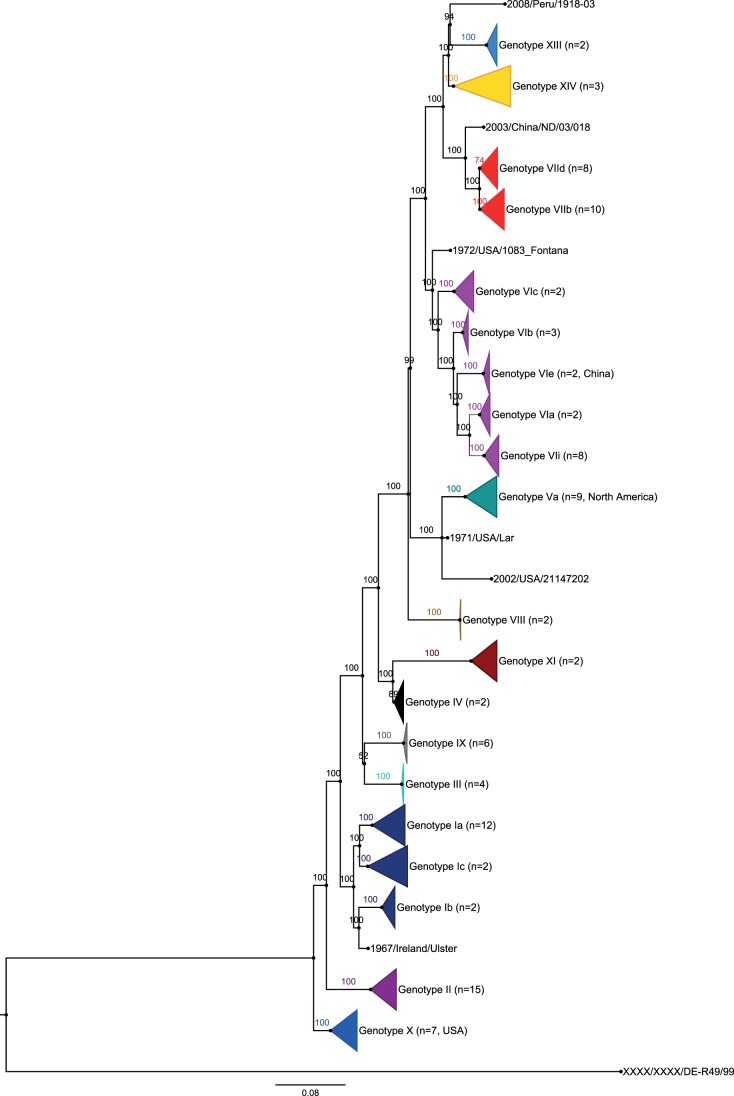
Figure 2. Phylogenetic analysis of 110 complete genome sequences.
Trees were constructed using Bayesian inference with 2,960,000 iterations and 1/1000 tree sampled in the chain Minimal average ESS for all parameters was 365, and PSRF were between 0.99978 and 1.0059. A class I virus was used as an outgroup. Sequences from this study are three Malian strains, one in each of sub-genotypes XIVa, b, and c. The complete list of the 110 sequences, the corresponding multiple sequence alignments, and the tree in Newick and Figtree format can be found in Table S8, Table S7, Figure S5HandFigure S9P, respectively.
Figure 3
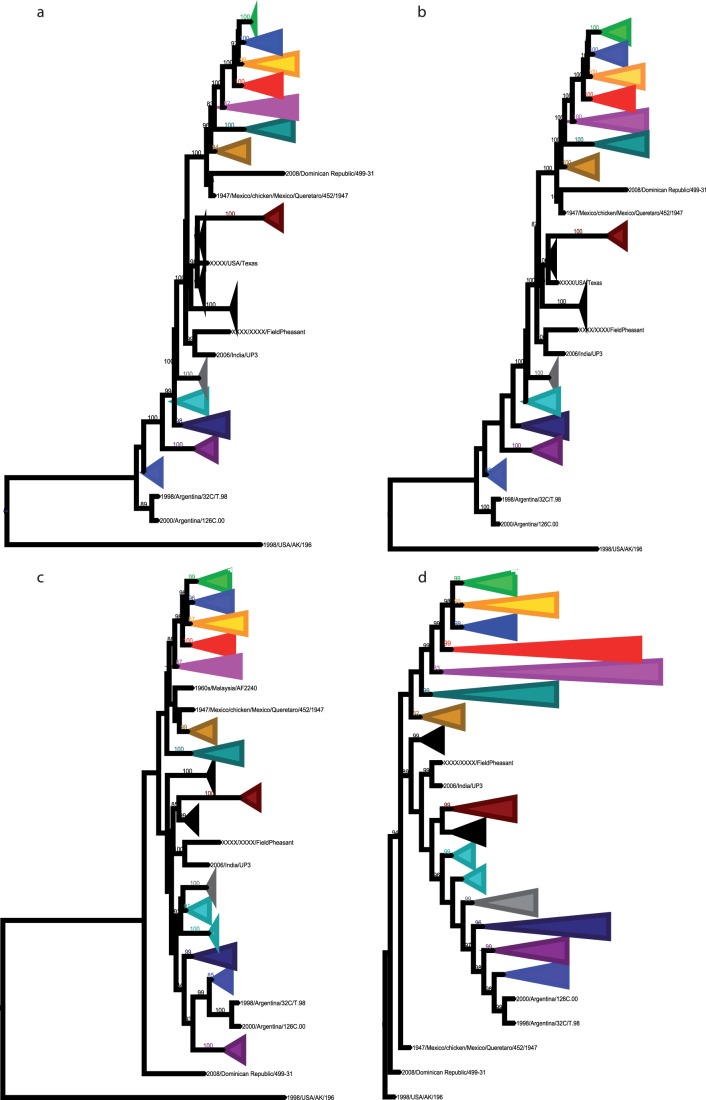
Figure 3. Comparison of tree topology after phylogenetic reconstruction on the 741 complete F gene sequences using four phylogenetic methods: (a) Maximum Likelihood (ML), (b) Bayesian (MrBayes), (c) Maximum Parsimony (MP), and (d) Neighbor Joining (NJ).
Branch support values correspond to 1000 bootstrap replicates for ML, MP, and NJ, and posterior probabilities estimated for 10,000 samples of the Markov chain for MrBayes. The area of the triangle is proportional to the number of isolates within the genotype.
Figure 4
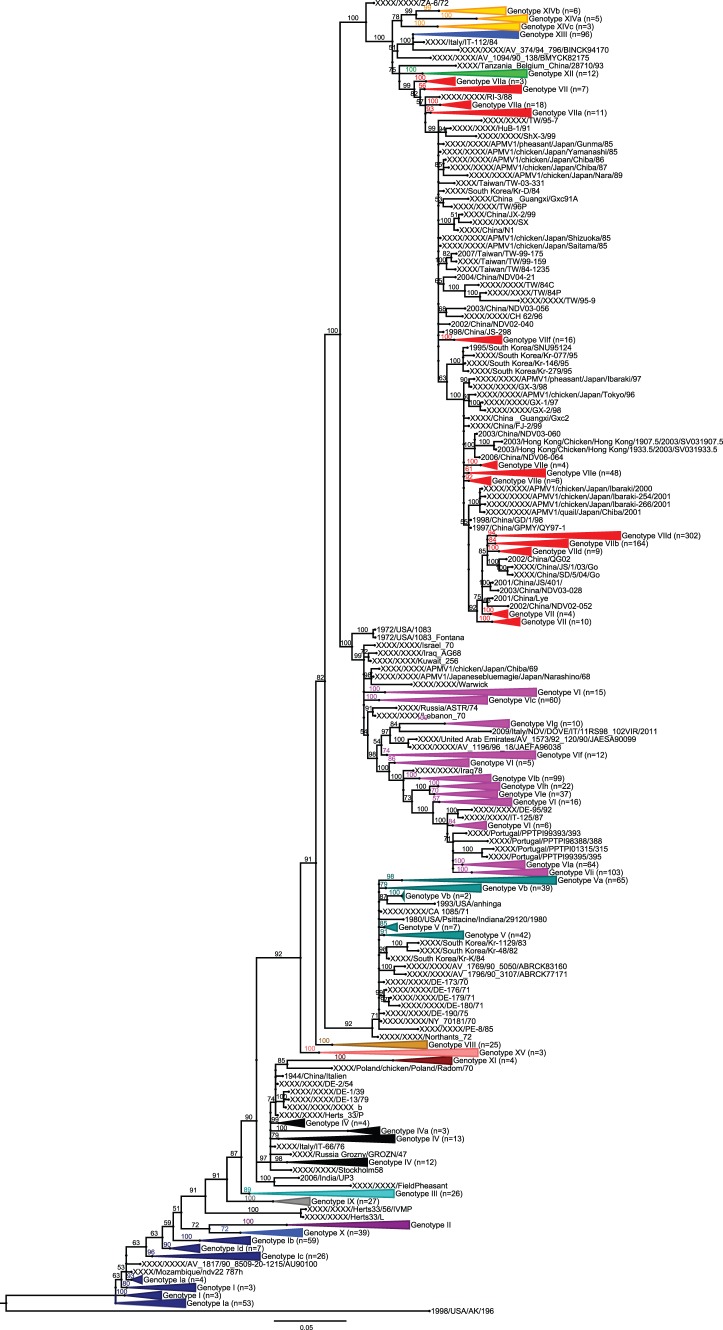
Figure 4. Phylogenetic analysis of 1921 partial F gene sequences based on nucleotides from positions 1 to 372.
Trees were constructed using Bayesian inference with 47,408,000 iterations and 1/1000 tree sampled in the chain. Minimal average ESS for all parameters was 88, and PSRF were between 1.00003 and 1.01335. A class I virus was used as an outgroup. Sequences from this study are 5 Malian strains (1 in sub-genotype XIVa, 3 in XIVb, and 1 in XIVc), 5 Ethiopian strains (VIf), and 4 Madagascar strains (XI). The complete list of the 1921 sequences, the corresponding multiple sequence alignments, and the tree in Newick and Figtree format can be found in Table S8, Table S7, Figure S5I, and Figure S9Q, respectively.

References

    1. Aldous EW, Mynn JK, Banks J, Alexander DJ (2003) A molecular epidemiological study of avian paramyxovirus type 1 (Newcastle disease virus) isolates by phylogenetic analysis of a partial nucleotide sequence of the fusion protein gene. Avian Pathol 32: 239–256. - PubMed
    1. Office-International-des-Epizooties (2008 and 2009) Newcastle disease. Manual of Diagnostic Tests and Vaccines for Terrestrial Animals.
    1. Steward M, Vipond IB, Millar NS, Emmerson PT (1993) RNA editing in Newcastle disease virus. J Gen Virol. 74: 2539–2547. - PubMed
    1. Czegledi A, Ujvari D, Somogyi E, Wehmann E, Werner O, et al. (2006) Third genome size category of avian paramyxovirus serotype 1 (Newcastle disease virus) and evolutionary implications. Virus Research 120: 36–48. - PubMed
    1. Alexander DJ (2000) Newcastle disease and other avian paramyxoviruses. Rev Sci Tech 19: 443–462. - PubMed

Publication types

LinkOut - more resources