Review
. 2013 Nov;32(11):582-93.
doi: 10.5732/cjc.013.10170.

Noncoding RNAs in cancer and cancer stem cells

Affiliations
Review

Noncoding RNAs in cancer and cancer stem cells

Tianzhi Huang et al. Chin J Cancer. 2013 Nov.

Abstract

In recent years, it has become increasingly apparent that noncoding RNAs (ncRNA) are of crucial importance for human cancer. The functional relevance of ncRNAs is particularly evident for microRNAs (miRNAs) and long noncoding RNAs (lncRNAs). miRNAs are endogenously expressed small RNA sequences that act as post-transcriptional regulators of gene expression and have been extensively studied for their roles in cancers, whereas lncRNAs are emerging as important players in the cancer paradigm in recent years. These noncoding genes are often aberrantly expressed in a variety of human cancers. However, the biological functions of most ncRNAs remain largely unknown. Recently, evidence has begun to accumulate describing how ncRNAs are dysregulated in cancer and cancer stem cells, a subset of cancer cells harboring self-renewal and differentiation capacities. These studies provide insight into the functional roles that ncRNAs play in tumor initiation, progression, and resistance to therapies, and they suggest ncRNAs as attractive therapeutic targets and potentially useful diagnostic tools.


Figures
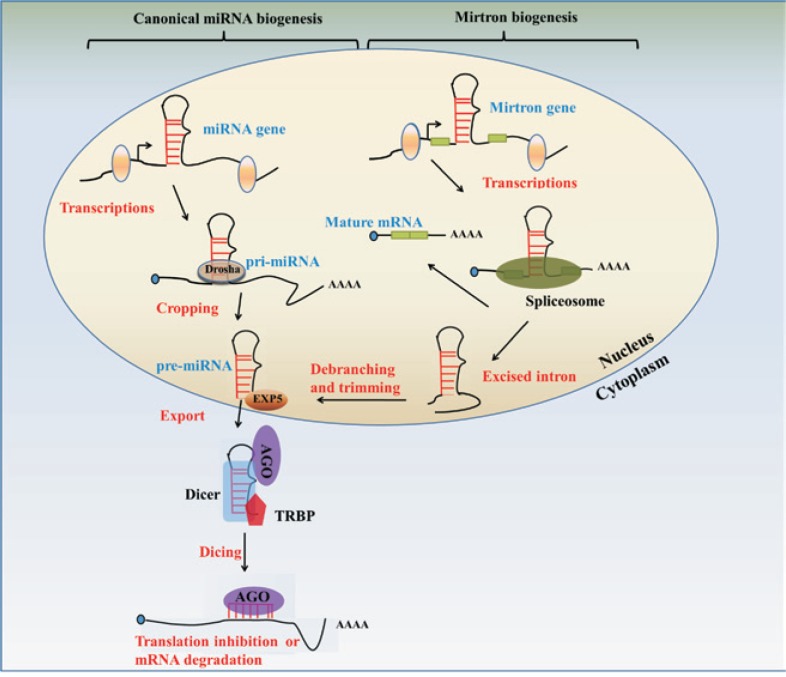
Figure 1.
Figure 1.. Canonical and non-canonical miRNA biogenesis pathways.
In the canonical pathway (left), long primary miRNAs (pri-miRNAs) are transcribed by RNA polymerase II and are then capped and polyadenylated, forming RNA with a hairpin secondary structure. Cropping is the first step in the maturation mediated by the RNase III enzyme Drosha and produces a ∼65 nucleotide hairpin RNA with a 2-3 nucleotide overhang termed precursor—miRNA (pre-miRNA). pre-miRNA is recognized and exported into cytoplasm by the Exportin-5 (EXP5)-Ran-GTP complex for further processing by Dicer with its partner TAR RNA-binding protein (TRBP) and Arogonaute proteins 1-4 (AGO). Dicer processing generates the miRNA:miRNA* duplex. One strand of the miRNA duplex is selected to form the RNA-induced silencing complex (RISC), which mediates translation inhibition or mRNA degradation. In the non-canonical pathway (right), some miRNAs called mirtrons are embedded in short introns and bypass the Drosha procession. After the splicing and production of the mature mRNA, the excised intron is debranched and trimmed to generate the pre-miRNA that can be EXP5 and exported by EXP5-Ran-GTP complex, and then subsequently enter the canonical pathway for miRNAs biogenesis.
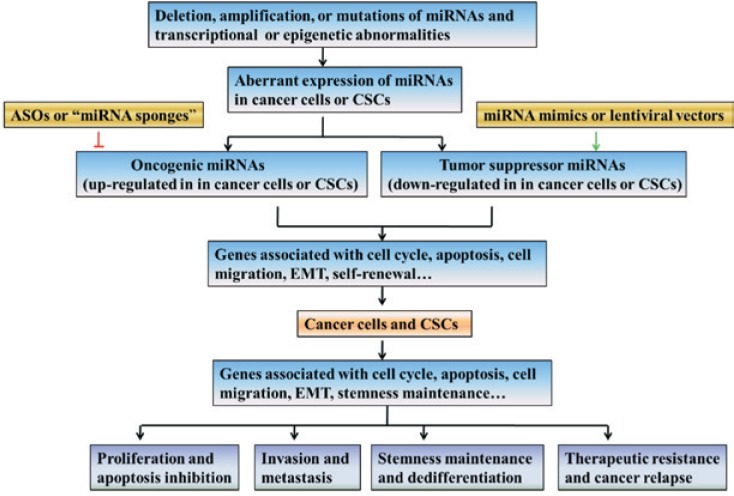
Figure 2.
Figure 2.. miRNA in cancer and cancer stem cells (CSCs).
Aberrant expression of miRNAs, either oncogenic or tumor suppressive, may be due to deletion, amplification, or mutations of miRNA genes, and dysegulation of transcriptional and epigenetic factors that regulate the miRNA genes. Dysregulation of genes linked to cell cycle, apoptosis, cell migration, epithelial-mesenchymal transition (EMT), and self-renewal results in carcinogenesis, invasion, metastasis, and maintenance of stemness. It is proposed that miRNA inhibition can knockdown the effects of oncogenic miRNAs, and miRNA mimics or lentiviral vectors expressing target miRNAs can restore the capabilities of tumor suppressor miRNAs. Therefore, miRNAs have great therapeutic potential against cancer progression, therapy resistance, and relapse. ASOs, antisense oligonucleotides.

References

    1. Alexander RP, Fang G, Rozowsky J, et al. Annotating non-coding regions of the genome. Nat Rev Genet. 2010;11:559–571. - PubMed
    1. Mercer TR, Dinger ME, Mattick JS. Long non-coding RNAs: insights into functions. Nat Rev Genet. 2009;10:155–159. - PubMed
    1. He L, Hannon GJ. MicroRNAs: small RNAs with a big role in gene regulation. Nat Rev Genet. 2004;5:522–531. - PubMed
    1. Mendell JT. MicroRNAs: critical regulators of development, cellular physiology and malignancy. Cell Cycle. 2005;4:1179–1184. - PubMed
    1. Croce CM. Causes and consequences of microRNA dysregulation in cancer. Nat Rev Genet. 2009;10:704–714. - PMC - PubMed

Publication types