


Intensity correlation-based calibration of FRET
- PMID: 24209847
- PMCID: PMC3824301
- DOI: 10.1016/j.bpj.2013.09.041
Intensity correlation-based calibration of FRET
Abstract
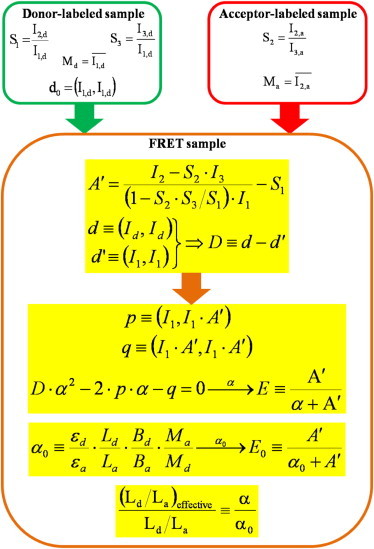
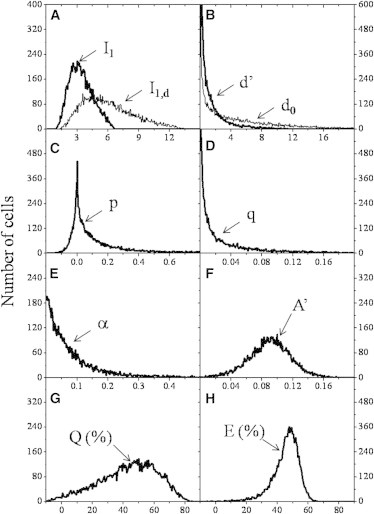
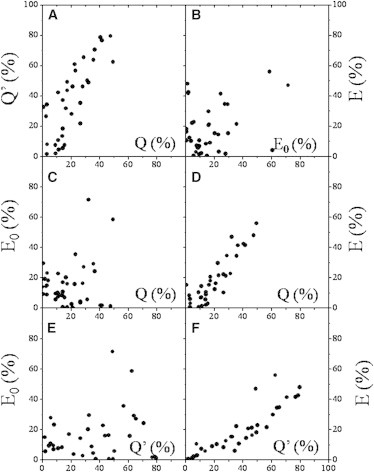
Dual-laser flow cytometric resonance energy transfer (FCET) is a statistically efficient and accurate way of determining proximity relationships for molecules of cells even under living conditions. In the framework of this algorithm, absolute fluorescence resonance energy transfer (FRET) efficiency is determined by the simultaneous measurement of donor-quenching and sensitized emission. A crucial point is the determination of the scaling factor α responsible for balancing the different sensitivities of the donor and acceptor signal channels. The determination of α is not simple, requiring preparation of special samples that are generally different from a double-labeled FRET sample, or by the use of sophisticated statistical estimation (least-squares) procedures. We present an alternative, free-from-spectral-constants approach for the determination of α and the absolute FRET efficiency, by an extension of the presented framework of the FCET algorithm with an analysis of the second moments (variances and covariances) of the detected intensity distributions. A quadratic equation for α is formulated with the intensity fluctuations, which is proved sufficiently robust to give accurate α-values on a cell-by-cell basis in a wide system of conditions using the same double-labeled sample from which the FRET efficiency itself is determined. This seemingly new approach is illustrated by FRET measurements between epitopes of the MHCI receptor on the cell surface of two cell lines, FT and LS174T. The figures show that whereas the common way of α determination fails at large dye-per-protein labeling ratios of mAbs, this presented-as-new approach has sufficient ability to give accurate results. Although introduced in a flow cytometer, the new approach can also be straightforwardly used with fluorescence microscopes.
Copyright © 2013 Biophysical Society. Published by Elsevier Inc. All rights reserved.
Figures
References
-
- Lakowicz J.R. Principles of Fluorescence Spectroscopy. 3rd Ed. Springer; New York: 2006. Ch. 13: Energy transfer; pp. 443–472.
-
- Jares-Erijman E.A., Jovin T.M. FRET imaging. Nat. Biotechnol. 2003;21:1387–1395. - PubMed
-
- Clegg R.M. Ch. 1: Förster resonance energy transfer-FRET: what is it, why do it, and how it’s done. In: Gadella T.W.J., Pillai S., van der Vliet P.C., editors. Vol. 33. Elsevier; Dordrecht, The Netherlands: 2009. pp. 1–48. (FRET and FLIM Techniques. Laboratory Techniques in Biochemistry and Molecular Biology).
-
- Bacsó Z., Bene L., Damjanovich S. A photobleaching energy transfer analysis of CD8/MHC-I and LFA-1/ICAM-1 interactions in CTL-target cell conjugates. Immunol. Lett. 1996;54:151–156. - PubMed
-
- Bene L., Fulwyler M.J., Damjanovich S. Detection of receptor clustering by flow cytometric fluorescence anisotropy measurements. Cytometry. 2000;40:292–306. - PubMed
Publication types
MeSH terms
Substances
LinkOut - more resources
Full Text Sources
Other Literature Sources
