


Left ventricular hypertrophy patterns and incidence of heart failure with preserved versus reduced ejection fraction
- PMID: 24210333
- PMCID: PMC3881171
- DOI: 10.1016/j.amjcard.2013.09.028
Left ventricular hypertrophy patterns and incidence of heart failure with preserved versus reduced ejection fraction
Abstract
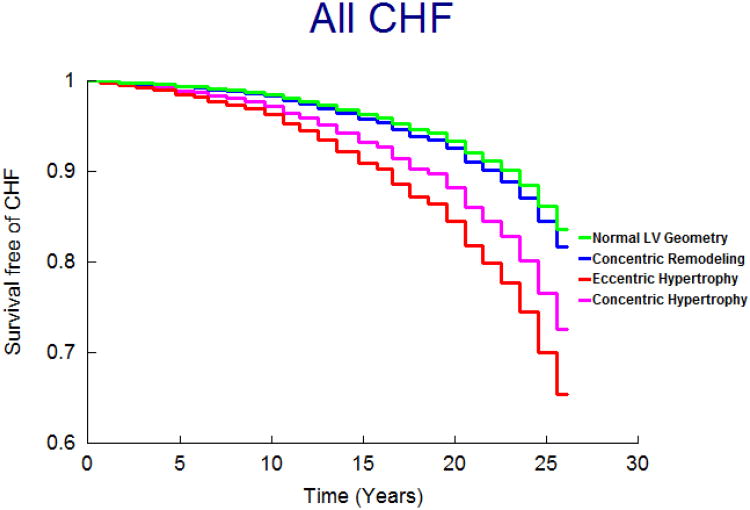
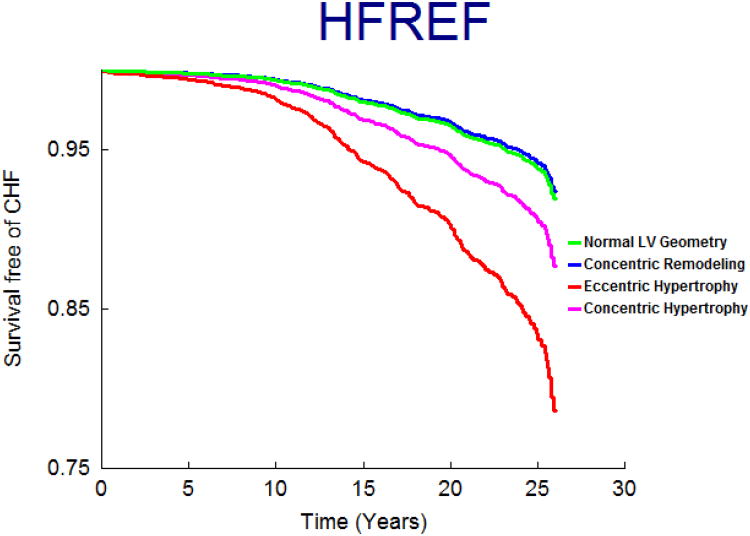
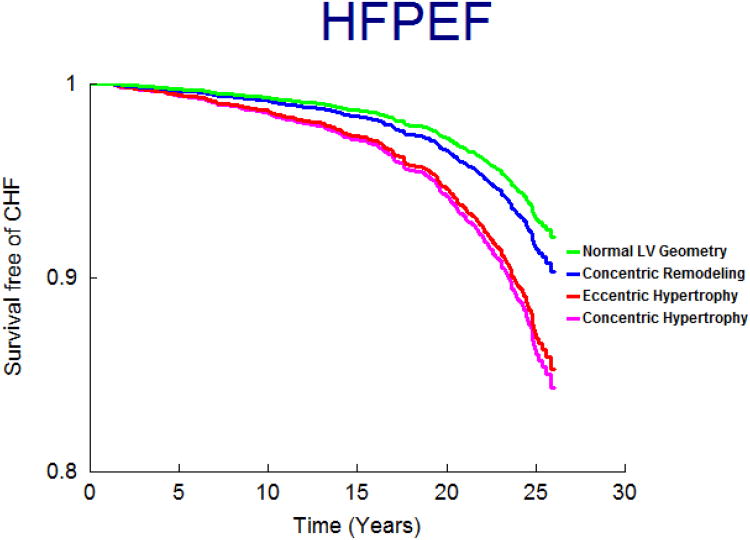
Higher left ventricular (LV) mass, wall thickness, and internal dimension are associated with increased heart failure (HF) risk. Whether different LV hypertrophy patterns vary with respect to rates and types of HF incidence is unclear. In this study, 4,768 Framingham Heart Study participants (mean age 50 years, 56% women) were classified into 4 mutually exclusive LV hypertrophy pattern groups (normal, concentric remodeling, concentric hypertrophy, and eccentric hypertrophy) using American Society of Echocardiography-recommended thresholds of echocardiographic LV mass indexed to body surface area and relative wall thickness, and these groups were related to HF incidence. Whether risk for HF types (HF with reduced ejection fraction [<45%] vs preserved ejection fraction [≥45%]) varied by hypertrophy pattern was then evaluated. On follow-up (mean 21 years), 458 participants (9.6%, 250 women) developed new-onset HF. The age- and gender-adjusted 20-year HF incidence increased from 6.96% in the normal left ventricle group to 8.67%, 13.38%, and 15.27% in the concentric remodeling, concentric hypertrophy, and eccentric hypertrophy groups, respectively. After adjustment for co-morbidities and incident myocardial infarction, LV hypertrophy patterns were associated with higher HF incidence relative to the normal left ventricle group (p = 0.0002); eccentric hypertrophy carried the greatest risk (hazard ratio [HR] 1.89, 95% confidence interval [CI] 1.41 to 2.54), followed by concentric hypertrophy (HR 1.40, 95% CI 1.04 to 1.87). Participants with eccentric hypertrophy had a higher propensity for HF with reduced ejection fraction (HR 2.23, 95% CI 1.48 to 3.37), whereas those with concentric hypertrophy were more prone to HF with preserved ejection fraction (HR 1.66, 95% CI 1.09 to 2.51). In conclusion, in this large community-based sample, HF risk varied by LV hypertrophy pattern, with eccentric and concentric hypertrophy predisposing to HF with reduced and preserved ejection fraction, respectively.
Copyright © 2014 Elsevier Inc. All rights reserved.
Figures
References
-
- Kannel WB, Feinleib M, McNamara PM, Garrison RJ, Castelli WP. An investigation of coronary heart disease in families. The Framingham offspring study Am J Epidemiol. 1979;110:281–290. - PubMed
-
- Sahn DJ, DeMaria A, Kisslo J, Weyman A. Recommendations regarding quantitation in M-mode echocardiography: results of a survey of echocardiographic measurements. Circulation. 1978;58:1072–1083. - PubMed
-
- Devereux RB, Alonso DR, Lutas EM, Gottlieb GJ, Campo E, Sachs I, Reichek N. Echocardiographic assessment of left ventricular hypertrophy: comparison to necropsy findings. Am J Cardiol. 1986;57:450–458. - PubMed
-
- Vasan RS, Benjamin EJ, Larson MG, Leip EP, Wang TJ, Wilson PW, Levy D. Plasma natriuretic peptides for community screening for left ventricular hypertrophy and systolic dysfunction: the Framingham heart study. JAMA. 2002;288:1252–1259. - PubMed
Publication types
MeSH terms
Grants and funding
LinkOut - more resources
Full Text Sources
Other Literature Sources
Medical
Research Materials
Miscellaneous
