. 2013 Nov 14;39(5):963-75.
doi: 10.1016/j.immuni.2013.10.005. Epub 2013 Oct 24.

A beneficial role for immunoglobulin E in host defense against honeybee venom

Affiliations

A beneficial role for immunoglobulin E in host defense against honeybee venom

Thomas Marichal et al. Immunity. .

Abstract

Allergies are widely considered to be misdirected type 2 immune responses, in which immunoglobulin E (IgE) antibodies are produced against any of a broad range of seemingly harmless antigens. However, components of insect venoms also can sensitize individuals to develop severe IgE-associated allergic reactions, including fatal anaphylaxis, upon subsequent venom exposure. We found that mice injected with amounts of honeybee venom similar to that which could be delivered in one or two stings developed a specific type 2 immune response that increased their resistance to subsequent challenge with potentially lethal amounts of the venom. Our data indicate that IgE antibodies and the high affinity IgE receptor, FcεRI, were essential for such acquired resistance to honeybee venom. The evidence that IgE-dependent immune responses against venom can enhance survival in mice supports the hypothesis that IgE, which also contributes to allergic disorders, has an important function in protection of the host against noxious substances.


Figures

Figure 1
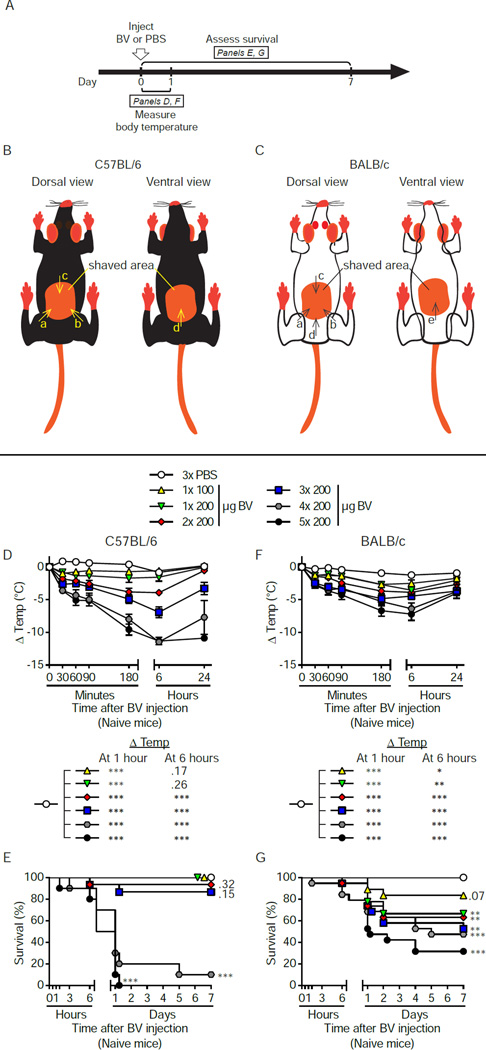
Figure 1. Acute systemic responses of naive C57BL/6 and BALB/c mice to increasing doses of BV
(A) Experimental outline. (B and C) Schematic showing sites of s.c. injection of up to 4 or 5 doses of BV (or PBS) in (B) C57BL/6 and (C) BALB/c mice. Arrowheads indicate the injection sites in the shaved area(s). Injections were carried out in alphabetical order, depending on the number of injections. In studies of innate responses to BV, C57BL/6 and BALB/c mice received 1–5 doses of BV or PBS (x3) (see D–G below). In experiments in which mice were challenged with high dose BV, C57BL/6 mice always got 4 injections of BV (200 µg each, as shown in B) and BALB/c mice always got 5 injections of BV (200 µg each, as shown in C). Female (D and E) C57BL/6 and (F and G) BALB/c WT mice were treated s.c. with the indicated doses of BV. Mock-treated control mice received 3 injections of PBS. Mice receiving 1–3 injections were treated in the back only (see B and C, arrows a–c); mice injected 4 times received 3 injections in the back and 1 in the belly (see B, arrows a-d); mice injected 5 times received 4 injections in the back and 1 in the belly (see C, arrows a–e). (D and F) Changes in body temperature (Δ Temp [mean ± SEM]) and (E and G) survival (% of live animals) were monitored at the indicated times. P values are versus PBS-treated mice and were calculated by (D and F) Student’s t test or (E and G) Mantel-Cox test. (D – G) Data are pooled from 2 (for groups receiving 4× or 5× 200 µg BV) or 3 (all other groups) independent experiments (n=10–19/group). *, P < 0.05; **, P < 0.01; ***, P < 0.001 versus PBS; numbers in D, E and G are the P values for comparisons to PBS that were not significant (P > 0.05). See also Figures S1 for a similar set of experiments with Russell’s viper venom.
Figure 2
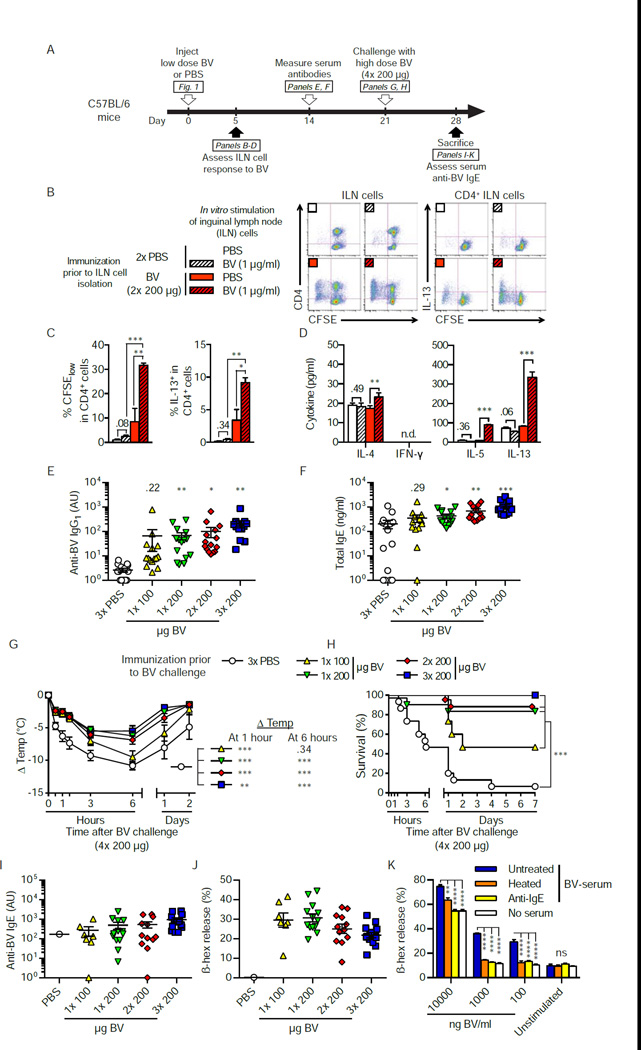
Figure 2. Injection of a sub-lethal dose of BV induces a Th2 cell immune response that can increase the resistance of C57BL/6 mice to the hypothermia and mortality caused by subsequent challenge with a potentially lethal dose of BV
(A) Experimental outline For assessment of the ILN cell response in B-D, mice were injected s.c. with 2× 200 µg BV or PBS. In panels E-J, mice were injected with PBS, 1× 100, 1× 200, 2× 200 or 3× 200 µg BV and challenged 3 weeks later with 4× 200 µg BV. (B and C) Flow cytometry analysis of CFSE-labeled ILN cells stimulated for 4 days with 1 µg/ml BV or PBS. (B) Representative dot plots and (C) quantification (pooled from 3 independent experiments) of proliferation (% CFSElow) and intracellular IL-13 (% IL-13+) of CD4+ ILN cells. (D) IL-4, −5, −13, and IFN-y in supernatants of CFSE-labeled ILN cells after 4 days of BV or PBS stimulation in vitro. (E) BV-specific IgG1 and (F) total IgE antibody levels in serum obtained two weeks after BV immunization or mock immunization with PBS. (G) Changes in body temperature (A Temp) and (H) survival (% of live animals) of mice challenged with 4× 200 µg BV three weeks after BV immunization. (I) Titers of BV-specific IgE in sera collected 7 days after venom challenge from all surviving mice shown in H. (J) C57BL/6 BMCMCs were sensitized with sera of individual mice, stimulated with 1 µg/ml BV, and the amount of β-hexosaminidase (β-hex) in the cell supernatant was measured to assess BMCMC degranulation. (K) Pooled serum of BV-immunized and challenged C57BL/6 mice (BV-serum, which was either heated to eliminate the ability of IgE to bind to FcεRI [heated], treated with rat anti-mouse IgE [anti-IgE], or mock-treated with PBS [untreated]) was used to sensitize C57BL/6 BMCMCs, which were then stimulated with different concentrations of BV (100 – 10,000 ng/ml) or an equivalent volume of PBS (unstimulated). (C–F) Data are pooled from 3 independent experiments (n=13–15/group). (C to G, I and J): Values are mean ± or + SEM (E, F, I and J also show values for individual mice). (K) Values shown are mean + SD from one representative of 3 independent experiments, P values are versus (C and D) in vitro PBS-treated cells or (E–H) PBS-injected mice or (K) cells sensitized with untreated BV-serum, by (C-G, K) Student’s t test or (H) Mantel-Cox test. *, P < 0.05; **, P < 0.01; ***, P < 0.001 (C, D and K) for the indicated comparisons or (E–H) versus PBS; the number in C-G are the P values for the comparisons that were not significant (P > 0.05). n.d., not detectable; ns, not significant. See also Figure S2 for data from a similar set of experiments performed in BALB/c mice.
Figure 3
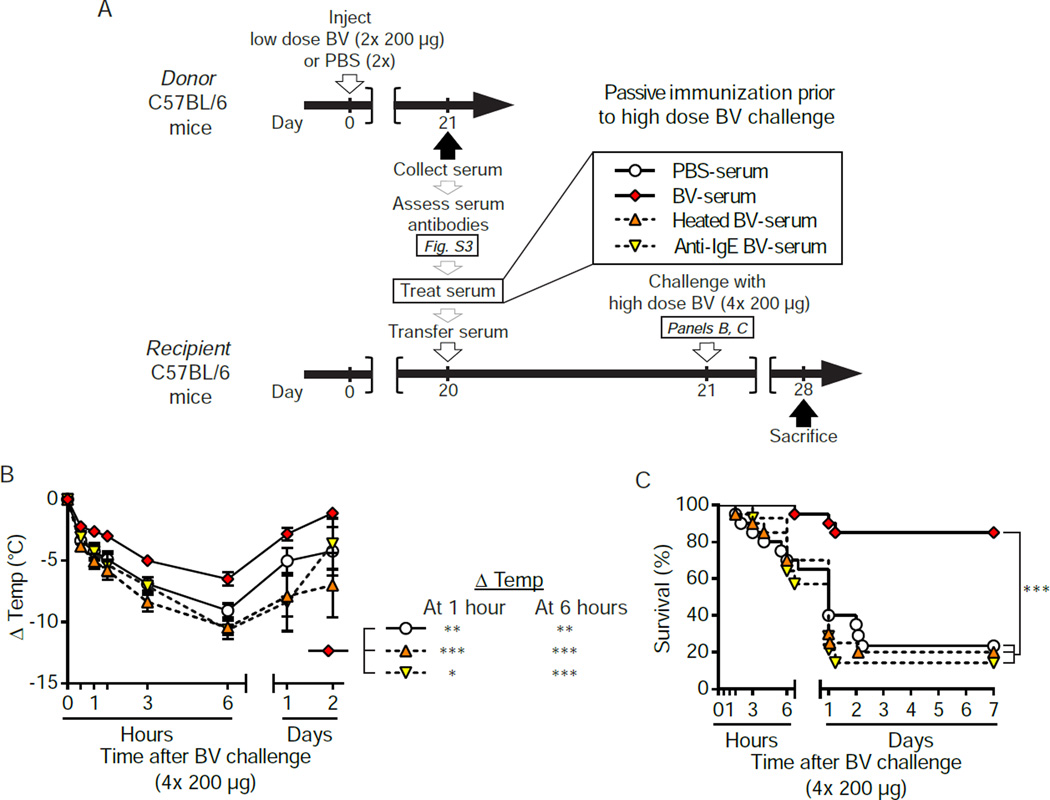
Figure 3. The increased resistance of passively immunized C57BL/6 WT mice to challenge with a potentially lethal dose of BV is dependent on functional serum IgE
(A) Experimental outline. Donor mice were injected with 2× 200 µg BV or PBS. Three weeks later, sera from PBS-or BV-injected mice ([PBS-serum] or [BV-serum], respectively) were collected (see also Figure S2), and pooled BV-serum was processed in vitro to neutralize IgE function, either by heating or anti-mouse IgE treatment ([heated BV-serum] or [anti-IgE BV-serum], respectively). Age-matched recipient mice were anesthetized and transfused i.v. with serum 22 h before challenge with 4× 200 µg BV. (B) Changes in body temperature after challenge (Δ Temp [mean ± SEM]) and (C) survival (% of live animals) were monitored at indicated time points. Data are pooled from experiments obtained with 2 different pools of serum and a total of 4 independent experiments (n=14–20/group). P values are calculated by (B) Student’s t test and (C) Mantel-Cox test. *, P<0.05; **, P < 0.01; ***, P < 0.001 for the indicated comparisons. See also Figure S3.
Figure 4
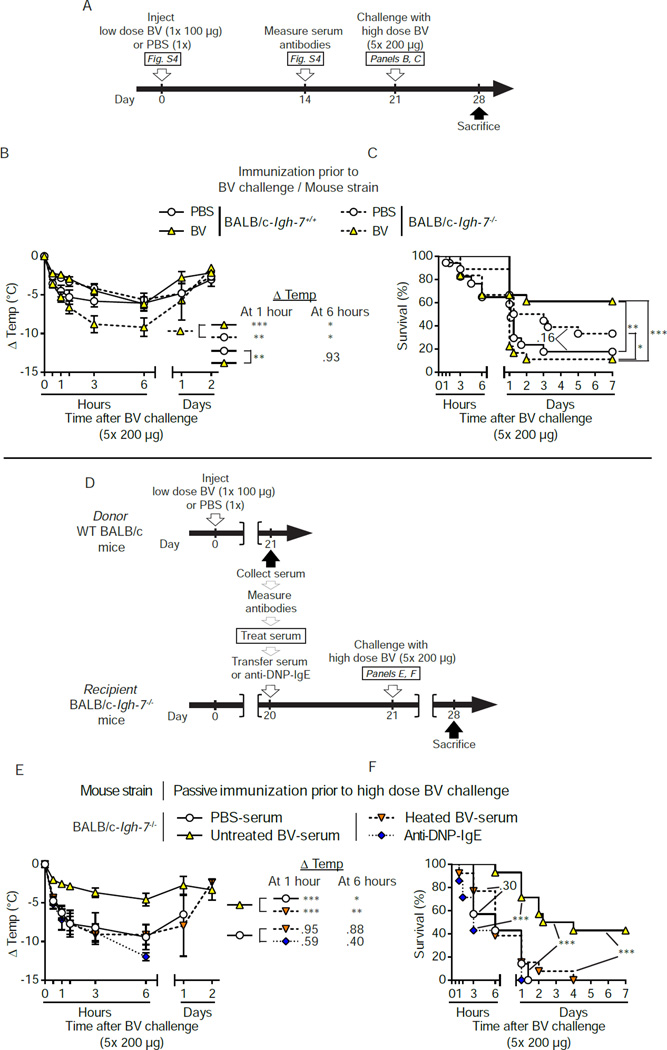
Figure 4. IgE, but not IgG antibodies, are necessary for the protective effect of the adaptive response to BV
(A) Experimental outline for panels B and C. (B and C) IgE-deficient (Igh-7−/−) or IgE-sufficient (Igh-7+/+) BALB/c mice mice were injected with 1× 100 µg BV or PBS. Three weeks later, mice were challenged with 5× 200 µg BV. (B) Changes in body temperature (Δ Temp) and (C) survival (% of live animals) were monitored at the indicated times. (D) Experimental outline for panels E and F. WT BALB/c donor mice were injected with 1× 100 µg BV or PBS. Three weeks later, sera from PBS- or BV-injected mice ([PBS-serum] or [BV-serum], respectively) were collected, and pooled BV-serum was processed in vitro to neutralize IgE function by heating (heated BV serum). Age-matched IgE-deficient recipient mice were anesthetized and transfused i.v. with serum or PBS containing monoclonal anti-DNP-IgE (an amount equivalent to the total IgE content of transferred BV-serum) 22 h before challenge with 5× 200 µg BV. (E) Changes in body temperature after challenge (Δ Temp) and (F) survival (% of live animals) were monitored at the indicated times. Data are pooled from (B and C) 4 independent experiments (n=17–19/group) or (E and F) from experiments obtained with 2 different pools of serum and a total of 3 independent experiments (n=8–14/group). (B and E) Values are mean ± SEM. P values are calculated by (B and E) Student’s t test or (C and F) Mantel-Cox test. *, P < 0.05; **, P < 0.01; ***, P < 0.001 for the indicated comparisons; the numbers in B, C, E and F are the P values for indicated comparisons that were not significant (P > 0.05). See also Figure S4.
Figure 5
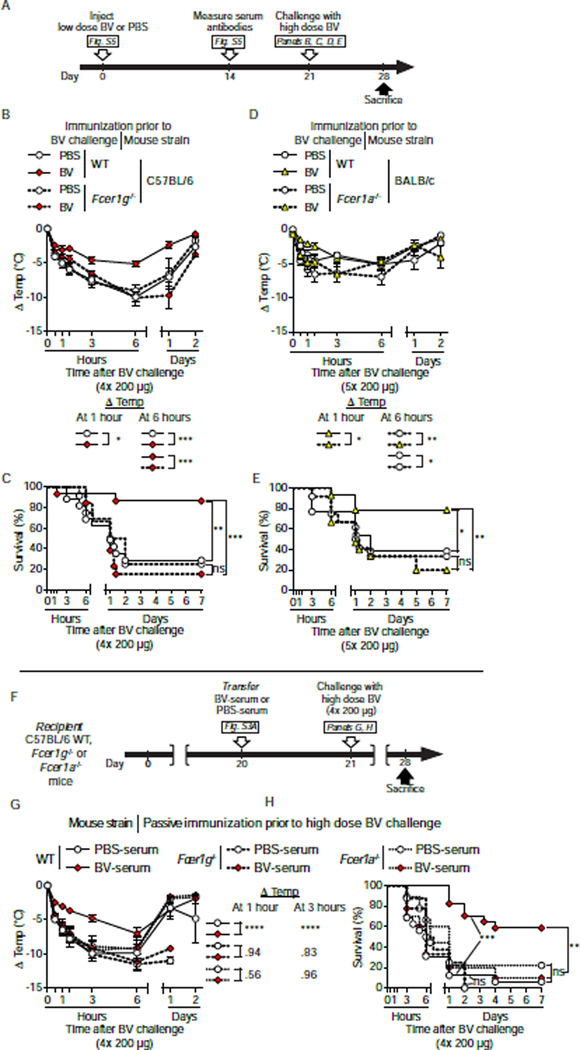
Figure 5. FcεRIoα IgE binding and FcεRIγ signaling are required for BV-immunized mice to exhibit increased resistance against a potentially lethal dose of BV
(A) Experimental outline for panels B to E. (B and C) C57BL/6 Fcer1g−/− and WT mice and (D and E) BALB/c Fcer1a−/− and WT mice were injected with 2× 200 µg BV or PBS (2x), or 1× 100 µg BV or PBS (1x), respectively. Three weeks later, (B and C) mice of C57BL/6 background were challenged with 4× 200 µg BV and (D and E) mice of BALB/c background were challenged with 5× 200 µg BV. (B and D) Changes in body temperature (Δ Temp) and (C and E) survival (% of live animals) were monitored at indicated time points. (F) Experimental outline for panels G and H. PBS-serum or BV-serum from WT C57BL/6 “donor” mice (see Figure S2A) were transferred i.v. into recipient C57BL/6 WT, Fcer1g−/− or Fcer1a−/− mice 22 h before challenge with 4× 200 µg BV. (G) Changes in body temperature (Δ Temp) and (H) survival (% of live animals) were monitored at the indicated times. Data are pooled (B–E) from 3 independent experiments (n=11–15/group) or (G and H) from experiments obtained with 2 different pools of serum and a total of 3–4 independent experiments (n=8–17/group). (B–D, G) Values are mean ± SEM. P values are calculated by (B, D and G) Student’s t test, and (C, E and H) Mantel-Cox test. *, P < 0.05; **, P < 0.01; ***, P < 0.001; ****, P< 0.0001 for the indicated comparisons; the numbers in B, D and G are the P values for the indicated comparisons that were not significant (P > 0.05); ns, not significant. See also Figure S5.
Figure 6
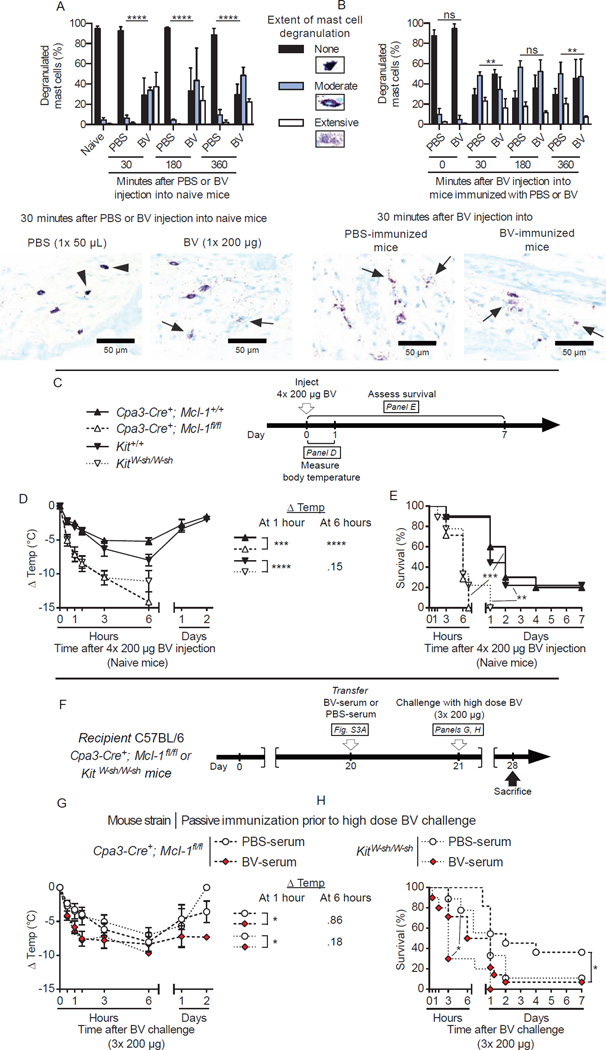
Figure 6. Passive immunization with serum of BV-immunized WT mice fails to increase the resistance against challenge with a potentially lethal dose of BV in MC-deficient mice
(A–B) Extent of MC degranulation (quantified as % of none, moderate and extensive degranulated MCs) at the site of injection (back skin) following (A) injection of PBS (1x) or BV (1× 200 µg) in naive mice or (B) challenge of BV (4× 200 µg) in mice previously immunized with PBS or BV, and representative Toluidine Blue-stained back skin sections from the 30 minutes time point; arrowheads indicate some non-degranulated MCs and arrows indicate some of the extensively degranulated MCs. In (A), PBS injection did not cause significant MC degranulation compared to naive animals. In (B), “0 minutes” refers to baseline values in back skin of mice in the two groups obtained prior to injections of BV; BV injection caused significant MC degranulation after 30, 180 or 360 minutes in PBS or BV groups compared to the corresponding “0” values. (C) Experimental outline for panels D and E. KitWsh/Wsh and Kit+/+controls, Cpa3-Cre+-Mcl-1fl/fl and Cpa3-Cre+-Mcl-1+/+ controls were injected with 4× 200 µg BV. (D) Changes in body temperature (Δ Temp) and (E) survival (% of live animals) were monitored at the indicated times. (F) Experimental outline for panels G and H. PBS-serum or BV-serum from WT C57BL/6 “donor” mice (see Figure S2A) were transferred i.v. into MC-deficient recipient KitWsh/Wsh and Cpa3-Cre+-Mcl-1fl/fl mice 22 h before challenge with 3× 200 µg BV. (G) Changes in body temperature after challenge (Δ Temp) and (H) survival (% of live animals) were monitored at the indicated times. Data are pooled from (C–E) 2 independent experiments (n=7–10/group) and (F–H) 2–3 independent experiments obtained with 3 different pools of serum (n=9–13/group). (A,B) Values are mean ± SD. (D, G) Values are mean ± SEM. P values are calculated by (A, B) Chi-square, (D, G) Student’s t or (E and H) Mantel-Cox tests. *, P < 0.05; **, P < 0.01; ***, P < 0.001 for the indicated comparisons; ns, not significant (P > 0.05).
Figure 7
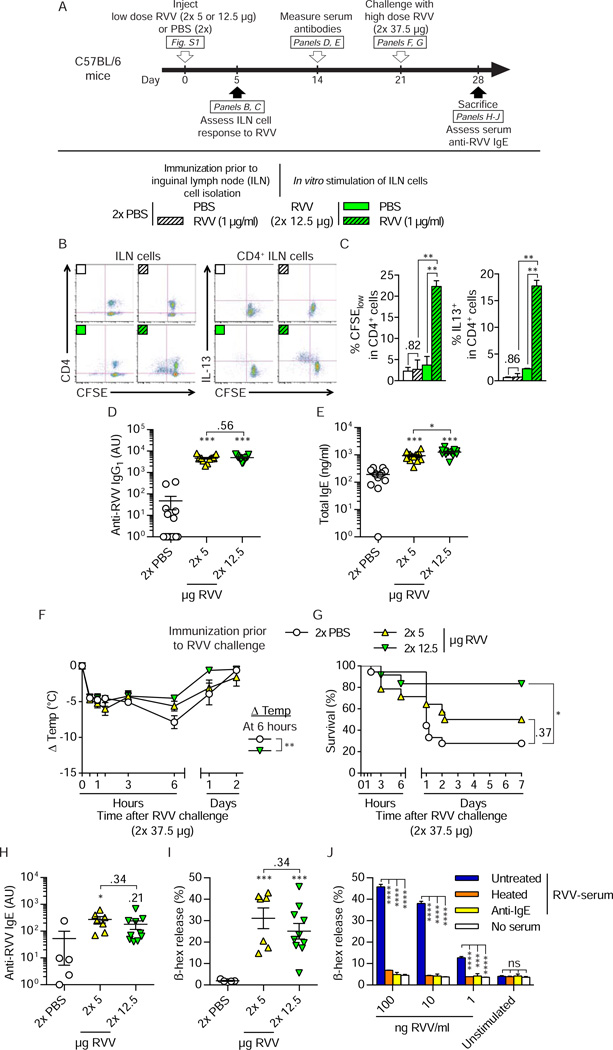
Figure 7. Injection of a sub-lethal dose of RVV induces a type 2 immune response that can increase the resistance of C57BL/6 mice to the hypothermia and mortality caused by subsequent challenge with a potentially lethal dose of RVV
(A) Experimental outline For assessment of the ILN cell response in B and C, mice were injected s.c. with 2× 12.5 µg RVV or PBS. In panels D–I, mice were injected with PBS, 2× 5 µg RVV or 2× 12.5 µg RVV and challenged 3 weeks later with 2× 37.5 µg RVV. (B and C) Flow cytometry analysis of CFSE-labeled ILN cells stimulated for 4 days with 1 µg/ml RVV or PBS. (B) Representative dot plots and (C) quantification (pooled from 2 independent experiments) of proliferation (% CFSElow) and intracellular IL-13 (% IL-13+) of CD4+ ILN cells. (D) RVV-specific IgG1 and (E) total IgE antibody levels in serum obtained two weeks after RVV immunization or mock immunization with PBS. (F) Changes in body temperature (Δ Temp) and (G) survival (% of live animals) of mice challenged with 2× 37.5 µg RVV three weeks after immunization with RVV or mock immunization with PBS. (H) Titers of RVV-specific IgE in sera collected 7 days after the challenge from all surviving mice whose data are reported in G. (I) C57BL/6 BMCMCs were sensitized with sera of individual mice, stimulated with 1 µg/ml RVV, and the amount of β-hexosaminidase (β-hex) in the cell supernatant was measured to assess BMCMC degranulation. (J) Pooled serum of RVV-immunized and challenged C57BL/6 mice (RVV-serum, which was either heated to eliminate the ability of IgE to bind to FcεRI [heated], treated with rat anti-mouse IgE [anti-IgE], or mock-treated with PBS [untreated]) was used to sensitize C57BL/6 BMCMCs, which were then stimulated with different concentrations of RVV (1 – 100 ng/ml) or an equivalent volume of PBS (unstimulated). (C–I) Data are pooled from 3 independent experiments ([C–G], n=12–15/group; [H and I], n=5–10/group). (C–F, H and I) Values are mean ± or + SEM (D, E, H and I also show values for individual mice). (J) Values shown are mean + SD of triplicate values from one representative of 3 independent experiments. P values are versus (C) in vitro PBS-treated cells and (D–F, H, I) PBS-injected mice or (J) cells sensitized with untreated RVV-serum. (C–F and H–J) Student’s t or (G) Mantel-Cox test. * P < 0.05; **, P < 0.01; ***, P < 0.001; ****, P < 0.0001 for the indicated comparisons (C–E and J) or versus PBS (E–J); the numbers in C–E, H and I and J are the P values for comparisons that were not significant (P > 0.05). ns, not significant. See also Figure S6 for data from a similar set of experiments performed in BALB/c mice.

Comment in

  • Antibodies: taking the sting out.
    Bordon Y. Bordon Y. Nat Rev Immunol. 2013 Dec;13(12):843. doi: 10.1038/nri3568. Epub 2013 Nov 8. Nat Rev Immunol. 2013. PMID: 24202657 No abstract available.
  • A sting in the tale of TH2 immunity.
    Gutierrez DA, Rodewald HR. Gutierrez DA, et al. Immunity. 2013 Nov 14;39(5):803-5. doi: 10.1016/j.immuni.2013.10.015. Immunity. 2013. PMID: 24238337

References

    1. Akahoshi M, Song CH, Piliponsky AM, Metz M, Guzzetta A, Abrink M, Schlenner SM, Feyerabend TB, Rodewald HR, Pejler G, et al. Mast cell chymase reduces the toxicity of Gila monster venom, scorpion venom, and vasoactive intestinal polypeptide in mice. J. Clin. Invest. 2011;121:4180–4191. - PMC - PubMed
    1. Amiri P, Haak-Frendscho M, Robbins K, McKerrow JH, Stewart T, Jardieu P. Anti-immunoglobulin E treatment decreases worm burden and egg production in Schistosoma mansoni-infected normal and interferon gamma knockout mice. J. Exp. Med. 1994;180:43–51. - PMC - PubMed
    1. Ando A, Martin TR, Galli SJ. Effects of chronic treatment with the c-kit ligand, stem cell factor, on immunoglobulin E-dependent anaphylaxis in mice. Genetically mast cell-deficient Sl/Sld mice acquire anaphylactic responsiveness, but the congenic normal mice do not exhibit augmented responses. J. Clin. Invest. 1993;92:1639–1649. - PMC - PubMed
    1. Annila I. Bee venom allergy. Clin. Exp. Allergy. 2000;30:1682–1687. - PubMed
    1. Antonicelli L, Bilo MB, Bonifazi F. Epidemiology of Hymenoptera allergy. Curr. Opin. Allergy Clin. Immunol. 2002;2:341–346. - PubMed

Publication types

MeSH terms