. 2014 Jan 10;4(1):89-96.
doi: 10.1534/g3.113.007617.

The use of SNP markers for linkage mapping in diploid and tetraploid peanuts

Affiliations

The use of SNP markers for linkage mapping in diploid and tetraploid peanuts

David J Bertioli et al. G3 (Bethesda). .

Abstract

Single nucleotide polymorphic markers (SNPs) are attractive for use in genetic mapping and marker-assisted breeding because they can be scored in parallel assays at favorable costs. However, scoring SNP markers in polyploid plants like the peanut is problematic because of interfering signal generated from the DNA bases that are homeologous to those being assayed. The present study used a previously constructed 1536 GoldenGate SNP assay developed using SNPs identified between two A. duranensis accessions. In this study, the performance of this assay was tested on two RIL mapping populations, one diploid (A. duranensis × A. stenosperma) and one tetraploid [A. hypogaea cv. Runner IAC 886 × synthetic tetraploid (A. ipaënsis × A. duranensis)(4×)]. The scoring was performed using the software GenomeStudio version 2011.1. For the diploid, polymorphic markers provided excellent genotyping scores with default software parameters. In the tetraploid, as expected, most of the polymorphic markers provided signal intensity plots that were distorted compared to diploid patterns and that were incorrectly scored using default parameters. However, these scorings were easily corrected using the GenomeStudio software. The degree of distortion was highly variable. Of the polymorphic markers, approximately 10% showed no distortion at all behaving as expected for single-dose markers, and another 30% showed low distortion and could be considered high-quality. The genotyped markers were incorporated into diploid and tetraploid genetic maps of Arachis and, in the latter case, were located almost entirely on A genome linkage groups.

Keywords: Arachis; breeding; genotyping; markers; wild.


Figures
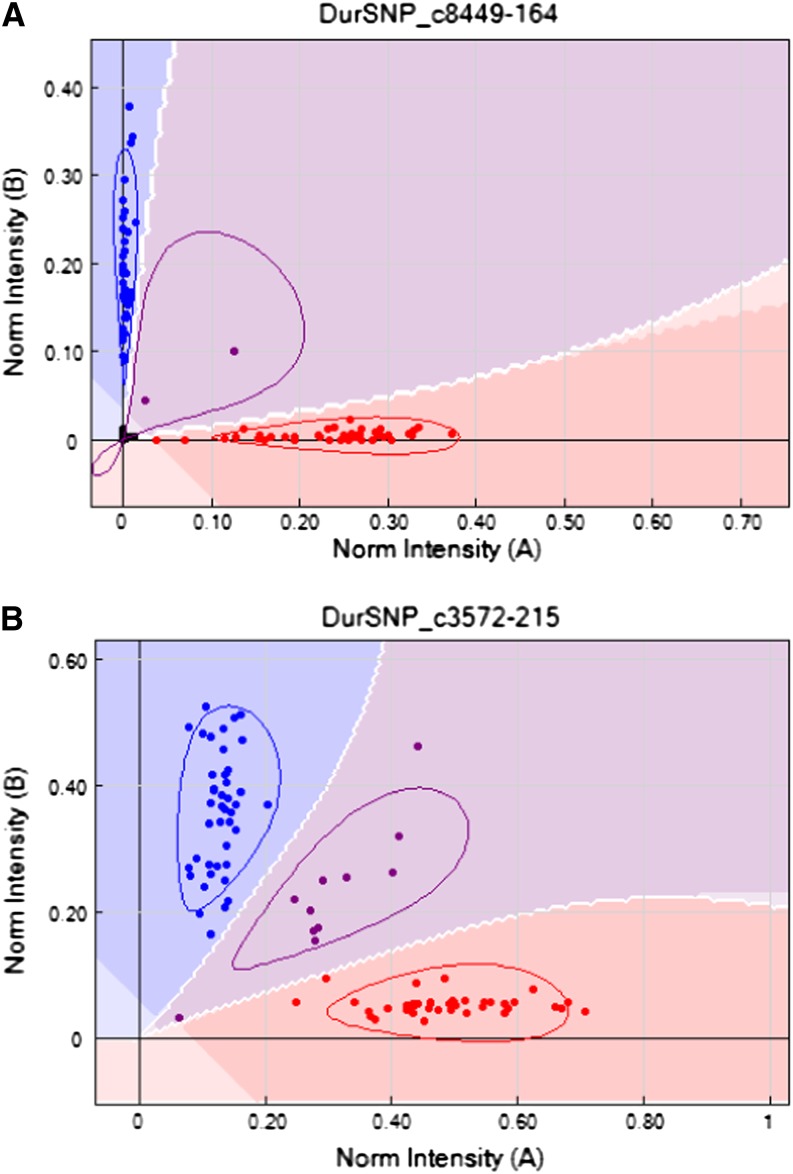
Figure 1
Figure 1
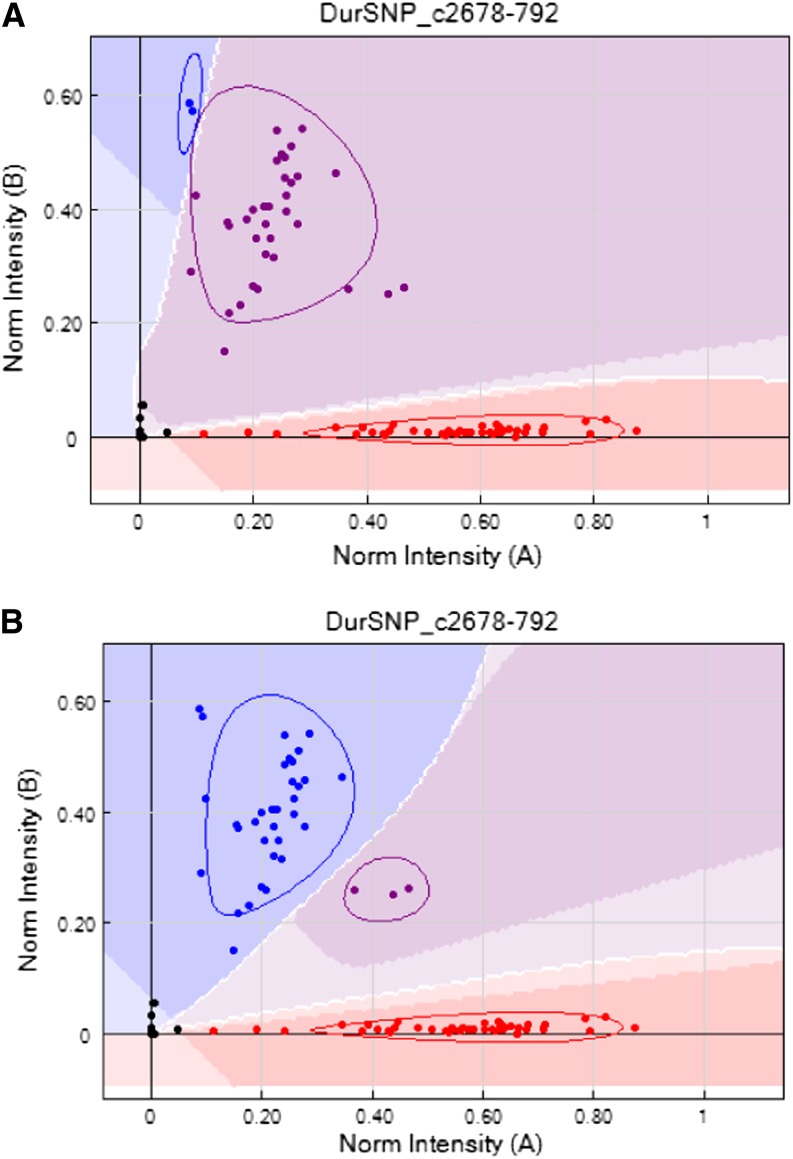
Examples of plots of signal intensities from SNP assay on the diploid population (A) and the tetraploid population after manual correction (B). Points in red and blue are homozygotes; points in purple are heterozygotes. Note how, in the tetraploid, the clustering is distorted and the separation between the genotype groups is reduced (B).
Figure 2
Figure 2
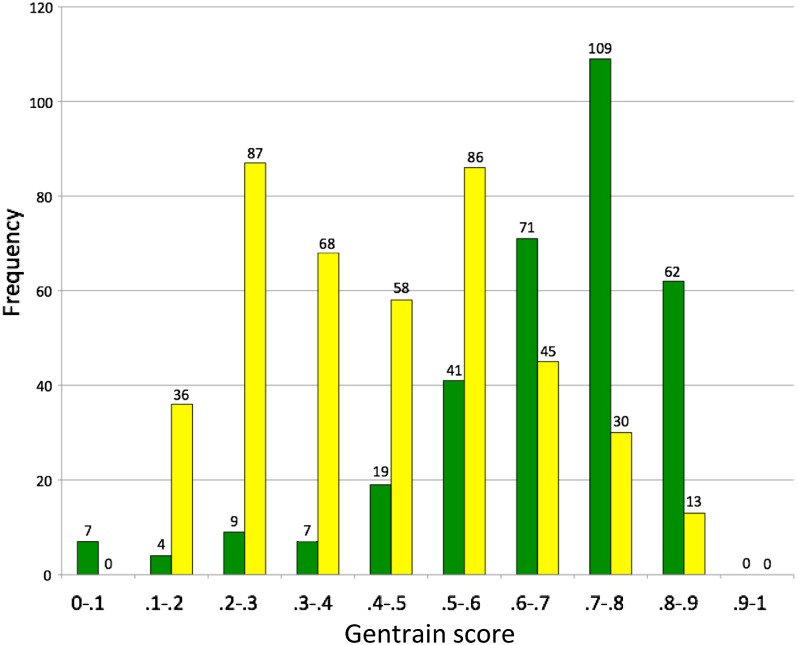
Frequency distributions in numbers of SNPs in quality score (Gentrain scores) classes for genotyping assays in the diploid (green) and tetraploid (yellow) mapping populations. The numbers of assays in each class are written above the bars. The scores for the diploid population form a single high-scoring peak, the scores for the tetraploid population form a double peak. Note that a significant number of the assays in the tetraploid population are high-quality.
Figure 3
Figure 3
An example of a plot of signal intensities from SNP assay on the tetraploid population using default parameters (A) and after manual correction (B). Points in red and blue are called as homozygotes; points in purple are heterozygotes. Note how genotype calling using default parameters falsely assigns one of the homozygous genotypes as heterozygous.
Figure 4
Figure 4
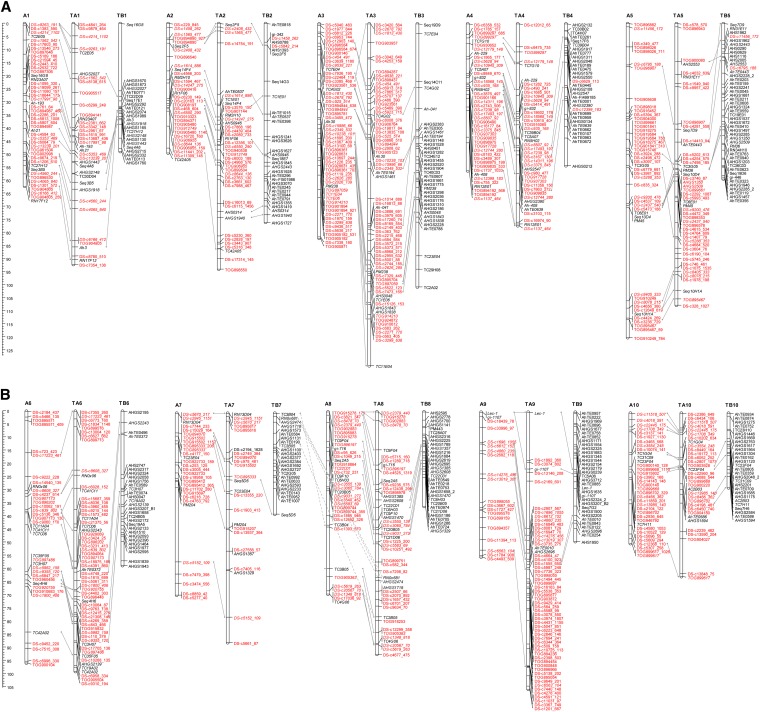
(A) Linkage maps of the diploid A and tetraploid AB Arachis genomes (linkage groups 1–5). The representation of the diploid A (linkage groups assigned AN) was generated using recombinant inbred lines derived from an A. duranensis × A. stenosperma cross. The representation of the tetraploid AB genome (linkage groups assigned TAN and TBN) was derived from a cross between cultivated peanut and an artificially induced tetraploid derived from two diploid wild species, A. ipaënsis and A. duranensis. Distances are centimorgans. Lines between linkage groups indicate marker correspondences and show genome syntenies. Single nucleotide polymorphism markers (SNPs) are represented in red; other markers, the incorporation of which were chosen to assign linkage groups and show synteny between A and B genomes, are shown in black. Note that almost all SNP markers are incorporated into the A genome of the tetraploid. (B) Linkage maps of the diploid A and tetraploid AB Arachis genomes (linkage groups 6–10). The representation of the diploid A (linkage groups assigned AN) was generated using recombinant inbred lines derived from an A. duranensis × A. stenosperma cross. The representation of the tetraploid AB genome (linkage groups assigned TAN and TBN) was derived from a cross between cultivated peanut and an artificially induced tetraploid derived from two diploid wild species, A. ipaënsis and A. duranensis. Distances are in centimorgans. Lines between linkage groups indicate marker correspondences and show genome syntenies. SNPs are represented in red; other markers, the incorporation of which was chosen to assign linkage groups and show synteny between A and B genomes, are shown in black. Note that almost all SNP markers are incorporated into the A genome of the tetraploid.

References

    1. Akhunov E., Nicolet C., Dvorak J., 2009. Single nucleotide polymorphism genotyping in polyploid wheat with the Illumina GoldenGate assay. Theor. Appl. Genet. 119: 507–517. - PMC - PubMed
    1. Bertioli D., Moretzsohn M., Madsen L. H., Sandal N., Leal-Bertioli S., et al. , 2009. An analysis of synteny of Arachis with Lotus and Medicago sheds new light on the structure, stability and evolution of legume genomes. BMC Genomics 10: 45. - PMC - PubMed
    1. Bertioli D. J., Seijo G., Freitas F. O., Valls J. F. M., Leal-Bertioli S. C. M., et al. , 2011. An overview of peanut and its wild relatives. Plant Genet. Resour. Characterization Util. 9: 134–149.
    1. Bertioli D. J., Vidigal B., Nielen S., Ratnaparkhe M. B., Lee T.-H., et al. , 2013. The repetitive component of the A genome of peanut (Arachis hypogaea) and its role in remodelling intergenic sequence space since its evolutionary divergence from the B genome. Ann. Bot. (Lond.) 112: 545–559. - PMC - PubMed
    1. Burow M. D., Simpson C. E., Starr J. L., Paterson A. H., 2001. Transmission genetics of chromatin from a synthetic amphidiploid to cultivated peanut (Arachis hypogaea L.): Broadening the gene pool of a monophyletic polyploid species. Genetics 159: 823–837. - PMC - PubMed

Publication types