


Genetic alterations in glioma
- PMID: 24212656
- PMCID: PMC3756406
- DOI: 10.3390/cancers3011129
Genetic alterations in glioma
Abstract
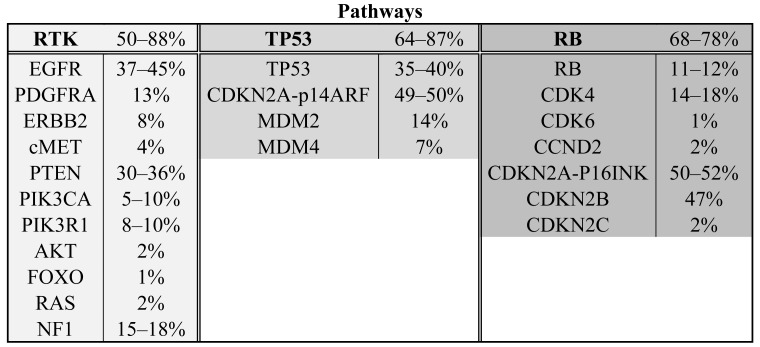
Gliomas are the most common type of primary brain tumor and have a dismal prognosis. Understanding the genetic alterations that drive glioma formation and progression may help improve patient prognosis by identification of novel treatment targets. Recently, two major studies have performed in-depth mutation analysis of glioblastomas (the most common and aggressive subtype of glioma). This systematic approach revealed three major pathways that are affected in glioblastomas: The receptor tyrosine kinase signaling pathway, the TP53 pathway and the pRB pathway. Apart from frequent mutations in the IDH1/2 gene, much less is known about the causal genetic changes of grade II and III (anaplastic) gliomas. Exceptions include TP53 mutations and fusion genes involving the BRAF gene in astrocytic and pilocytic glioma subtypes, respectively. In this review, we provide an update on all common events involved in the initiation and/or progression across the different subtypes of glioma and provide future directions for research into the genetic changes.
Figures
References
-
- Ohgaki H., Kleihues P. Population-based studies on incidence, survival rates, and genetic alterations in astrocytic and oligodendroglial gliomas. J. Neuropathol. Exp. Neurol. 2005;64:479–489. - PubMed
-
- Stupp R., Mason W.P., van den Bent M.J., Weller M., Fisher B., Taphoorn M.J., Belanger K., Brandes A.A., Marosi C., Bogdahn U., Curschmann J., Janzer R.C., Ludwin S.K., Gorlia T., Allgeier A., Lacombe D., Cairncross J.G., Eisenhauer E., Mirimanoff R.O. Radiotherapy plus concomitant and adjuvant temozolomide for glioblastoma. N. Engl. J. Med. 2005;352:987–996. - PubMed
-
- Hegi M.E., Diserens A.C., Gorlia T., Hamou M.F., de Tribolet N., Weller M., Kros J.M., Hainfellner J.A., Mason W., Mariani L., Bromberg J.E., Hau P., Mirimanoff R.O., Cairncross J.G., Janzer R.C., Stupp R. Mgmt gene silencing and benefit from temozolomide in glioblastoma. N. Engl. J. Med. 2005;352:997–1003. - PubMed
-
- van den Bent M.J., Carpentier A.F., Brandes A.A., Sanson M., Taphoorn M.J., Bernsen H.J., Frenay M., Tijssen C.C., Grisold W., Sipos L., Haaxma-Reiche H., Kros J.M., van Kouwenhoven M.C., Vecht C.J., Allgeier A., Lacombe D., Gorlia T. Adjuvant procarbazine, lomustine, and vincristine improves progression-free survival but not overall survival in newly diagnosed anaplastic oligodendrogliomas and oligoastrocytomas: A randomized european organisation for research and treatment of cancer phase iii trial. J. Clin. Oncol. 2006;24:2715–2722. - PubMed
-
- Giannini C., Burger P.C., Berkey B.A., Cairncross J.G., Jenkins R.B., Mehta M., Curran W.J., Aldape K. Anaplastic oligodendroglial tumors: Refining the correlation among histopathology, 1p 19q deletion and clinical outcome in intergroup radiation therapy oncology group trial 9402. Brain Pathol. 2008;18:360–369. - PMC - PubMed
LinkOut - more resources
Full Text Sources
Research Materials
Miscellaneous
