


Serial progression of cortical and medullary thymic epithelial microenvironments
- PMID: 24214487
- PMCID: PMC4253091
- DOI: 10.1002/eji.201344110
Serial progression of cortical and medullary thymic epithelial microenvironments
Erratum in
- Eur J Immunol. 2014 Jul;44(7):2197
Abstract
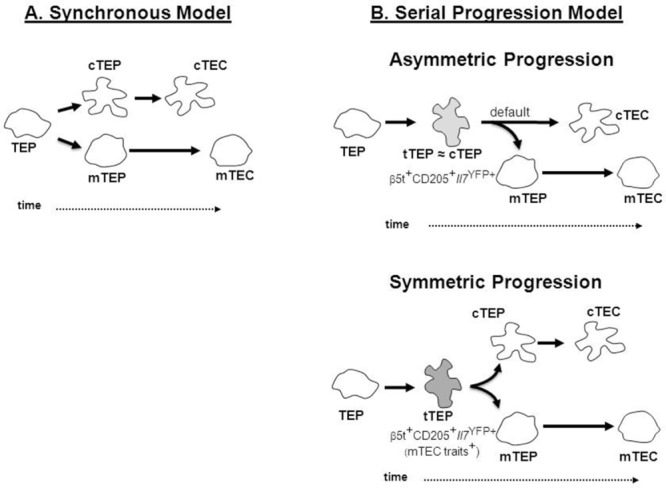
Thymic epithelial cells (TECs) provide key instructive signals for T-cell differentiation. Thymic cortical (cTECs) and medullary (mTECs) epithelial cells constitute two functionally distinct microenvironments for T-cell development, which derive from a common bipotent TEC progenitor. While seminal studies have partially elucidated events downstream of bipotent TECs in relation to the emergence of mTECs and their progenitors, the control and timing of the emergence of the cTEC lineage, particularly in relation to that of mTEC progenitors, has remained elusive. In this review, we describe distinct models that explain cTEC/mTEC lineage divergence from common bipotent progenitors. In particular, we summarize recent studies in mice providing evidence that mTECs, including the auto-immune regulator(+) subset, derive from progenitors initially endowed with phenotypic properties typically associated with the cTEC lineage. These observations support a novel "serial progression" model of TEC development, in which progenitors serially acquire cTEC lineage markers, prior to their commitment to the mTEC differentiation pathway. Gaining a better understanding of the phenotypic properties of early stages in TEC progenitor development should help in determining the mechanisms regulating cTEC/mTEC lineage development, and in strategies aimed at thymus reconstitution involving TEC therapy.
Keywords: Cortex; Medulla; Thymic epithelial cells; Thymus.
© 2013 WILEY-VCH Verlag GmbH & Co. KGaA, Weinheim.
Figures
References
-
- Takahama Y. Journey through the thymus: stromal guides for T-cell development and selection. Nat. Rev. Immunol. 2006;6:127–135. - PubMed
-
- Anderson G, Takahama Y. Thymic epithelial cells: working class heroes for T cell development and repertoire selection. Trends Immunol. 2012;33:256–263. - PubMed
-
- Alves NL, Huntington ND, Rodewald HR, Di Santo JP. Thymic epithelial cells: the multi-tasking framework of the T cell “cradle. Trends Immunol. 2009;30:468–474. - PubMed
Publication types
MeSH terms
Grants and funding
LinkOut - more resources
Full Text Sources
Other Literature Sources
