


Incidence and progression of cervical lesions in women with HIV: a systematic global review
- PMID: 24216030
- PMCID: PMC5524184
- DOI: 10.1177/0956462413491735
Incidence and progression of cervical lesions in women with HIV: a systematic global review
Abstract
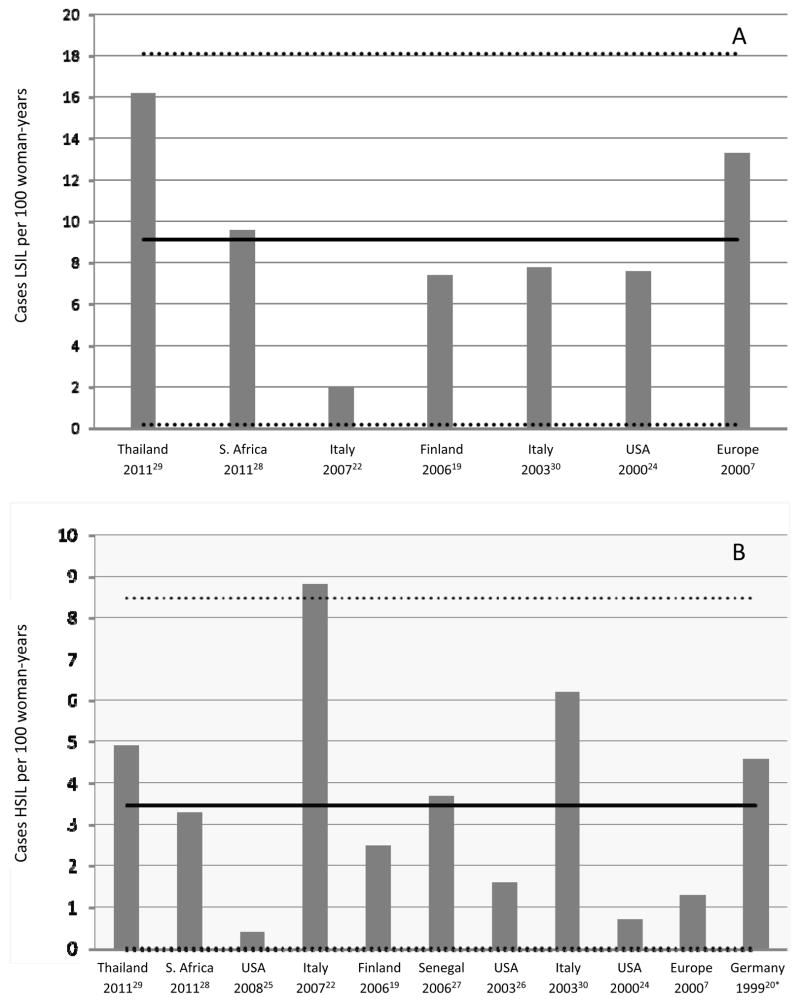
Global data on cervical lesion incidence and progression in HIV-positive women are essential for understanding the natural history of cervical neoplasia and informing screening policy. A systematic review was performed summarizing the incidence and progression of cervical lesions in HIV-positive women. Of 5882 HIV-positive women from 15 studies, incidence ranged from 4.9 to 21.1 cases per 100 woman-years for any cervical lesion and 0.4 to 8.8 cases per 100 woman-years for high-grade cervical lesions. HIV-positive women showed a median three-fold higher incidence of cervical lesions compared to HIV-negative women. Of 1099 HIV-positive women from 11 studies, progression from low- to high-grade lesions ranged from 1.2 to 26.2 cases per 100 woman-years. Both incidence and progression rates increased with lower CD4 counts. The effect of antiretroviral therapy on the natural history of cervical neoplasia remains unclear. HIV-positive women have higher incidence and progression of cervical neoplasia. Cervical cancer screening should be integrated into HIV treatment programmes.
Keywords: AIDS; CIN; HIV; SIL; cervical cancer; cervical lesions; incidence; progression; review; screening; squamous epithelial lesions; women.
Conflict of interest statement
The authors declare no competing interests.
Figures
References
-
- UNAIDS, WHO. AIDS Epidemic Update. 2009 Dec; http://data.unaids.org/pub/report/2009/jc1700_epi_update_2009_en.pdf.
-
- Scheurer ME, Tortolero-Luna G, KA-S Human papillomavirus infection: biology, epidemiology, and prevention. Int J Gynecol Cancer. 2005;15(5):727–746. - PubMed
-
- De Vuyst H, Lillo F, Broutet N, Smith JS. HIV, human papillomavirus, and cervical neoplasia and cancer in the era of highly active antiretroviral therapy. Eur J Cancer Prev. 2008;17(6):545–54. - PubMed
-
- Ahdieh L, Munoz A, Vlahov D, Trimble CL, Timpson LA, Shah K. Cervical neoplasia and repeated positivity of human papillomavirus infection in human immunodeficiency virus-seropositive and -seronegative women. Am J Epidemiol. 2000;151(12):1148–57. - PubMed
Publication types
MeSH terms
Substances
Grants and funding
LinkOut - more resources
Full Text Sources
Other Literature Sources
Medical
Research Materials
