. 2013 Nov 11:10:332.
doi: 10.1186/1743-422X-10-332.

Lack of evidence for retroviral infections formerly related to chronic fatigue in Spanish fibromyalgia patients

Affiliations

Lack of evidence for retroviral infections formerly related to chronic fatigue in Spanish fibromyalgia patients

Elisa Oltra et al. Virol J. .

Abstract

Background: The etiology of fibromyalgia and chronic fatigue syndrome (FM/CFS) is currently unknown. A recurrent viral infection is an attractive hypothesis repeatedly found in the literature since it would explain the persistent pain and tiredness these patients suffer from. The initial striking link of two distinct orphan retroviruses: the gamma retroviruses murine leukemia virus (MLV)-related virus and the delta retrovirus T-lymphotropic virus type 2 (HTLV-2) to chronic fatigue have not been confirmed to date.

Results: Genomic DNA (gDNA) from 75 fibromyalgia patients suffering from chronic fatigue and 79 age-matched local healthy controls were screened for the presence of MLV-related and HTLV-2 related proviral sequences. The XMRV env gene was amplified in 20% of samples tested (24% patients/15% healthy controls). Unexpectedly, no PCR amplifications from independent gDNA preparations of the same individuals were obtained. None of the positive samples showed presence of contaminating murine sequences previously reported by other investigators, neither contained additional regions of the virus making us conclude that the initial env amplification came from spurious air-driven amplicon contaminants. No specific HTLV-2 sequences were obtained at any time from any of the 154 quality-controlled gDNA preparations screened.

Conclusions: Previous associations between MLV-related or HTLV-2 retrovirus infection with chronic fatigue must be discarded. Thus, studies showing positive amplification of HTLV-2 sequences from chronic fatigue participants should be revised for possible undetected technical problems.To avoid false positives of viral infection, not only extreme precautions should be taken when nested-PCR reactions are prepared and exhaustive foreign DNA contamination controls performed, but also consistent amplification of diverse regions of the virus in independent preparations from the same individual must be demanded.The fact that our cohort of patients did not present evidence of any of the two types of retroviral infection formerly associated to chronic fatigue does not rule out the possibility that other viruses are involved in inciting or maintaining fibromyalgia and/or chronic fatigue conditions.


Figures
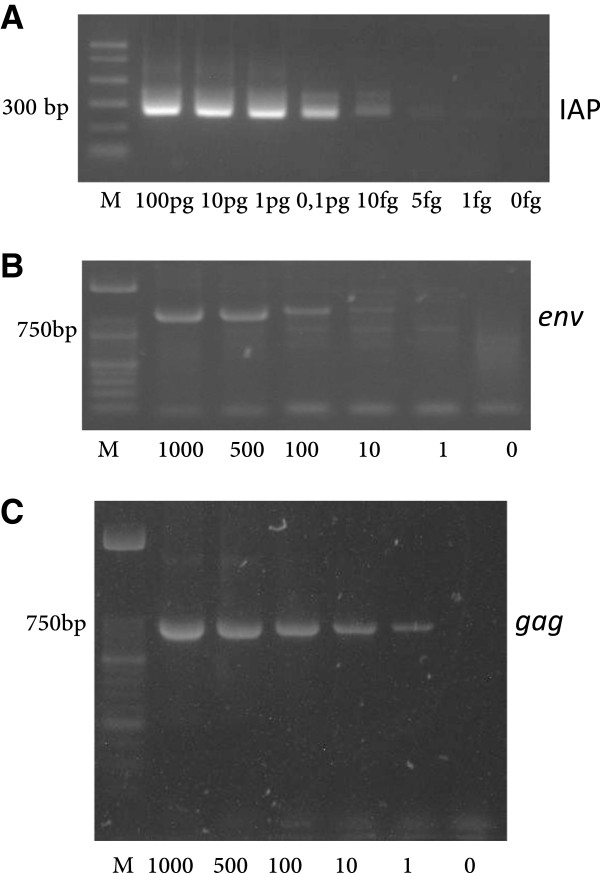
Figure 1
Figure 1
IAP and XMRV amplification sensitivity assays. Panel A: the indicated amounts of mouse genomic DNA were spiked into 1 μg of human gDNA and IAP sequences (236–312 bp) were amplified using previously described conditions [10]. Panels B and C show amplification of the env (973 bp) and gag (730 bp) genes using each outer primer set respectively, from the pcDNA3.1-VP62 construct (AIDS Research and Reference Reagent Program Cat# 11881) (number of copies 0–1000 as indicated) spiked into 1 μg of human gDNA with the outer amplification primers and conditions described in Methods. All PCR products were visualized on 2% agarose real-safe stained gels. M: molecular DNA markers correspond to PCR markers (Promega) (panel A) and marker XIII (Roche) (panels B and C).
Figure 2
Figure 2
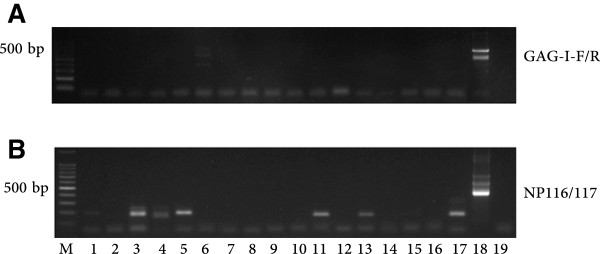
Amplified products with gag primers were unspecific. Representative nested PCR amplification of 17 gDNA samples from 9 patient samples (lanes 1–9) and 8 healthy controls (lanes 10–17) visualized on 2% agarose real-safe stained gels. Lane 18 corresponds to the VP62 XMRV positive control and lane 19 is a negative control with no DNA template. M is the 100 bp ladder marker (Promega). Panel A shows the products amplified with the GAG-I-F and GAG-I-R primers (410 bp) [7,44] while Panel B shows the products of the NP116 and NP117 primers (380 bp) [8]. All amplifications were performed under the permissive conditions described in materials and methods.
Figure 3
Figure 3
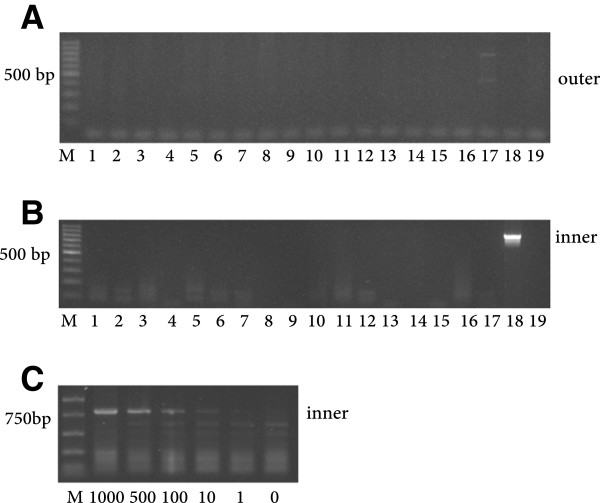
Lack of HTLV-2 amplification. Representative nested PCR amplification of 17 samples (10 patient and 7 healthy controls) (lanes 1–10 and 11–17 respectively) visualized on 2% agarose real-safe stained gels. Panel A shows the products of the first round of PCR amplification (outer primers), while Panel B shows the nested PCR final products (inner primers). Lane 18 corresponds to a HTLV-2 patient positive gDNA kindly provided by Drs. Treviño and Soriano [26], and lane 19 is a negative control with no DNA template. Panel C shows amplification of the gag HTLV-2 gene from the pGEMT-HTLV-2-gag construct (see Methods) (number of copies 0–1000 as indicated) spiked into 1 μg of human gDNA with the inner amplification primers and conditions described in Methods. All PCR products were visualized on 2% agarose real-safe stained gels. M: molecular DNA markers correspond to 100 bp ladder marker (Promega) (panels A and B) and PCR markers (Promega) (panel C).

References

    1. Bartels EM, Dreyer L, Jacobsen S. et al.Fibromyalgia, diagnosis and prevalence. Are gender differences explainable? Ugeskr Laeger. 2009;171(49):3588–3592. - PubMed
    1. Lorusso L, Mikhaylova SV, Capelli E, Ferrari D, Ngonga GK, Ricevuti G. Immunological aspects of chronic fatigue syndrome. Autoimmun Rev. 2009;8(4):287–291. doi: 10.1016/j.autrev.2008.08.003. - DOI - PubMed
    1. Fletcher MA, Zeng XR, Barnes Z, Levis S, Klimas NG. Plasma cytokines in women with chronic fatigue syndrome. J Transl Med. 2009;7:96. doi: 10.1186/1479-5876-7-96. - DOI - PMC - PubMed
    1. Fletcher MA, Zeng XR, Maher K, Levis S, Hurwitz B, Antoni M, Broderick G, Klimas NG. Biomarkers in chronic fatigue syndrome: evaluation of natural killer cell function and dipeptidyl peptidase IV/CD26. PLoS One. 2010;5(5):e10817. doi: 10.1371/journal.pone.0010817. - DOI - PMC - PubMed
    1. Bisbal C, Silverman RH. Diverse functions of RNase L and implications in pathology. Biochimie. 2007;89(6–7):789–798. - PMC - PubMed

Publication types