


Histologic and genetic advances in refining the diagnosis of "undifferentiated pleomorphic sarcoma"
- PMID: 24216705
- PMCID: PMC3730306
- DOI: 10.3390/cancers5010218
Histologic and genetic advances in refining the diagnosis of "undifferentiated pleomorphic sarcoma"
Abstract
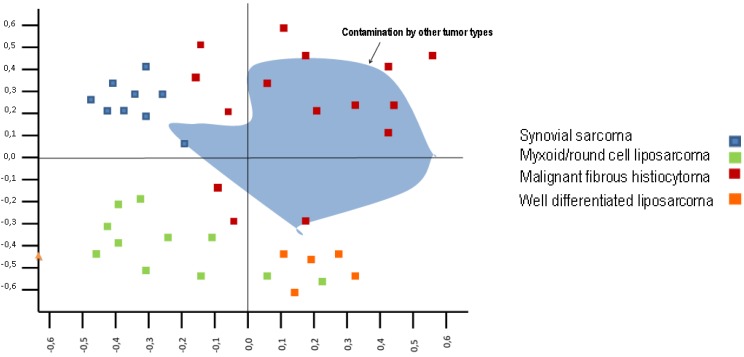
Undifferentiated pleomorphic sarcoma (UPS) is an inclusive term used for sarcomas that defy formal sub-classification. The frequency with which this diagnosis is assigned has decreased in the last twenty years. This is because when implemented, careful histologic assessment, immunohistochemistry, and ultra-structural evaluation can often determine lineage of differentiation. Further attrition in the diagnostic frequency of UPS may arise by using array-comparative genomic hybridization. Gene expression arrays are also of potential use as they permit hierarchical gene clustering. Appraisal of the literature is difficult due to a historical perspective in which specific molecular diagnostic methods were previously unavailable. The American Joint Committee on Cancer (AJCC) classification has changed with different inclusion criteria. Taxonomy challenges also exist with the older term "malignant fibrous histiocytoma" being replaced by "UPS". In 2010 an analysis of multiple sarcoma expression databases using a 170-gene predictor, re-classified most MFH and "not-otherwise-specified" (NOS) tumors as liposarcomas, leiomyosarcomas or fibrosarcomas. Interestingly, some of the classifier genes are potential molecular therapeutic targets including Insulin-like growth factor 1 (IGF-1), Peroxisome proliferator-activated receptor γ (PPARγ), Nerve growth factor β (NGF β) and Fibroblast growth factor receptor (FGFR).
Figures
References
-
- Clark J., Rocques P.J., Crew A.J., Gill S., Shipley J., Chan A.M., Gusterson B.A. Cooper CSIdentification of novel genes, SYT and SSX, involved in the t(X;18)(p11.2;q11.2) translocation found in human synovial sarcoma. Nat. Genet. 1994;7:502–508. - PubMed
-
- Dunham M.A., Neumann A.A., Fasching C.L., Reddel R.R. Telomere maintenance by recombination in human cells. Nat. Genet. 2000;26:447–450. - PubMed
-
- Ulaner G.A., Hoffman A.R., Otero J., Huang H.Y., Zhao Z., Mazumdar M., Gorlick R., Meyers P., Healey J.H., Ladanyi M. Divergent patterns of telomere maintenance mechanisms among human sarcomas: Sharply contrasting prevalence of the alternative lengthening of telomeres mechanism in Ewing’s sarcomas and osteosarcomas. Genes Chromosomes Cancer. 2004;41:155–162. doi: 10.1002/gcc.20074. - DOI - PubMed
LinkOut - more resources
Full Text Sources
Other Literature Sources
Miscellaneous
